Water Road: Wednesday: The Neldathi Clans

As I mentioned last week, the Neldathi, who live south of the Water Road in the universe of The Water Road, are physically quite distinct from the Altrerians who live to the north. They’re different species, in fact, although they can produce infertile offspring. When it comes to how their societies work, the differences are even more pronounced.

While the Altrerians are organized into what we might call nation states (or city states, at least in the case of the Arbor), the Neldathi are organized into clans. Each clan is ruled by a thek (or chief), selected in various ways, from based on heredity to something more like democracy (without the coin flips). Some clans are patriarchal, some matriarchal, others more egalitarian. In other words, there’s a good deal of variety to how each clan is set up.

There are several other positions of authority in Neldathi clans aside from theks. Two of the most important are War Leader (which is just what it sounds like) and Master of the Hunt, each of which is responsible for ensuring the clan’s survival. Speakers of Time are individuals who become walking storehouses of knowledge – libraries with legs, essentially – and pass on the clan’s history, traditions, and laws. Finally, kels act as judges, settling disputes between clan members.

The Neldathi are nomads, which is why they don’t have “states” as we (or the Altrerians) think of them. That doesn’t mean they aren’t territorial. Each clan has a Great Circuit, a route along which they regularly move through the year. Each guards its circuit jealously. Three clans have circuits that cover the northernmost ground, near the Water Road itself – the Dost, Kohar, and Haglein. Three more stick toward the southern coast and the Islander cities – the Mughein, Elein, and Sheylan. That leaves five others – the Chellein, Akan, Volakeyn, Uzkaleyn, and Paleyn – who roam the most mountainous ground in the middle.

The Great Circuit’s aren’t defined with great particularity and clans don’t necessarily travel them in regular cycles. As a result, it’s not uncommon for neighboring clans to run into one another, which leads to violence. For example, the Volakeyn and the Akan have circuits that border one another. If they happen to wind up in the same space at the same time, they’ll fight over resources, same as anybody else. Neldathi don’t fight wars of conquest – they’d have no means of securing territory – but they do fight.

In fact, the Neldathi have a history of long-simmering feuds between clans, for several reasons. One is that if clans meet when circuits overlap, that frequently means resources are limited in that area and one side is bound to lash out. Another is that the same clans routinely interact with each other, breeding bad blood. Finally, the Speakers of Time tell stories of glory won in battle and of the evil done to their clans by their enemies. That allows feuds to grow and fester between certain clans.

That last feature, in particular, provides an opening that might be exploited by outsiders.
Water Road: Wednesday: The Neldathi & Their Lands

Although the Altrerians lend their name to the land in which The Water Road takes place, it’s not theirs alone. The land to the south of the Water Road is quite different from that to the north and includes a very different species of inhabitants.

For starters, the Neldathi don’t have green skin, but blue, although some have complexions that near completely white. They’re still humanoid, but where the Altrerians are smaller than your average human, the Neldathi are bigger. For a sense of scale, Rob Gronkowski would on the small side of average for a Neldathi. Thus they’re strong, but also slower of foot and, to the Altrerians, slower of thought, as well. More on them as a people next week.

The lands south of the Water Road are defined by a series of rugged mountain ranges, all named by and after Altrerians, although very few of them live there. The mountains begin to rise just south of the river, becoming fearsome snow-capped peaks in short order. The ranges often run up against one another, sometimes parallel to each other. Some of the mountains are covered with great stands of timber. It’s forbidding territory, a place that’s referred to in curses and hushed tones by Altrerians.

Because the continent of Altreria is in the southern hemisphere, the further south one goes the colder it gets. The lands south of the Water Road, therefore, are frequently blanketed in snow, making existence there difficult. Neither the climate nor terrain lends itself to the kind of settlements that developed to the north. Unlike the north, there are no great cities in the south.

Which is not to say there are no cities at all. When the land nears the coast, warm currents provide a more hospitable climate. In four locations along the southern coast, the Slaisal Islanders have built cities, way stations for use during their trade with the Neldathi. The Islander cities are the one place where the Neldathi clans share space, along with a small population of Islander sailors and the occasional Altrerian, mostly traders and the like – or at least they appear to be.

Water Road Wednesday: Altreria & Altrerians

In the universe of The Water Road the name “Altreria” carries several responsibilities.

For one thing, Altreria is the name of the land in which the story takes place, by which I mean all of it. It is that world’s equivalent to “Earth,” for lack of a better comparison.

Altreria also refers to the world’s only major landmass. It’s a continent that runs roughly north to south (think of Australia turned on its side and twisted a bit) and sits in the southern hemisphere, so traditional American/European directional notions (north is cold, south is warm) are reversed. There’s also a chain of islands, the Slaisal Islands, off the northeast coast. The Water Road itself runs from west to east – from Great Basin Lake to the Bay of Sins – across its width about two-third’s of the way down the continent. To the north live Altrerians, with Neldathis to the south. More of them later, of course.

Altreria also refers to the land north of the Water Road – hence the reason those who live there are called Altrerians (if you’re noticing that they seem to control the vocabulary of geography in this world, you’re right). That land’s most obvious distinguishing features are two other rivers, the River Innis and the River Adon, that run north to south through the middle third of the continent. North of the source of those rivers are the Badlands – a dry, dusty, and hot region with very little in it.

Those rivers also help define the political landscape of Altreria. To the east, between the River Adon and the coast, is the Kingdom of Telebria (fully the “Bonded Realms of Greater & Lesser Telebria” – they’re a bit picky about it). Southern Telebria is home to the Endless Hills, which lend their name to the second book of the trilogy. To the west, between the River Innis and the coast, are the United Guilds of Altreria. In between is a dense forest known as the Arbor, which consists of numerous city states gathered together in a confederation. Again, more of those later.

Altreria has several major cities of note. In Telebria, on the east coast is Sermont on the Sea, the kingdom’s capital. In the west, Innisport, the largest of the Guilder cities, lays at the confluence of the River Innis and the Water Road. Finally, there’s Tolenor, a fairly recent settlement, a planned city built on an island in the Bay of Sins. It’s home to the Triumvirate, of which – yet again – more later!

As for the inhabitants of Altreria, they’re not human. No one in The Water Road is. They’re bald humanoids, a bit smaller than we are with skin that’s green, of one hue or another. Generally those born deep in the Arbor have dark green skin, while those born closer to the Water Road wind up nearly white, with just hints of light green. They’re not particularly strong, but they’re quick, cunning, and good strategists.

That’s not all (obviously!), of course, but that gives you a taste of the world of The Water Road. Or at least the lay of the land, so to speak.

Water Road Wednesday: What Is a “Water Road” Anyway?

Welcome to 2016, the year of The Water Road! Every Wednesday I’ll be providing some previews, background, and “behind the scenes” information on my upcoming fantasy saga, due for release beginning in the spring. Let’s start with the logical place – what is a “water road”?

To begin with the Water Road is a river. Not just any river, mind you, but one that is the primary geographical feature of Altreria. It runs almost the entire width of the continent and is navigable all the way. It divides the two races that live in Altreria – the Altrerians live to the north, the Neldathi to the south. They’re related, but very different.

Next, The Water Road is the name of a book, my next novel and first in a trilogy. It’s a story about two women from opposite sides of that river who discover a shocking secret about the way the Altrerians and the Neldathi have treated one another. What they do after (independently) learning this secret changes their world forever.

As I said, that’s the first volume in a trilogy, which is also called (zing me for lack of creativity here), The Water Road Trilogy. It’s composed of The Water Road, The Endless Hills, and The Bay of Sins. In addition, there will be two shorter works that fit in between the novels, The Badlands War and The Trails of the Arbor. More on those stories, the world in which they’re set, and the people who inhabit them as the year goes on.

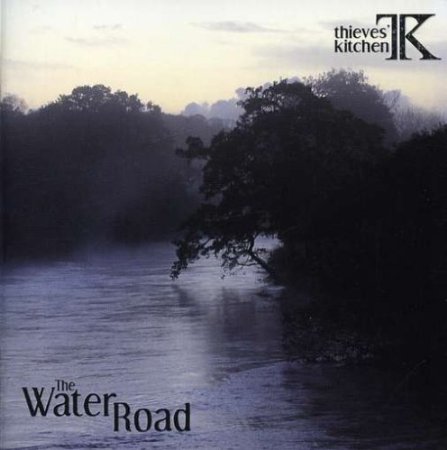
Finally, it’s a excellent song of very fine album of the same name (that is, The Water Road), by UK proggers Thieves’ Kitchen. It’s got a dark, brooding quality to it (it’s all the strings and Mellotron), but the theme that pops up here and there really soars, particularly when the guitar player gets a hold of it. It’s not an inspiration for the books, but the name stuck in my head. Credit where credit’s due.

TKTWR