Is Any Game a “Big Game”?

It was the kind of situation that screamed “big game,” a few weeks ago. Leeds United were on 72 points and top of the English Championship, but only two points ahead of their closest pursuer, Sheffield United. Leeds travelled to Sheffield with the chance to not just stay top but create a bit of a cushion with a win over their Yorkshire rivals.

It was a hell of a game – Sheffield scored early in the first half (on an own goal attributed to Leeds’ keeper) and looked poised to hold off the visitors. Until the 72d minute, after which Leeds went on a run that created three goals unanswered. At the end of the night it was a 3-1 win and a five-point gap at the top. Surely, that’s the makings of a big game right?

Maybe not.

Over the next two games, by definition against teams lower down in the table, Leeds managed only a point, while Sheffield United bagged six. As a result, things are all tied up at the top of the standings just two weeks later (as I’m writing, Leeds is on top on goal differential). All this got me thinking about whether, in European soccer at least, there are such things as big games.”

The issue comes down to the league format that’s utilized in the big leagues in Europe. Rather than the typical American setup of a regular season followed by playoffs where a champion is crowned, in those leagues every team plays every other team twice (home and away), with the team that earns the most points (three for win, one for a draw) over the course of the season winning the title. It prioritizes sustained excellence at the expense of not having those do-or-die playoff games at the end of the season.

As a result, I’m not sure big games really matter. Every game is a potential three points gained or lost, regardless of the quality of opponent. This theory first sprouted in my mind last year, given how well Leeds did against the top teams in the Championship, only to fail to win promotion to the Premier League. Leeds finished third, behind Leicester City and Ipswich Town – who, in four games, Leeds defeated four times (ironically, the team that beat Leeds in the promotion playoff final, Southampton, beat Leeds twice during the regular season). Those were the big games last season, but in the end they didn’t matter anymore than losing at home to Blackburn (who finished 19th) and dropping points to Sheffield Wednesday (20th) and Sunderland (16th), among others. It was Leeds’ performance against lower table teams that mattered, in other words.

The same thing might be happening this season. Leeds’ record against the other top teams in the Championship is pretty good – three wins, two draws, and a loss. Certainly good enough to win promotion, you’d expect. But they’ve also dropped points to teams currently in 19th and 16th places, which might matter more in the end.

But maybe this is just a Leeds thing that I’m particularly attuned to as a fan. To check, let’s look at the past few seasons in the Premier League and the big games there.

Last season, Manchester City beat Arsenal to the title by two points – even though Arsenal beat them once and their other match up was a draw. What mattered more, in the end, was that Arsenal was tripped up by 13th-place Fulham twice during the season (one loss, one draw). By contrast, the year prior Manchester City’s five-point margin at the end of the season was certainly bolstered by beating Arsenal twice. The year before that, Liverpool triumphed by a single point over Manchester City, even though they drew both times they played each other. It’s not a large sample, but it at least suggests that big games often aren’t (the two seasons before that were such blowouts that there’s no point in analyzing them).

Is that enough data to draw any conclusions? Of course not, but I’m going to, anyway. I don’t see anything here that persuades me that big games mean anything over the course of long seasons like these. There are almost always other games against lesser opponents where one team slips up and the other doesn’t and those matter just as much in the end. The equivalence I’m thinking of is when somebody misses a last-second jumper or field goal and they get all the blame for a loss, when in fact there were mistakes and missed opportunities all through the game that made the last-ditch effort necessary in the first place. Are there seasons so close where defeating your closest rival head to head will make the difference? Sure, but I think those are more rare than fans would like to admit.

None of which is to say there aren’t big games for other reasons, such as rivalry/derby matches, or in other competitions – by definition every game in the FA Cup or March Madness is a big game, because if you lose you’re done. But leagues like the Championship or Premier League require a longer view.

If nothing else, it’ll lower your blood pressure from stressing over the next big game.

On the Freedom of Mediocrity

Over the weekend my alma mater’s football regular season ended in a pretty humiliating 52-15 ass whoopin’ at the hands of the Texas Tech Red Raiders. “Regular season,” of course, because in the modern era a team that struggles to 6-6 still gets to go to a bowl game nobody’s ever heard of before, so there’s still the chance to finish the season with a losing record! The nature of the defeat led to the firing of head coach Neal Brown, who leaves with a middling 37-35 record over six years.

Six years ago, nearly to the day, I wrote a piece  examining the WVU football program and making the “sobering, but fairly obvious, conclusion” that we are “only a mediocre football program.” In that post I characterized the acceptance of mediocrity as “heartbreak,” but over the ensuing years I’ve come to view it differently – it’s really more liberating than heartbreaking.

The shift of perspective came not so much from WVU football, but from following the US Men’s National Team during those six years. 2018, of course, marked the World Cup in Russia for which we did not qualify, the first time in decades we’d been absent from soccer’s biggest stage. The time since has been an interesting experience when it comes to fandom.

On the one hand, these have been halcyon days for the USMNT. More American players than ever ply their trade at top European clubs. Hell, Christian Pulisic played a regular role for a Chelsea team that won the Champion’s League in 2021 and is currently tearing it up for AC Milan. And the team, as a whole, rebounded. We qualified for the 2022 World Cup and have reestablished the US as the dominant player in our region, winning all three editions of the new CONCACAF Nations League over old rivals (Mexico) and new (Canada).

On the other, we kind of appear to have found our ceiling and it’s not elite. In the World Cup we did about as well as we ever do, making it out of the group stage and losing in the first knockout round. And while being kings of CONCACAF is better than the alternative, the truth is our region is one of the weakest and coming out on top here isn’t saying a whole lot.

Where does that leave the USMNT? About where we’ve been over the past few decades. Our current FIFA ranking (for what those are worth) is 16, which is not bad when you consider there are 210 members of FIFA. A solid top-20 program is nothing to scoff at, but it’s hardly exceptional. We’d not be favorites to win any major tournament outside our own region and haven’t had a signature win against a European or South American power for a long while.

Overall, it’s hard to conclude that, in global terms, the USMNT is fundamentally mediocre.

Capable of big results, sure, but also frequently struggling to defeat Central American nations with a fraction of the population, too. We are entirely capable of making a deep run in the World Cup we co-host in 2026, but it will be a great story precisely because it would involve some upsets.

And I’m OK with that. I’ve come to terms with the fact that we will never be Brazil or France or Argentina or Germany (seriously, only eight countries have ever won the World Cup!). At best, in the right circumstances – a particular group of skilled and experienced players, a coach who can maximize all that, a favorable draw, etc. – we can make a good run and maybe even win the thing, if we get lucky. You know? That’ll be way more fun, anyway, than constantly worrying if we’re falling short of a goal we can never achieve in the first place.

I should, at this point, assure readers that I’m not arguing in favor of giving over to mediocrity in every part of your life. When it comes to your work, your family, and other important things you should always try to be the best version of yourself you can be. I’m talking about interacting with stuff that is, fundamentally, beyond your control. I have absolutely no control over whether WVU wins their bowl game or whether the USMNT wins another Nations League title next spring.

But when it comes to sports, it’s a pretty good deal. Particularly for things like colleges and national teams that, maybe, you can’t just up and dump for better teams, tamping down expectations means that when they win it’s great and when they don’t, eh, it’s no big deal. Sport is a diversion, right? It’s supposed to be fun? For all the talk hard-core fans of INSERT TEAM HERE make about how difficult it is to be a fan, if you really aren’t enjoying it then get another hobby – life’s too damned short.

So, come with me, friends. Embrace the almost certain mediocrity of your favorite teams. Wins will mean more, losses won’t hurt. Return sport to the proper place in your life!

Why Messi Can’t Be the MLS MVP (This Year, At Least)

The Major League Soccer regular season wraps up on the other side of this current international break. Every team but one will be in action on “decision day,” as the final playoff spots are booked and seedings secured. DC United are still alive for playoff berth (it’s been a few years), so I’m fairly excited.

With the regular season winding up, that means there’s talk about end-of-season awards, including who should be named Most Valuable Player. An early favorite for that award at the start of the season would have been Lionel Messi, who was expected the lead Inter Miami CF to the Supporters’ Shield (awarded to the team with the best regular season record), top playoff seed and, eventually, MLS Cup. But a funny thing happened on the way to that Supporters’ Shield, which the club wrapped up a couple of weeks ago – Miami proved that maybe they didn’t really need Messi that much after all.

Before we go any further, I’m not here to rip on Messi’s talent or career. He’s an amazing player, easily in the running for GOAT status when it comes to soccer, and I’ve enjoyed watching him play even though he’s never played for any of my teams. I’m just talking about whether, in this particular season, Messi deserves the title of MLS MVP.

Let’s get the numbers (all sourced from FotMob) out of the way – going into the final weekend of play Messi has scored 17 goals and dished out 10 assists in only 18 games. That’s an insane rate of production, down to a combination of Messi’s freakish talent and MLS not exactly being the most competitive league in the world. For context, DC United’s Christian Benteke, who leads the league in goals scored, has 23 in 29 games (with 5 assists to boot), while assist leader Luciano Acosta (of FC Cincinnati – and formerly DC United!) has 16 assists and 14 goals in 31 games. If it was just a matter of per-game production, Messi is the easy choice.

But that’s not the award. There are purely stat-based awards for scorers and assisters and such. One could argue that those should be based on something other than raw numbers (goals per 90 minutes played, or something), but that’s a debate for another day. Other leagues award the best player. The crux of the biscuit when it comes to MVP awards, however, is the word in the middle – “valuable.” What does it mean to be the most “valuable” player on a particular team, much less in the league?

By one measure Messi would clearly be the most valuable player in MLS, given the eyeballs and money he’s brought to the league. Messi isn’t the league’s first big signing  (his owner/operator at Miami, David Beckham, literally changed the way MLS operated when he came to the Galaxy in 2007), but there’s no denying he’s had a huge impact on the league’s profile globally. Haters may call it a “retirement league,” but if the retirees are the best who ever played the game does anybody really care?

Of course, that’s not what “valuable” really means in this context. It has to do with on the field performance, what a player means to the success of his team. That said, it’s not purely about who has the most talent or who had the gaudiest stats. Therein lies the problem with Messi being MVP, at least this year.

The 2024 MLS season was semi-interrupted by Copa America, with the nominally South American championship being held in the United States. Messi, of course, played for Argentina in that tournament. His last MLS match prior to the tournament was a 3-3 draw with St. Louis City on June 1. At the time, 18 games into the season, Miami was in first place in the Eastern Conference and overall with 35 points, 2 points clear of Cincy.

While Copa America was going on, Miami played 5 MLS games (the league doesn’t actually stop for these big tournaments, which makes it look pretty amateur, honestly), of which it won 4. The only blemish was a 6-1 drubbing by Cincinnati. In spite of that, Miami slipped behind Cincy by a point at the top of the table. Maybe Messi’s absence was a big deal?

Here’s the thing – Messi was injured during Copa America and didn’t play again for Miami until September 14. In the interim, Miami played 4 more league games (we’ll leave to one side the Leagues Cup), all of which they won, including a 2-0 win over their Cincy nemesis. As a result, when Messi came back, Miami was right where they were when he left for Copa America – at the top of the table and 8 points clear of Cincy.

In other words, while Messi was away for either international duty or due to injury, Miami played 9 league games, won all but one of them, and were in the same place in the table as when Messi left, but even more secure in that perch. Given that, how can it be said that Messi was the “most valuable” member of that team? Sure, the other big name players that have flocked to Miami over the past few years – Jori Alba, Luis Suarez – are largely there because of Messi, but evidence suggests if Messi had simply vanished from the face of the Earth during preseason Miami would have been just fine.

Who is the most “valuable” player from MLS this season? I can’t say, as I haven’t seen many games outside of DC United’s and I’m biased towards Benteke because of that. But I am fairly certain it’s not Messi, at least not this year. Best player in the league? Almost certainly. The most valuable on a team that barely noted his absence? Certainly not.

Weekly Watch & Read: The Damned United

When I latched onto Leeds United as my favorite team outside the United States I didn’t do it with any sense of the club’s history. Sure, I knew they’d been around a long time, but it was their then-current form that lured me in (and led to years of heartbreak – alas, that is the truth of the beautiful game). What I didn’t know at the time was that for about a decade leading up to my birth they were one of the, if not the, best team in England, winning the top division twice, the FA Cup once, and finishing runners up in both competitions several times between 1964 and 1974.

What I also didn’t realize was that they did so with a bit of a reputation. Think of the infamous Philadelphia Flyers team known as the “Broad Street Bullies” and you’re on the right track, except there were twice as many of them and at the time there was only one allowed substitute in soccer. Any injury often meant the other team playing a man down.

That Leeds team was the product of manager Don Revie who, after the 1973-1974 season ended, left the club to become manager of the England national team. His replacement, Brian Clough, was a former player who had worked wonders as a manager at Derby County, dragging the team up to the top flight and to the league title. One the one hand, it looked like following on from one brilliant manager to another.

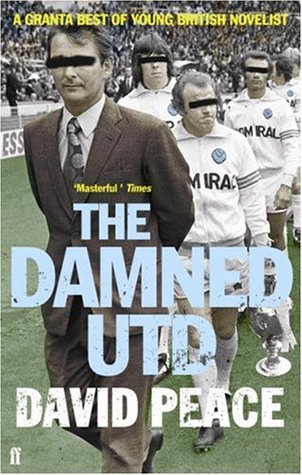
On the other hand, well, that’s the story of The Damned United, first a novel by David Peace and then a movie, directed by Tom Hooper with Michael Sheen (current Wales national team hype man) as Clough. They cover Clough’s rocky 44-day stint at the helm of Leeds and the culture clash that led to his ultimate downfall. It’s never a good sign when the new boss comes in and declares that all your prior success was down to “cheating” and you were going to start winning the “right way” now that he’s here.

I saw the movie first around the time it came out, based more on the good reviews than any particular interest in the story itself. Sports movies tend to be built around cliches leading to the “big game” and, honestly, once you’ve seen a few what’s the point of another? What makes The Damned United so interesting is that it turns the cliche on its head – rather than being about a coach who pulls together a group of underperforming misfits into a team of winners, it’s about a team of winners slowly falling apart. Honestly, it would be a good case study for a management class or something, a cautionary tale of how someone so convinced of his own brilliance can get things so wrong.

The biggest difference between the movie and the book was Clough’s motivation and general attitude about all this. Both portray Clough as a supreme egotist, convinced that he’s right about everything related to soccer (Peace uses the word multiple times in the book, so back off) and everyone else is wrong. In the movie, this comes across as more hopeful delusion than anything else. He has a better way to play the game, one that prioritizes attack and frowns on the “dark arts,” and that’s what’s driving him. He wants to improve things, elevate them.

Novel Clough is, by contrast, a complete rage-driven asshole.  This is evident in the book because we’re entirely in Clough’s head, privy to all his thoughts and the loathing he has for just about everyone and every place. While his wife and children come out unscathed (though they’re press so far to the edges that he might as well have been a bachelor, for the book’s purposes), he even goes after his assistant manager/partner Peter Taylor, with whom he had already had (and would again have) great success. It’s unclear at points whether he really wants to reform Leeds or drive them into a ditch. Clough’s head is, for the most part, a frightening place to be.

To be fair, the novel gives Clough some basis for his anger, giving us more detail on his playing and prior managerial career than the movie does. Primarily, we get Clough’s bitterness at his playing career being cut short by a knee injury. I think movie Clough mentions his goal-scoring tally at one point, but book Clough returns to it again and again. It is impressive – 251 goals in 274 games – but comes with a major caveat: all but a handful of those came in the Second Division, making Clough sort of a Crash Davis of English football, without Crash’s recognition that records in a lower league don’t mean all that much.

The other pillar of novel Clough’s anger is his belief that he should be manager of the England national team. This makes his taking over Leeds all the more fraught, given that he thinks Revie doesn’t deserve the England job. It adds an additional layer to the way that Revie haunts Elland Road (Leeds’ stadium) after he’s gone, like a millstone ghost hung around Clough’s neck. That he goes so far as to destroy and burn Revie’s desk is extreme, but you can kind of see where he’s coming from.

Aside from that, the novel and movie tell the same story. I think the movie does it better, partly because I found Peace’s style – which makes copious use of repetition of words (usually in threes) – annoying. As usual, I consumed the book via audio and even with the narrator’s cadence giving it some life, it felt overdone, as if the book (not that long to begin with) could have been a third shorter without it. And I can see why Clough’s family was upset with both the book and movie. One review I read noted that the three main characters – Clough, Revie, and Leeds midfielder/captain Billy Bremner – were all dead at the time the book came out. You can’t libel the dead, after all. Another Leeds player, Johnny Giles, did win a libel lawsuit about the book, although given British libel laws I’m not sure how much that means about what is, after all, a work of fiction.

That said, I kind of wish both book and movie had an epilogue of some sort. If you weren’t a soccer fan you’d think that Clough crashed and burned at Leeds and that was it, his days of success over. In actuality, he went on to even greater heights afterwards, leading Nottingham Forrest to not one but two European Cups (what they call the Champions League these days), an amazing feat for a club that size. Never got to manage England, however.

Will the Other Shoe Drop?

When Russia invaded Ukraine a few weeks ago, the world responded pretty quickly to isolate Russia and exclude Russians around the world from various things. A major Russian conductor was dropped for concerts at Carnegie Hall because of his close ties to Putin and unwillingness to criticize the invasion (a similar result came with an famed opera singer a little while later). Bars stopped serving Russian vodka. Hell, even rapacious companies like BP decided that being in business with Russia was a no-go.

Soccer was one of the first parts of the sporting world to respond. UEFA, the European federation, announced that it was moving the Champions League final, the capstone of its most important club competition, from St. Petersburg to Paris. In the wake of that, several countries – notably Poland, Sweden, and the Czech Republic – announced they would not play Russia under any condition. That was important, as they were all involved with Russia in the same playoff round of World Cup qualifying and so were, potentially, forfeiting a chance to make this year’s World Cup Finals (other federations with less skin in the game, including the US Soccer Federation, made similar statements). Eventually, FIFA stepped in and banned Russia from further competition, leaving the Swedes, Poles, and Czechs to fight it out for World Cup berth with clean hands.

Sort of.

It was a shock, to say the least, when Qatar beat out Australia, Japan and others to win the right to host the 2022 World Cup (in the same process that awarded the 2018 World Cup to . . . Russia). The Qatari heat would require the tournament to take place in November and December, rather than in the middle of the summer. Beyond that, of course, Qatar is not a democracy and has a shady human rights record.

But specifically, the numerous new stadiums the nation needed to build for the World Cup, are killing workers at an alarming rate, up to 6500 migrant workers from India, Pakistan, and surrounding areas alone. A minimum wage for those workers only came into effect in 2021. A good idea of what laboring to build the stadiums is like can be found here. So not only are there ethical questions about the host nation for the World Cup in general, but specifically linked to the competition itself.

So what should the countries that have qualified do about it? The invasion of a sovereign nation by a neighbor, in a way that wrecks the equilibrium of modern Europe, may be sui generis. After all, the nations who initially stepped up to say that wouldn’t play Russia could find themselves in Putin’s crosshairs sooner rather than later. Lots of the other countries, including the United States, are doing everything they can to stop the war without it blowing up into World War III.

What’s gone on in Qatar isn’t that, but it isn’t good. More and more, repressive regimes are using sports to try and launder their reputations. Called “sportswashing,” it’s probably a driving force behind the fact that there are now things like a Formula 1 race in Saudi Arabia and the recent Winter Olympics (and current Paralympics) in China. Letting Qatar host the World Cup is more of the same.

But it’s very likely that they are going to host, so what to do about it? Is the reaction of the sporting world to Russia’s aggression the beginning of a new era in sports activism? Or is it so beyond the pale of the modern world that it won’t impact anything else? I wish I knew, because I struggle with what to do about the World Cup, too. I watched almost every game of the 2018 version in Russia and the Americans didn’t even qualify. If we make it this time? You bet I’ll be paying attention, but won’t feel good about it.

Let me address the elephant in the room – if global sports is going to develop a conscience about things like human rights and violating international law, won’t that standard mean excluding the United States from certain things? Maybe. People asking “what about Iraq?” have a very good point. There are differences between the two situations, but I’m not sure they make a difference. Nor is invading Iraq without cause our country’s only sin when it comes to international relations. If that means we get punished for it, I’m not sure that’s a bad thing.

For most of us, sports are a distraction, a fun way to spend free time and we try to keep that frame even when we’re engaging with multi-billion dollar competitions that span the globe. We want them to an escape from the regular world, from the conflicts that rage in “real” life. But they’re part of our world, in all its pain and joy, and that means inextricably entwined with world affairs.

In Praise of Gregg Berhalter

When Gregg Berhalter was announced as the head coach of the US Men’s National Team in 2018 that decision was not greeted with a lot of enthusiasm. Gregg’s managerial career consisted of a couple of non-descript years in Sweden followed by a solid run in charge of the Columbus Crew, losing MLS Cup in 2015 (at home) to the Portland Timbers. There were other big, international names that were allegedly in the mix, so this pick seemed underwhelming. It didn’t help that Gregg’s brother Jay was one of the higher ups in US Soccer at the time, leading to lazy charges of nepotism in Gregg’s hire. That Gregg had appeared 44 times for the USMT as a player, but never made the field during the World Cup where he was on the roster kind of said it all.

Gregg’s hire came in the shadow of the USMNT failing to qualify for the 2018 World Cup. His ultimate success will be judged solely on whether we qualify for the 2022 tournament in Qatar and, if we do, how well we do there. Up to this summer there hadn’t been a lot of meaningful games for Gregg to show fans what he can do at the helm. But, oh boy, has he had a very good summer.

Like everything else, the pandemic wreaked havoc with the international soccer calendar. League seasons that were suspended in early 2020 finished up later than usual that year, leading to the cancellation of major 2020 national competitions and the late start of the next club season. That season then got compressed so the delayed summer competitions could happen. So this summer has been packed solid with the Copa America and European Championships taking place on a year delay, not to mention the Olympics. And then there’s World Cup qualifying, which gets underway in September and will include schedules with three games played in two weeks (usually it’s only two).

For CONCACAF, the regional federation to which the United States and the rest of North and Central American and the Caribbean belong, its championship, the Gold Cup, was already scheduled for 2021. But the inaugural finals of the Nations League, a new tournament meant to fill in the gaps between World Cups and Gold Cups, was supposed to have taken place in 2020, but got pushed back. So, for Gregg and the USMNT this summer meant two games in the Nations League final, the Gold Cup, and then the start of World Cup qualifying, all with players who have been at it pretty much nonstop for the past year or so. Oh, and CONCACAF moved the Gold Cup back a month so as to not compete with Copa America and the Euros, pushing it into the preseason for a lot of European clubs.

Thankfully, Gregg had a plan. Step 1 – take the best team possible into the Nations League finals with the intent of winning a trophy. This would bet the core players, most of whom play in Europe. It would be the first meaningful chance to see them play together, in anticipation of a meeting with full-strength Mexico in the final. Step 2 – take a younger, mostly MLS-based team into the Gold Cup, with the intent of discovering roster depth that will help us when World Cup qualification begins, while giving the first-team guys some rest and letting them start preseason work with their club teams. Go as far as you can in the tournament, but don’t expect to win it, especially if we came up against Mexico, again. Step 3 – start World Cup qualifying with the strongest team possible and, hopefully, some momentum.

Well, as for Step 1 – this happened:

After a less than impressive semifinal win against Honduras, the US beat Mexico 3-2 in extra time to lift the first Nations League trophy. It didn’t go completely to plan – injuries kept the preferred Best 11 from playing together much – but you can’t argue with the results. Off to some vacation for most of those guys, on to the Gold Cup.

The Gold Cup was never going to be beautiful. The only real holdover from the Nations League roster was midfielder Kelly Acosta. More than a dozen players had appeared less than ten times for the USMNT. The guys called in from Europe were basically trying to make moves to new clubs. How much talent did this group have?

Enough to blow through the group stage, at least. By which I mean we won all three games, even if two of them were a lot closer than you’d like them to be. Rosters were rotated, players were given chances to sink or swim. Nothing convincing but, again, the results were coming. We were probably outplayed for large parts of the quarterfinal against Jamaica and the semi against Qatar (here as guests and reigning champions of Asia), but the result in the end was the same: 1-0 to the US.

But remember, the goal here isn’t necessarily to win, but to learn. What did we learn in all those games? That New England goalkeeper Matt Turner should be in the running for the top job when qualifying starts. That defender Miles Robinson and midfielder/defender James Sands are both worthy of the qualifying roster. The defensive depth we were worried about is here and it’s pretty good. The attack not so much (Matthew Hoppe’s enthusiasm aside), but we’re top heavy with attacking talent with the first-choice team. We’ve also learned that Gregg can make great use of substitutes – keeping in mind that FIFA is keeping 5 substitutes (as opposed the usual three) until at least the next World Cup is over.

But we want to win this thing, right? Over Mexico for the second time this summer? You’re damned right we did:

It should be noted that, due to injuries and Olympic duty, Mexico was missing a few first-teamers, but they had a lot more of their “A” team on the field in the Gold Cup final than we did. We won anyway. Was is pretty? No. Was is great fun to watch? Absolutely.

I’d like to say I was a Gregg booster from the beginning, but that would be a lie. I wasn’t as down on him as some other folks, but I wasn’t thrilled. As we waded through lots of friendlies with questionable roster selections and what not I wondered if he was up to it. Now I’m ready to buy in completely. Gregg might not do it the way I want him to, but his job is to get us back to the World Cup and regain are spot on top of CONCACAF.

We’re halfway there!

Weekly Read: The Ball Is Round and The Age of Football

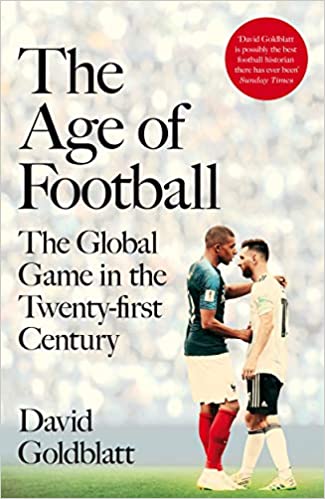
Does anyone really need to read more than 1500 pages about soccer? Or, in my case, listen to more than 63 hours of it? Probably not, but if you’re at all interested in the beautiful game beyond watching games, you could do worse. These two volumes – both written by journalist David Goldblatt – explore why the game developed as it has as well as the challenges facing it in the 21st century.

I should say, right at the top, that I’m going to call the game “soccer” throughout. As the history in these books points out, soccer is a derivation of “Association Football,” the actual name of the sport, and is a British phenomenon (in several quoted period sources the game is called “soccer”). It’s not just a heathen American thing – it’s a it’s-called-different-things-around-the-world thing.

The Ball Is Round is the more essential (and longer) of the two because it covers the history of the game, rather than the state of its current form (it was written about the time of the 2006 World Cup in Germany). And it starts with the beginning – surveying the games of ancient cultures to try, without real success, to find the ancestor to soccer.

As an aside, let me say that one thing both of these books have going for them is their scope. They deal with the game on a global level and while Europe (and South America, to a lesser extent) command the most attention, Africa, Asia, and the unholy alliance known as CONCACAF (North and Central American and the Caribbean) are examined pretty closely.

Getting back to the history of the game, more interesting than the nitty gritty origins of the sport and the codification of its rules (sorry, “laws” – soccer is serious business) is how the game spread around the globe. Given its origins in the UK and its spread while the British Empire was at its height, you’d think it was a simple question of imperial imposition, but it really wasn’t. Indeed, large countries with close ties to the British Empire have largely rejected soccer in favor of other pastimes, including the United States, Canada, India, and Australia. What really did it was the soft power of British industry and financing, the tendrils of which reached well beyond the formal boundaries of the Empire.

Thus, in lots of places, the game arrived with expat British workers and grew from there. It’s why so many big named clubs around the world actually have British origins, including Barcelona, AC Milan, and a host of South American clubs. Ever wonder why AC Milan’s big rivals are Inter? It’s because Internazionale was formed in response to the closed up Britishness of AC Milan!

Another interesting part of the development of the game is how tied it was to the Industrial Revolution and the emergence of more affluent working and middle classes (there’s an interesting intersection with the nascent labor movement, which was providing folks with more free time). This helps partially explain why Brazil, for example, has robust state championships based around big cities, in addition to a national league, as the big clubs grew up in cities, without a lot of development in the hinterlands.

Things get less compelling after the Second World War and the book focuses on what Goldblatt calls “industrial football.” That is, the rise of big money in the game, particularly with the increased profile of international competitions like the European Cup (now Champions League), the Copa Libertadores in South America, and, of course, the World Cup. The history is interesting, but Goldblatt slips into a style that is more a string of anecdotes than a compelling central thesis with supporting evidence. The result, as he checks in all over the globe, is a little numbing and overwhelming.

It also highlights some flaws in the book, such as some of the chapters that end with “you are there!” style descriptions of particular matches. Listening to the audiobook it was unclear whether these were taken from actual reports of the game, but it appears that they were Goldblatt’s creation. They’re fine, so far as they go, but it seems to me that writing about a soccer game is a little bit like Frank Zappa’s turn of phrase that “writing about music is like dancing about architecture” – it just doesn’t capture the essence of what you’re writing about.

Speaking of the audiobook – the narrator of The Ball Is Round has some odd blind spots when it comes to pronunciation. My heart died a little bit every time he referred to Juventus as “Jewv” (as opposed to “Juve” – aka “you vey”). He gets some other Latin names wrong, too, just often enough for it to be an issue. Thankfully, Goldblatt himself narrates the sequel and it doesn’t have the same problem.

As for The Age of Football, it basically picks up where The Ball Is Round leaves off in terms of chronology – starting with the 2014 World Cup in Brazil and ending with the 2018 World Cup in Russia. Rather than just updating the history, however, this book focuses more on how soccer is intertwined with other aspects of politics and economics around the world. As such, it suffers from the same checking of boxes as we go all around the world seeing the same pathologies play out over and over.

In that sense, The Age of Football is pretty depressing. It shows how the game is used by regimes, authoritarian and otherwise, for legitimacy and national unity. It shows how money had become the primary driver of the global game, with little regard for what that means in places that are left behind.

Goldblatt notes how, for example, interest in local African leagues has plummeted since the advent of satellite TV and smart phones, which allow people all over the continent to watch top leagues in Europe instead. What’s funny is that the same is true, somewhat, in the United States, where diehard fans of English or German teams don’t give Major League Soccer the time of day.

Amidst the gloomy underbelly of the modern game, there is the damned near universal nature of its allure. All those places I mentioned above where soccer didn’t take root initially are starting to come along. China, where the game’s never had much of an impact, is ramping things up. The World Cup is one of the few moments of unity the world gets, which is worth celebrating. And the game is, as they say, the beautiful one, whether it’s played in a gleaming stadium in front of a worldwide audience of billions or in a bare field in the middle of nowhere.

A Mountaineer In the Duke of York’s Shire

Back in the spring, when the first blush of the pandemic shut things down around the world, one of the “holy shit, this is serious” moments was when the sports world ground to a halt. In the United States the big deal was when the NCAA men’s basketball tournament, March Madness, was cancelled outright. In Europe, soccer leagues shut down one by one across the continent.

At the time, there were serious discussions about what that meant for the 2019-2020 season that was in the home stretch. Would it be completed later, keeping in mind that the 2020-2021 season kicks off in August? Would the standings be set and stone at the time things were halted, even though the season wasn’t complete? That’s the path the French leagues took, setting final tables based on points earned per game. Would the powers that be simply declare things over, void, and disappear the entire season? That’s what the Dutch leagues did.

In England, the debate about how, and whether, to finish the season centered around Liverpool FC, which were well on their way to their first Premier League title and first top-flight championship in three decades. I was more interested in what was going to happen in the Championship, England’s second tier, where Leeds United topped the table at the time things shut down. It had been 16 years since Leeds had been in the Premier League and I’d been rooting for them to get back all that time.

Why? How does a person born and raised in West Virginia come to root for a team in Yorkshire?*

While I played soccer growing up, it wasn’t really until I was in college that I became a fan of the game. Part of that was due to the 1994 World Cup, which was hosted in the United States and all over TV. Major League Soccer was an outgrowth of that, too. But what really captured my attention was the one-game weekly broadcasts of UEFA Champions League games on a regional sports station. In the Champions League the top teams from all over Europe (each nation has its own league – even each of the UK nations have their own!) from the previous season play to crown a continental champion.

That’s where I first met Leeds United.

LUFC Logo

At the time I didn’t know anything about Leeds or the county, Yorkshire, when the city is located. What I saw was a team that appeared to be overachieving. It appeared to be doing it with young talent that was largely British or Commonwealth based (it was a little odd for a newbie to see English teams primarily made up of players from around the world – I hadn’t learned about the Bosman ruling yet). In other words, they looked like underdogs and I’ve always had a soft spot for underdogs. So they won my support.

In the years since I’ve developed a little bit of an affinity for Leeds and Yorkshire. Two of my favorite bands are from Leeds, The Tangent (or at least its main man, Andy Tillison) and Kaiser Chiefs. The latter is even named after the prior club of former Leeds captain Lucas Radebe! And Yorkshire has a history as one of England’s major producers of coal, so it resonates with my West Virginia roots.

Now, at the time, I didn’t know that Leeds United had a glorious history, particularly in the mid-1960s and early 1970s  when they were one of England’s elite (around the same time progressive rock ruled the land – coincidence?). From the time I was in law school until just about the time I started my current gig in 2002, things were like that again, with the team finishing in the top five for five consecutive seasons.

Then the wheels came off. The team had made some bad financial decisions, gotten overstretched on credit, and had to sell some of its best young players. The bottom fell out and the team was relegated to the Championship and then, three seasons later, to League One (which, confusingly is England’s third tier – the equivalent to AA baseball). They bounced back to the Championship at the start of this decade, but were frustratingly underachieving, until crashing out in the promotion playoffs last year.

Which is what made the pandemic pause so nerve wracking. This season it looked like promotion was theirs to take. Would the interruption mess with the team’s chemistry? Would a compressed schedule put too much stress on Marcelo Bielsa’s thin squad? Would there even be any more games? Thankfully, the rest of the season played out and the right result ensued:

BBCLeedsHeadlineNYTLeeds

Had the pandemic not swept along, my wife and I had planned to visit England and Scotland in the spring and see Leeds play at Elland Road. We might have wound up at the game where they clinched promotion. Alas, it was not to be. At least the promotion part happened! “Marching On Together” as they say.

* I should note that I do my soccer loyalties like some people do publishing rights – for the United States and then for the rest of the world. I root for DC United in Major League Soccer. Who suck so bad right now they’re giving me all the soccer pain I can handle.

Dear US Soccer – Please Shut Up and Settle

I practice criminal law, criminal defense to be precise. I’m glad I do, because there’s a clarity of focus in it that can be a bit hazy in other legal areas. My job is to do the best for my client in court, period – whether that means an acquittal, a better sentence, or (as in my practice, for the most part) a successful result on appeal. Very very rarely are the other considerations to worry about. That the public doesn’t like the process is irrelevant – I’m trying to keep my guy out of a cage.

Civil law is different, particularly civil defense. People who get sued are often really determined to prevail on court, to prove to the world that they’re right. But part of their lawyer’s job is to suggest that winning in court is not necessarily going to solve their problem. A criminal defendant is rarely made worse off by a bold defense in court. A civil defendant, by contrast, particularly a corporation without any real personality – well, sometimes the big machine gets it right:

WinningMove

That went through my head when I read about US Soccer’s pleading last week in its ongoing litigation with the US Women’s National Team (USWNT) over equal pay. I don’t know enough about employment law to know if the arguments made in it are legally sound or have a chance of success, but I’ll assume they do. Question is, what does US Soccer think a “win” would look like at this point?

This article at SI breaks down the federation’s latest argument, which basically has two parts. The first is one familiar to anyone who has brushed up against the legal system – non fregit eum, et emit eam (aka “you broke it, you brought it”):

Stolzenbach first asserts that the fundamental flaw of the players’ legal theory is that they compare a pay system that their own labor union, the U.S. Women’s National Soccer Team Players Association, negotiated with the pay of players who aren’t in their bargaining unit—players on the men’s team.

To that end, U.S. Soccer stresses that courts have consistently rejected attempts by unionized employees to compare their employment terms to employees who are outside of their bargaining unit.

This is the kind of procedural argument I’d expect any lawyer to make. It appears to be the equivalent to how plea bargains are treated in criminal law – once you sign one, you’re stuck with it. Assume A and B are charged in an indictment and A decides to get a good early plea bargain. B sticks it out and, later, either gets a better deal or goes to trial and is acquitted. Can A back out of his plea? Not a chance. Courts routinely hold that so long as you weren’t misinformed, mistaken, or misled into making a guilty plea then you won’t be able to back out of it later. Whether this is a winning argument in the context of the USWNT case I don’t know, but it seems fairly standard.

The other one, though . . . yikes. It has to do with whether the job of USWNT player is “roughly equal in terms of effort, skill, and responsibility” to that of US Men’s National Team (USMNT) player. It was bad enough to point out that in terms of “responsibility” that the USWNT may not have the same earning potential as the USMNT (while eliding the fact that the USMNT choked and missed out on its last big earning opportunity – the 2018 World Cup).

From there it got worse:

Stolzenbach attempts to supplement this argument, even wading into some territory that could be described as misogynistic.

He insists that men’s players face much more demanding working conditions and thus have fundamentally different—and, by implication, harder—jobs. He contends that men’s players encounter ‘opposing fan hostility’ in road environments, particularly in Mexico and Central America, that is ‘unmatched’ by anything experienced by women’s players. Stolzenbach stresses that the women don’t play in Mexico, Central America or the Caribbean when trying to qualify for tournament play. Further, Stolzenbach maintains that ‘science’ confirms there are different levels of speed and strength required for men’s and women’s players. He insists it is not a ‘sexist stereotype’ to recognize this distinction.


Now, if US Soccer was fighting to stay out of jail I might question this strategy, but you do what you have to do. But at the end of the day, US Soccer is going to have to continue to do business with the USWNT (and the USMNT, who have publicly supported the drive for equal pay) and, more importantly, the American public. Why on Earth would they want to denigrate about the only good thing coming out of American soccer at the moment?

Let’s recap. The women are undefeated in more than a dozen matches, just swept through the She Believes cup against quality competition, are the two-time defendant champions of the world (with two other World Cups prior), and are gearing up to try and win their fifth gold medal at this summer’s Olympics. By contrast, the men failed to qualify for the last World Cup (to be fair, so did traditional powers Italy, Chile, and the Netherlands), their furthest progression in the Cup came before the Second World War, and they’ve ceded the pole position in the region to Mexico. Oh, and the Olympics? The men haven’t qualified since 2008.

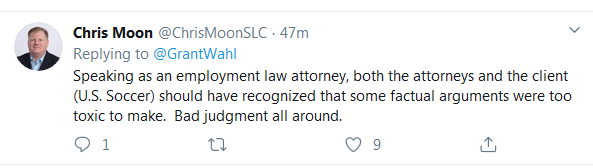
Whether those comparisons are apples to oranges or not is irrelevant. In the public eye, US Soccer has precisely one broadly loved group whom people outside of soccer fanatics care anything about – the USWNT. Building the game in the United States – at all levels, men’s and women’s – requires public support. Pissing off a large swath of the public with arguments like this – even if it’s a winner legally – is a long-term losing proposition. It’s not just my criminal law mind that thinks this is a bad play (in response to this tweet):

USSoccerTweet1

Indeed, the backlash from this filing has been swift and fierce. US Soccer eventually apologized, but the players weren’t buying it. The president of the federation resigned and, apparently, the law firm responsible was fired.

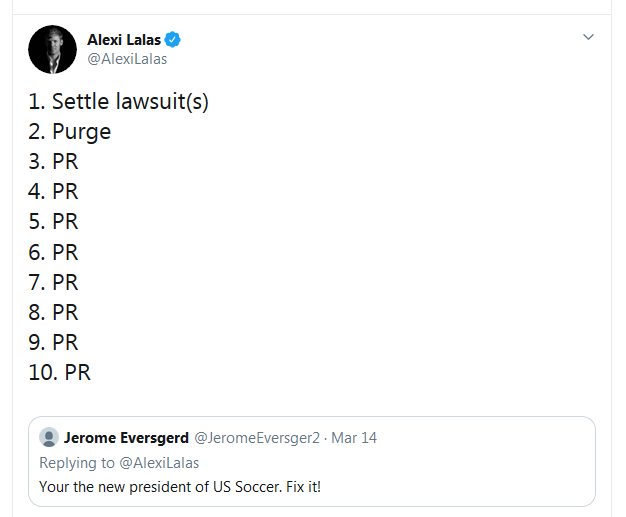
Ultimately, as to what comes next, I think Alexi Lalas has it about right:

USSoccerTweet2

This really isn’t a legal fight. It can’t be won in a courtroom. It’s only going to be won in the court of public opinion and that’s going to require some serious groveling on US Soccer’s part. So, let’s get to it, US Soccer – shut up and settle this thing already!

Please-Shut-Up-Morgan-Freeman-Picture

Reassessing Sportsmanship

So this is probably the weirdest goal you’ll see in (nearly) top-flight soccer this year (video* via).

You’re seeing that right – one team basically gets out of the way while the other walks the ball into the net, tying the game at 1-1. What the hell was going on? Sportsmanship, or so it’s being sold. I’m more than a bit confused.

But first some background, both personal and contextual.

You know how sometimes you see publishing or distribution deals that give the US rights to one company and another firm gets the rights for “rest of the world”? I’m kind of that way with soccer loyalties. Here in the US my team is DC United. I’ve followed them since MLS started in 1997, from early domination to later doldrums and everything in between. For the rest of the world, so to speak, my team is Leeds United.

Scarves1Crop

They’re currently toiling in the second tier in England (which is called the Championship and is right above the third-tier league called . . . League One – yes, it’s confusing). Leeds was peaking when I started following soccer closely in the 1990s and something about them attracted me. They’ve since overspent and plummeted down the ranks in England, going so far as the aforementioned League One before settling into a fairly consistent pattern of disappointment in the Championship.

Which brings us to this season. With a new manager, the enigmatic Marcelo Biesla, Leeds has been in the thick of the promotion race from the jump. The top two teams in the Championship automatically move up to the Premier League the next season, while the next four (third to sixth places) go into a playoff to determine the third promoted team. Leeds has been solidly within the six for most of the season, and had some hopes of snagging one of the top two spots, but some recent bad performances basically ruled that out.

So it was that they hosted Aston Villa on Sunday. Villa is also among the six, so the game still had some bite to it. Which is how this happened.

Essentially, with a Villa player down apparently injured around midfield, the Leeds players kept playing. For years the “sporting” thing to do was for one team to play the ball out so the injured player could be treated, but more recently it’s been made clear that it’s the referee’s job to stop play. As we tell kids at the lowest level of little league anything – you play to the whistle. Villa took offense and a brouhaha erupted (complete with a pretty bad dive by Leeds forward Patrick Bamford).

So, Bielsa had his team lay down so Villa could score the equalizer. What made it more farcical was that Leeds defender Pontus Jansson either didn’t get the memo or disagreed with the boss, making an attempt to tackle the ball away. The game ended 1-1, keeping Villa in position for the playoff while finally extinguishing any remote chance (it was very very remote) of scraping back into the top two and earning automatic promotion.

Bielsa’s gotten his fair share of praise for this as an example of good sportsmanship. Although Alexi Lalas lays the blame at the clumsy feet of the players:

Naturally, others suggest that there was nothing really to lose, since Leeds had no real chance of getting second place anyway, or that Bielsa is still trying to rebuild his image after a “spying” scandal earlier in the season. Regardless, the end result is the same – the team essentially forfeited a win and sacrificed two points in the standings to affirm an unwritten rule that maybe shouldn’t be honored anymore.

This all reminds me of something I wrote about earlier this year in the wake of the Rams/Saints fiasco before the Super Bowl – in 1999 Arsenal manager Arsene Wenger demanded that his team replay a FA Cup match against a lower division team after Arsenal had scored a goal in a moment of confusion following a similar incident – the other team played the ball out to allow an injured player to get treatment, then an Arsenal substitute pounced on the ensuing throw in. I’ve always viewed that as a great example of sportsmanship where Wenger really put something on the line – had Arsenal lost the replay they would have been out of the tournament.

But, truth be told, I’d don’t care about Arsenal’s success. Leeds, on the other hand, I care about, so I’m having to rethink my ideas on sportsmanship in these situations. I mean, given the point of the season where it occurred it didn’t matter a whole lot, so in such situations there good reason to be magnanimous. Plus, the laws of the game (soccer has laws, not rules, you understand) could be clearer, as it says that the ball is out of play only when it’s actually crossed a boundary or “play has been stopped by the referee.” But, obviously if a team kicks the ball out intentionally that’s still out of play, so where does that get you?

On the other hand, unspoken rules – “gentleman’s agreements” – are supremely flimsy. I’m generally of the opinion that a right without a remedy, without a means of enforcement, is no right at all and that same’s true for an unwritten rule in sports. Leeds’ players did nothing wrong by playing on when the ref didn’t stop the game. That’s his job, not theirs. It’s the same thing as a player correcting a ref’s bad call – it’s the ref’s job to get things right, not the player’s to atone for his sins. In other words, it’s above and beyond the call to play the game with complete honesty. And, honestly, does anybody believe that if the same situation happened in the playoff final, with promotion at stake, that Bielsa would have done the same thing?

I don’t think so. I hope he wouldn’t. There’s a world of difference between cheating and taking advantage of an opponent’s expectations. All may be fair in love and war, but as the old saying goes, soccer is more important than that!

* Apologies for the lack of embedded video. Couldn’t figure out how to get Deadspin’s player to work on the blog.