The Simple Power of “What If?”

Every work of fiction, or damned near every one, can been seen as an answer to a “what if?” question. What if a family has to uproot their entire existence because of climate change? What if most of a small town’s children are killed in a tragic accident? What if a young attorney’s cushy law firm is a front for the mob? On and on it goes.

The power of “what if?” is given particularly free reign in speculative fiction, since the question doesn’t have to conform itself to the real world. Stepping outside reality to ask the question can still lead to powerful insights into the real world, however.

Last week while putting laundry away I stumbled into a Twilight Zone marathon on TV. The episode I landed on, “I Am the Night – Color Me Black”, that takes a preposterously simple “what if?” question and uses it to drill down about the human condition. The opening narration lays it out:

Sheriff Charlie Koch on the morning of an execution. As a matter of fact, it’s seven-thirty in the morning. Logic and natural laws dictate that at this hour there should be daylight. It is a simple rule of physical science that the sun should rise at a certain moment and supersede the darkness. But at this given moment, Sheriff Charlie Koch, a deputy named Pierce, a condemned man named Jagger, and a small, inconsequential village will shortly find out that there are causes and effects that have no precedent. Such is usually the case—in the Twilight Zone.

In typical Twilight Zone fashion the supernatural event isn’t really the important part of the story. It’s how it throws everyone in the episode out of equilibrium and allows the filters of euphemism and manners to slip enough to see peoples’ true selves. Thus, not only do we have the deputy who’s certain (against the evidence) that Jagger is guilty, but we get the realization that Jagger is pretty much a douche, anyway. He may have been wronged, but that doesn’t make him right.

So the darkness lingers, until after the execution when we learn that it’s appearing all over the world, at locations like the Berlin Wall, Budapest, and a street in Dallas (keep in mind, the episode first aired four months after the Kennedy assassination). So, in less than half an hour, a simple question – “what if one morning the sun didn’t rise?” – leads us to, on the micro and macro scale, sober observations on human nature.

That’s the simple power of “what if?” when it comes to storytelling. It’s the prime mover, the thing that gets the ball rolling. It can upend the real world and give us a way to reflect on it all at the same time.
whatif1

Watch Me On TV (Actually YouTube)!

A few weeks ago I mentioned sitting down with author Eliot Parker for his interview show Chapters. The show’s been broadcast and has now been posted to YouTube. If you’re interested in what I had to say, check it out:

We talk about speculative fiction, The Water Road, a couple of stories from The Last Ereph and a few other things. Check it out, enjoy, and thanks again to Eliot for having me on.

Weekly Read: We Stand On Guard

There’s an episode of Futurama where Fry and Bender are sent off to a far away planet to battle a species of alien ball things (they joined the Army for the discounts, but “war were declared”). The dramatic pivot – if such a thing could exist in an episode that included Zapp Brannigan, the disembodied heads of Richard Nixon and Henry Kissinger, and a running gag about M*A*S*H – is when Fry learns that the planet wasn’t just a rock, but the home planet of the aliens. In other words, we were the invaders, the bad guys.

That, largely, is the big idea behind We Stand On Guard, in which a small band of guerillas in the Canadian wilderness fight back against marauding invaders from . . . the United States. It’s an interesting idea and in the hands of Bryan K. Vaughn – of Saga, The Private Eye, and many others fame – you’d think it would be more interesting. As it is, the six-issue run is too short to do anything all that original and, in the end, it turns into a better executed version of Red Dawn. With, you know, Canadians.

You see, in 2112 (a Rush reference, surely?), somebody bombs the White House. In response, we blow the ever loving shit out of Canada. You may think what happened in the South Park Movie was bad, but that’s just peanuts to what we do in We Stand On Guard. Fairly quickly thereafter we’re thrown into the story of Amber who, along with her brother, survived the initial onslaught and lived to fight another day. The story flips back and forth between the present (2124) and the past as Amber and her brother escape advancing American forces.

Why does any of this happen? It’s not really clear, even by the end of things. Sure, some Canadian general confesses to the White House thing, but it’s clear he’s been beaten (at least) and so I suspect this isn’t supposed to be the final word on things. Why we freaked the fuck out and razed our long-time peaceful neighbor doesn’t even get a cursory explanation. We’re out for Canadian water, but whether that’s a happy accident of the invasion or the goal of it is never clear.

Which is a shame, because beyond the initial setup the story plays out like any where the main character joins a plucky band of resistance fighters. It’s bloodier than most, but in the end the good guys win (at least for now) because, you know, they have to. As my brother is fond of saying, “because it’s in the script.” The brief run time doesn’t allow for any of the characters to get defined beyond archetypes or for any kind of interesting world building that doesn’t directly relate to the story We Stand On Guard is rushing to tell.

We Stand On Guard has a lot going for it, anyway. The art’s quite good, clean and vivid. And Vaughn has come up with some really awful ways to get people to talk. Let’s just say that in a hundred years we’ve become even more fluid with our “enhanced interrogation techniques.” And, say what you will about the short nature of the book, that means it doesn’t drag at all. It’s fast paced pretty much from the get go.

Which is precisely the problem. It’s an odd thing to say, but this would have been better had there been more of it. The Private Eye got ten “issues” (since it was originally released in digital format only I’m not sure how they compare to regular comic issues) and that seems about the minimum needed to tell a story set in a new world populated by new people. Maybe there’s a comics equivalent to a director’s cut out there, somewhere, that would fill in some of the blanks.

westandonguard

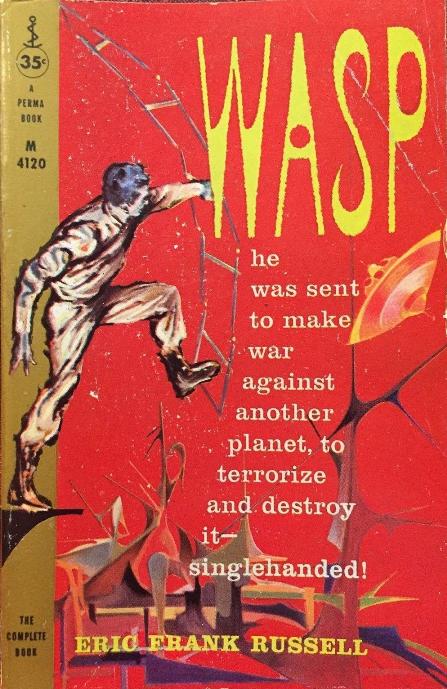
Weekly Read: Wasp

Ready an older book can be tricky – and I’m not even talking about Chaucer or Voltaire here. On the one hand, a recognition of the fact that the book arose from a different time, a different social context, is necessary to give it a benefit of the doubt sometimes, to explain why it doesn’t quite fit with modern expectations. On the other hand, sometimes you can defer too much and paper over that a book just isn’t very good with the explanation that, at one time, people must have thought it was.

Wasp, which was first published in 1957, has a brilliant idea at its core – a single operative is dropped behind enemy lines with instructions to wreak havoc among the populace, drawing resources and attention away from the front lines. The analogy the title makes is to when a wasp gets into a car, freaks out the driver, and kills all on board in an accident. It could have easily been written as a Cold War thriller, a James Bond kind of thing, but one side in Wasp is on Earth and the other on Jaimec, near Sirius, and the war is an interstellar one.

The wasp in this case is James Mowry, who had the good fortune to have been born on the enemy planet and raised there until he was a teenager. As a result he gets drafted for this dangerous assignment (he’s not a career spy). After some montage-like training, he’s dumped on an outlying planet, given lots of resources, and let loose. He does precisely what he’s supposed to do, with the expected results.

Which is the biggest problem with Wasp, something that doesn’t really have anything to do with when it was written. Mowry is just too good at what he does, particularly considering his lack of espionage background. Yes, he gets into scrapes with the secret police, but there’s never really much danger. There’s no real antagonist, no dogged cop trying to hunt Mowry down that makes it seem like he’s really at risk.

Nothing goes wrong until almost the very end when his cache of goods is found and he’s effectively cut off from communicating with Earth (don’t whine about spoilers – did I mention 1957?). Had this happened in the middle of the book, throwing Mowry out of his comfort zone and forcing him to deal with some serious problems, it would have been a welcome twist. As it is, he survives what’s left of the book in quick fashion before he’s picked up (in an admittedly twisted coda) by Earth forces.

That wouldn’t be too problematic if there was something interesting going on inside Mowry. Given his background, one might think he would have some sympathy from the Sirians. In spite of their secret police, they don’t seem all that different from what we know of the Terrans (Mowry, after all, is impressed against his will and sent to indiscriminately blow up stuff – hardly noble) and surely Mowry made a friend while he was growing up? More immediate, he doesn’t forge any kind of connection with the people he uses in his scheme. Everybody is a pawn being moved around the board, even Mowry.

The lack of depth draws sharper focus to the anachronisms of the story. For one thing, there are no women involved. I don’t mean there are no notable female characters, I mean there are no women anywhere at all (As Jo Walton put it, “[t]his is an old fashioned book, written before women were invented.”). Par for the course in 1957, but glaringly unrealistic to modern eyes. For another, there isn’t any attempt to extrapolate future tech, aside from space travel and communications, such that Jaimec looks and sounds almost exactly like 1950s America. A typewriter features prominently at one point. With a better story and deeper, more interesting characters, it would be easy to overlook.

Lots of people make a lot of Mowry being a “terrorist.” No less a luminary than Terry Pratchet said of Wasp he “can’t imagine a funnier terrorists’ handbook.” Neil Gaiman, at one point, owned the film rights. He was working on a script when 9/11 happened and he abandoned it because audiences wouldn’t be ready for a movie where the terrorist is the good guy (although, given his lack of depth, he functions more as a psychopath than a good guy).

I’m not sure that’s an accurate characterization of Mowry and what he does. For one thing, he’s an agent of a state at war inflicting damage on the other state with which is at war (presumably openly declared). That’s straight up warfare, even if carried out in a slightly unconventional way. For another, most of Mowry’s targets are military or government related, even if there’s some collateral damage. Compared to carpet bombing, lacing the countryside with landmines, and atomic weapons, however, it’s damned precise. If Mowry had  brain in his head I’d think that perhaps the author was trying to make a larger point.

There’s something to be said for quick dumb fun. Wasp is certainly quick and, in spots, it’s kind of un in a subversive kind of way. But it’s pretty dumb and doesn’t think very highly of its characters. It’s intriguing central idea deserved a better execution.

Wasp-1959

On Not Finishing Books

Last week I did something about which I’m not proud. I created a new bookshelf in my Goodreads profile, one for “unfinished” books. And I put two books on it.

Generally, when I start something, I like to finish it. That’s particularly true of artistic things, which can sometimes change radically as they go along. When I get a new album I listen to is all the way through, several times, even if it’s not clicking with me. I want to give it a fair chance. I don’t think I’ve ever walked out on a movie, even while watching at home. It’s only a couple of hours, after all.

But books can be different. After all, they take more time and (in some cases) effort than albums or movies. That’s particularly true for me because I do a lot of my “reading” in the car, via audiobooks. It can take me weeks (if not a month) to get through a decent length novel. Given that, is it OK to bail on a book before I reach the end?

Maybe the better comparison is with TV shows. Most of them involve a considerably larger investment of time than a movie, if we’re talking about shows that go on for seasons. Given that, I don’t think I’ve ever felt bad deciding, after watching a couple of episodes, that a show’s not for me. After all, if two or three hours of (to pick a random example) Orange Is the New Black doesn’t really do much for me, why should I sit through 48 more hours of it?

But books are different, right? I’m a writer for fuck’s sake! Shouldn’t I be more dogged in my determination to finish a book I start? Shouldn’t I be willing to take one for the team, to do what I’d hope any reader would do with one of my books?

I don’t think so. It comes down to time, really. It’s not quite like this:

FinishBooks

But it’s close. The thing is, the books I’ve decided to give up on aren’t “bad.” I don’t (to borrow a phrase from an Absolute Write forum thread) throw them across the room with great force. I want to finish them, but my heart just isn’t in it. I read for pleasure, just like I write because I enjoy it. If it starts to feel like work, something’s wrong. I already work in my life without literature adding to the load.

That the books I don’t finish can’t be labeled as “bad” (if any art can ever be so labeled) is obvious just by looking at them.

The first, the one that prompted the shelf construction, is The Grace of Kings by Ken Liu.

Grace_of_Kings_cover

Liu is decorated with sci-fi and fantasy awards for his short fiction and he recently translated the Hugo-winning The Three Body Problem from Chinese, the first novel in a non-English language to win the award. Plus, he’s a lawyer and I always like reading books by lawyers who don’t write legal thrillers.

The Grace of Kings is Liu’s first novel at it’s a neat setup. It’s an epic fantasy with an Asian background, rather than European, complete with the steampunk touch of airships (Liu calls it “silkpunk”). It involved a ruthless empire and the unlikely heroes who bring it down and the aftermath of their revolution. Should be right up my alley, but it just didn’t work for me. The last straw was the interesting back story of a minor character that came across like a Wikipedia entry – all the facts, none of the drama of the story. Others love it, so I’m sure I’m missing out, but I thought it was time to move on.

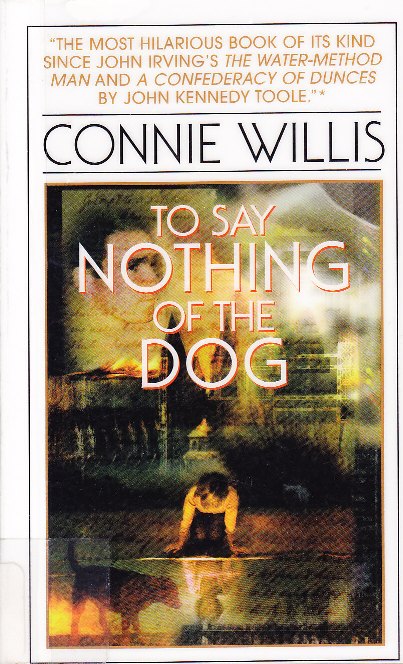
The other book on that shelf really pains me, as it’s To Say Nothing of the Dog by Connie Willis.

nothingdog

I first experienced Willis’s world of Oxford historians who do field research via time travel in “Fire Watch,” which I thought was great. I moved on to Doomsday Book which I truly love. In both the entire process of time travel was dangerous and subject to cock ups that could put the traveler’s life in danger. It was, as the kids say, serious bizness.

To Say Nothing of the Dog is set in the same world and involves the same kind of travel. Except it’s a comedy and, in the part I read, makes hay with an historian using the machine to travel back in time to escape a particularly annoying donor to the college. It just seemed . . . wrong. It would be like if the first book in the Hitchhiker’s Guide to the Galaxy series was a serious, violent space opera about rampaging Vogons. Bad poetry, towels, and mice running the universe after that just wouldn’t seem right. So it was my own dissonance that caused me to give up on To Say Nothing of the Dog.

Thus, to those two books, and the others that will inevitably wind up on my “unfinished” shelf, I say – it’s not you, it’s me. Really, truly. But life’s short and I just have to move on. At least I still feel kind of bad about it.

Weekly Watch: The Martian

It’s a fact of my modern life that I don’t see most of the movies I want to see when they hit theaters. Various factors conspire to keep me separated from these flicks for months, until they happen to slip through my sphere of influence. The minute The Martian came out, I wanted to see it. Ridley Scott adapts a DIY-publishing success sci-fi story for the big screen? Yes, please!

Alas, it came and went from theaters. It kind of slipped below my radar. I nearly paid way too much money to watch it while I was on the road last week, but fought the urge. Finally, a stroke of luck – it was on HBO last weekend. Hooray for my low tech ways!

Here’s the real problem with that kind of delay. It’s hard in the modern world to avoid opinions about a movie (or a book or album) when the first come out. It’s damned near impossible to do so for months afterward, particular when it’s nominated for some big awards and wins some others. I’m not talking about being ruined by spoilers. I’m just talking about how you can have certain expectations about something when you finally get around to see it.

So what of The Martian? Well, it didn’t live up to the hype.

Which is not to say it’s bad. In fact, it’s very well made, pleasing to look at, and has some good performances. It’s got a “rah rah, bring the boy back home” story that winds up into a feel good ending. That’s not a problem in and of itself, but it’s what leads up to it that doesn’t work so well.

Mark Watney, the main character, is a nice enough guy and the situation he’s put in really sucks. Not just stranded, but left for dead. He has considerable obstacles to overcome in order to survive and he . . . fairly easily overcomes them. At one point he says, about a problem, that he’s going to “science the shit” out of it. That attitude – every problem has a solution, take one at a time – is driven home back on Earth when Watney begins training the next generation of astronauts.

It’s a great motto and probably an excellent way to deal with real world problems. It doesn’t, however, bear any real dramatic weight. The bottom line – Watney’s too damned competent. Everything he tries works (until plot requires that it get destroyed) and, while we see him make some snarky comments about his situation, it never really seems to get to him. Even if all his schemes kept working, he’s still millions of miles from home and alone. We know what solitary confinement does to people – it ain’t pretty.

In this way, The Martian suffers considerably from comparison to the much smaller (and much less seen) Moon. Even before it gets to the issue of clones and whatnot, it paints a really effective picture of what being along on another planet(oid) would really be like. The struggle, as the kids say, is real.

But Watney’s isn’t. It’s not that I want to see the man suffer, but some struggle would have been nice. There’s no way a big-budget summer movie, rated PG13 and starring Matt Damon, is going to go all the way dark and have him die on the planet or commit suicide or something. But some hint that the vast expanse of time without human contact had some impact on his psyche would have been interesting. As it is, only his weight loss seems like an issue (and it’s light years away from what Christian Bale puts up with).

Writing this, I’m reminded of a post on the IMDB discussion board where someone asks “is this based on a true story?”. It’s not as dumb a question as it sounds, looking at it now. Real life can be many things, but it’s not often filled with the dramatic tension we expect in fiction. A true story of clever survival, rooted in the fact that it actually happened, has a pull to it that a fictional tale of similar stature just doesn’t. I read somewhere that the difference between fiction and real life is that fiction has to make sense. It has to have some drama to it, too.

Which is not to say The Martian sucked. It was a perfectly enjoyable way to spend a couple of hours, but it didn’t live up to my perhaps exaggerated expectations. It was fluff, but it was engaging fluff. There’s something to be said for that.

martian2015-5

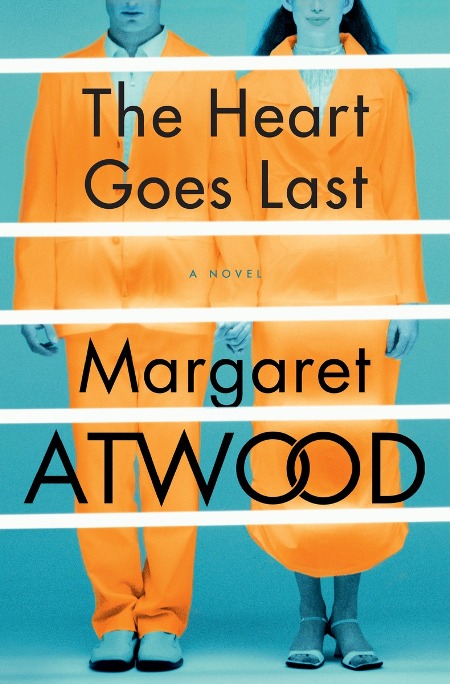
Weekly Read: The Heart Goes Last

My brother used to have a saying – an aphorism, I suppose – taped to his wall. It was attributed to Skippy the Lizard God and went like this:

Sex is like pizza – when it’s good, it’s really good. Even when it’s bad, it’s still pretty good.

The same is true of albums by great bands, movies by great directors, or books by great authors – even their lesser efforts are generally worth your time. That’s a long way of saying that while The Heart Goes Last is far from Margaret Atwood’s best work, it’s still worth a read.

The Heart Goes Last has a deliciously absurd premise. A husband and wife, Stan and Charmaine, are living in their car in a depressed, near-future New England dystopia (there’s some suggesting things are better in the rest of the US). They’re not exactly happy, but they’re getting by. They find out about a quasi-utopian project called Consilience that promises work, happiness, and safety, but with a catch – people in the town live one month in their home and then one month in prison (where they’re used as cheap labor). Stan and Charmaine move in. It’s wrong to say “wackiness ensues,” but what transpires is pretty fucked up.

Without going too deep into spoiler country, Stan and Charmaine get caught up in a grand scheme that could bring down the whole operation, one that detours through murder and organ harvesting, Elvis impersonators, romantic imprinting gone awry, and Dutch-designed sex robots.*

There are some wonderfully dark and funny bits in all of this. In one instance, Stan finds what he thinks is a love note between the two “alternates” who share his and Charmaine’s house (occupants switch each month – one set in the house, one set in the big house). It’s lusty and sexy in a way Charmaine simply isn’t, which makes Stan determined to find and bed the other woman (contact between alternates is strictly forbidden). He spins out an R-rated, Technicolor fantasy that covers not only his attempted seduction but the surely violent reaction from her muscled, bald, and tattooed husband. It’s all completely inane, made all the more so when we learn the truth about the note.

Then there’s the blue teddy bears. I don’t think anybody has gotten such mileage out of an ordinary inanimate object since Tom Hanks (Castaway link).

Which is all amusing for a bit, but it doesn’t really coalesce into anything substantive in the end. Part of that’s due to Stan and Charmaine, who are our only POV characters. Since they’re essentially pawns in the game, we never get a solid idea of what the game is, who’s playing it, and why (even at the end). In addition, neither one are what you’d call bright. Stan is mostly a slave to his baser urges, while Charmaine is so chirpy and positive (even when dispatching souls in her prison job) that it’s hard to sympathize with her very much. I agree with this bit from the NPR review:

The Heart Goes Last’s deepest investment isn’t in Consilience’s hideous secrets. It isn’t even in Stan and Charmaine’s inner lives — both characters have interior monologues like repetitive tape loops. The book is mostly interested in their sexual obsessions, and the way they fetishize each other only once they’re separated. But their predictability doesn’t do much to ground an unpredictable narrative, or give readers a worthy point of view. As other people plot against Consilience, the protagonists become hapless bystanders in everything from their marriage to the larger story.

It doesn’t help matters that the endgame, as it plays out between this two, has a confusing, Rube Goldberg quality. Which could be fun, if we had some idea of what the people setting up the scheme were trying to accomplish.

As I said, all that makes The Heart Goes Last frustrating and I certainly wouldn’t suggest it as a starting point for someone who’s never read Atwood before. But she’s too talented a writer to not score some points along the way, so I’d definitely say it’s worth it (it’s pretty brief, all things considered). Nobody succeeds every time, but few of us are lucky enough to stumble as interestingly as Atwood.

Also, if I ever meet Grandma Win in person, I’ll punch her dentures down her throat.

* Indeed, it’s kind of odd how many parallels there are with The Mechanical and The Rising that I reviewed recently. Dutch robots? Check. Reprogrammed humans? Check. Ruminations on the nature of free will? Check. Done in completely different ways, of course. The sex bots also remind me of Zappa, naturally.

Book Review The Heart Goes Last

My Watery Bridge Too Far

I’ve talked before about the flying snowman point, the point at which a reader or viewer is no longer willing to suspend disbelief to enjoy a story. There’s a similar thing that happens when certain things are depicted in the narrative, things that are so off putting that they ruin things, or at least leave a sour aftertaste.

I’ve read some people for whom that thing is rape, either survivors who don’t want to relive their trauma or people who just think it’s something that is too casually thrown around in fiction. For my wife it’s animal abuse or neglect. She can rarely push past that, once it comes up. I’ve always thought of myself as tougher than that, able to shrug off anything in the service of a narrative. A reader’s version of a cast iron stomach. Apparently, I was wrong.

Last year my wife and I took our belated honeymoon in Cambodia. It’s a beautiful, historic place, filled with friendly people. But it’s also the scene of one of the worst authoritarian regimes of the 20th Century. During the reign of the Khmer Rouge in the 1970s up to 2 million Cambodians died, either worked to death in a program of rural fixation or outright murdered as enemies of the state.

While we were in Phnom Penh we went to the Killing Fields outside the city, as well as the Tuol Sleng prison, from which many of those doomed people came.

TS1

Tuol Sleng is a former school and it’s been left largely in the same condition in which the Vietnamese found it when they rolled into the city in 1979. In fact, rooms in which prisoners were murdered just ahead of the Vietnamese advance still have blood on the walls and ceilings. Of the 17,000 of people sent to Tuol Sleng only a dozen survived (we met one of them). It’s easy enough to be horrified at the place just be using your imagination.

Not that you’re limited to that. Several rooms are given over to exhibits about what went on there. In one room there are implements of torture, as well as paintings done by a survivor of the various torture techniques. Take a look at this picture:

TS2

See the painting in the right, behind the rack upon which victims would lay while their fingernails were pulled out? It depicts waterboarding, simulated drowning, which was a crime against humanity when the Khmer Rouge did it, a war crime when the Japanese did it in World War II, but mere an “enhanced interrogation technique” during our glorious War on Terror. Whatever it’s called, it’s torture and the thought that it’s been done in my name turns my stomach.

Which brings me to Channel Blue, a comic sci-fi novel by Jay Martel. In the book a down and out Los Angeles screenwriter, Perry, accidentally learns that the Earth is actually a huge reality TV show run for the benefit of an alien race. Even worse, ratings are down and the show’s been cancelled – in other words, the Earth is to be destroyed. Perry does his best to save it, but each attempts tends to fail miserably and leads to Perry suffering in all kinds of ways.

The other night, while going through another of these episodes (it gets kind of tedious), Perry is identified as a potential terrorist, taken to a secret location, and waterboarded. Not for any good reason (he’s back on his way quickly enough), but, there it is – a depiction of waterboarding in what’s otherwise been a funny, light bit of entertainment. It stopped me cold.

It’s not that I object to any depiction of torture in literature or film. But it’s one thing to depict it as part of a serious work, perhaps shedding light on the brutality of the whole process. It’s quite different to put it in a comedic work even if the act itself wasn’t played for laughs.

But if that’s true, what about one of my favorite books (and others) of all time? Very early on in The Hitchhiker’s Guide to the Galaxy the entire planet Earth is destroyed. It’s played completely as a joke – the Earth is destroyed to make way for a hyperspace bypass. Billions of people are killed. That’s never bothered me – why not?

I think it comes down to realism, oddly enough. Realistically, the Earth is not going to be destroyed, certainly not to make way for a hyperspace bypass by an alien race spouting awful poetry. The idea is so absurd that it’s not worth taking seriously. By contrast, waterboarding of alleged terrorist suspects is something we’ve done, and not in the recent past.

I’ll admit this is probably not a rational response. Most things like this are more visceral than intellectual (although not all). There’s nothing wrong with that, so long as people recognize it. I guess I do now.

Technical Brilliance Only Goes So Far

A few weeks ago my wife and I finally saw Mad Max: Fury Road, the movie that’s risen to the rarified air of awards talk genre pictures seldom see. It’s got an Oscar nod for Best Picture, after all. Although I’m not a huge fan of the old Mad Max flicks, I’m a sci-fi fan, fond of dystopia. My wife’s a big action movie fan. So we’re definitely in what might be the target audience for something like this. Nonetheless, when it was done, we turned to each other and asked:

“Is that it?”

Not that it wasn’t cool. The movie looks gorgeous and George Miller deserves a lot of credit for doing some really insane stunt work using real vehicles and people instead of wallowing in CGI overload. Who wouldn’t want a flamethrower guitar? Or keytar, maybe? I’m a keyboard player, after all. And, yes, it was cool to see such overt feminist overtones in a movie that comes out of a very masculine tradition.

But is that enough?

The best explanation I’ve read as to why Fury Road deserves consideration as one of the best movies of 2015 is from this article by Amanda Marcotte over at Salon. Her argument seems to boil down to it being a great technical achievement:

“Mad Max” is more than just a really good movie. It’s also a wildly innovative movie, one that plays with the very idea of filmmaking itself. The director, George Miller, tore up the book on how to make a movie, taking huge risks in doing so, and ended up making the movie that people could not stop talking about this year.


“Mad Max” barely has a script. There was heavy storyboarding, but in terms of a traditional script for actors to work from, nope. Instead, they filmed for months in the desert, collecting 480 hours of footage (which is three weeks, if you watch non-stop), which was pounded and then refined into a coherent story in the editing bay, with Margaret Sixel, Miller’s wife, at the helm.

As a result, she argues, it’s an

artistic experiment toying with how to use the tools of film-making to tell a story in an entirely different way than we’re used to

that happens to be “fun” and “moving.”

Therein, I guess, lies the rub. I’ll give Fury Road the “fun” label – it certainly wasn’t an experience I wish I hadn’t had when it was over. But I don’t get “moving” from it and, in retrospect, can see where the fact that it “barely has a script” is perhaps a main reason why. It’s not the film is incoherent (which is a credit to the editing work), it just doesn’t make much sense.

The talk about Fury Road reminds me a little of the buzz last year around Boyhood. It, too, was a great movie making experiment, filmed over years in order to capture the main character aging into adulthood. However, I remember, amidst the plaudits, that some critics dared to suggest that, at the end of the day, the finished product wasn’t all that captivating. Still, the audacity of its making carried it a long way.

Technical achievement is worth celebrating, but it’s not the be all and end all of art. Progressive rock, more than most subgenres of popular music, values instrumental mastery – it lionizes people who can play. That being said, there’s still something to be said for avoiding the “too many notes” trap). A flurry of sound might be impressive, but is it interesting or moving? Not necessarily.

So it goes with literature. Clever wordplay and narrative structure that defies common sense can be daring experiments and produce new ways of telling stories. But at the end of the day, if the story itself doesn’t connect with readers, it’s a lot of flash that, in the end, doesn’t produce much heat.

Same thing with movies. Fury Road is, without a doubt, technically impressive. I just didn’t get a lot out of it beyond that. To be truly great, as so many think Fury Road is, demands more.

I Want Swoopy Spaceships!

Confession time. I have been a consumer – reader, watcher, even listener – of science fiction for most of life. I consider it my first love, even though when I write I tend to drift into fantasy more often than not. That’s not the confessional bit (not in 2016, for crying out loud!). No, the confessional bit is this:

I don’t really care that much about the scientific accuracy of my science fiction.

There, I said it!

Now, I’m not saying I completely switch off my brain when something walks into the room with “sci-fi” written all over it. We all have our flying snowmen points after all. But some of the things I see other sci-fi fans complain about – like movies with sound in space or faster-than-light travel – just don’t bother me that much. I kind of appreciate it when somebody decides to get it “right” and see where that goes, but I’m perfectly happy to nod and move on otherwise, so long as the story and characters are engaging.

All this is a way of saying I’m deeply bummed by the current state of spaceship design in visual sci-fi. Particularly, I’m disappointed that the ships in The Expanse look so damned ugly.

The Expanse is another attempt by SyFy to regain its footing as a decent home for science fiction on television. Based on the novels by James S. A. Corey (actually two authors working together), it’s set at a time in the future where humanity has expanded into the solar system, but not yet beyond it. With that caveat, it’s a space opera as you can get, with character shuttling off from planet to asteroid to space station as the plot requires. The books (at least the first two) are damned good and the TV series is doing an all right job with the adaptation.

A big part of said shuffling involves a ship called the Rocinante. Yes, it’s named after Don Quixote’s horse. It also happens to be the name of the narrator’s ship in Rush’s epics “Cygnus X-1” and “Hemispheres” in which he is “sailing through the galaxy.” When I pictured the Roci in my head (because I don’t remember a description from the text) I imagined something sleek, swoopy, and sexy. Truth is, I almost always think of space ships like the Heart of Gold:

one hundred and fifty meters long, shaped like a sleek running shoe, perfectly white and mind-bogglingly beautiful.

On TV there is no such leeway, however. The Roci looks like it looks and, depressingly, it looks like this:

Rocinante

This may be a very realistic conception of what such a ship would really look like. But, damn, it’s dull. Others will disagree – some folks value practicality when making an aesthetic judgment and who am I to say they’re wrong? It just bums me out a bit.

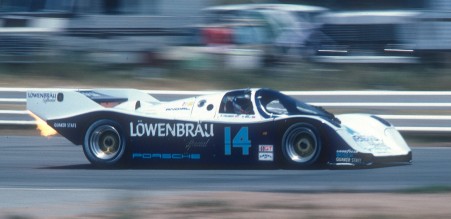
I’ve seen a similar transformation in the design of race cars over the years. When I was younger and first getting into racing, this is what a top of the line prototype sports car looked like:

Jaguar-XJR-8

lowenbrau-porsche-962_16c_apr-86

Mazda-RX-792P1-500x250

Now, as the black science of aerodynamics has continued to develop and every part of the car has to produce downforce, they’ve become this:

Audi R18 at the 1000km of Spa 2011. Picture was taken during the warm-up.

Don’t get me wrong – the modern car would run circles around the older ones. There’s something to be said for finding beauty in performance. But at the same time, it’s hard not to see that something’s lacking in the modern era.

Same goes with the modern visual depictions of spacecraft. Realism counts for a lot and I don’t begrudge anyone who prizes that in their sci-fi. But that doesn’t keep me from being disappointed.

I want my swoopy spaceships back. And race cars, too.