On American Dystopia and the Great White North

Dystopian fiction can be tricky. Assuming you’re setting it on Earth, you either need to have the whole world go to hell, which isn’t all that probable, or the shit show is more localized, in which case you have to address how the rest of the world interacts with the place where the story is set. I’ve been set to thinking about this a bit thanks to two recent bits of television.

Margaret Atwood’s The Handmaid’s Tale is as localized as dystopia can get. It’s told entirely from the point of view of the titular handmaid, June, and doesn’t concern itself at all with the outside world. Gilead is what she experiences; nothing more.

The TV adaptation probably couldn’t have worked if it maintained that rigorous POV, so it wisely broadened its world from the get go. In the first season, therefore, we learned that June’s husband and her best friend managed to escape to Canada, where there’s a growing population of expats from the area that used to be New England. But we don’t really know what that means in a global socio-political sense.
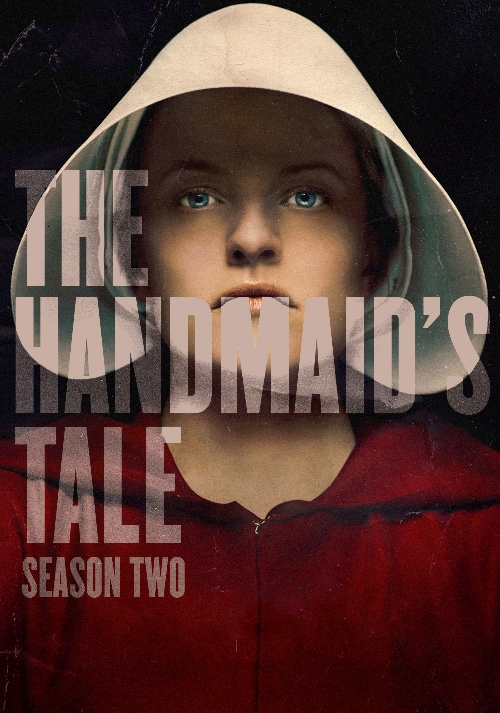
HandmaidS2

That was evident in the recent episode “Smart Power,” where Commander Fred and his wife, Serena, take a diplomatic trip to the Great White North. They’re received professionally, if coolly, in the manner you’d expect for delegates from a nation with which the Canadians have at least some normal relations. But do they? We don’t really know. Things are complicated when an American agents of some kind offers Serena a new life in Hawaii, one where she actually gets to control her destiny.

All this is a bit confused because we don’t really know how Gilead relates to the rest of the world – or what the rest of the world thinks of Gilead (once some info leaks out during the Commander’s visit, we quickly find out, at least partly). How big is Gilead? We know it’s centered in New England, but what of the rest of the United States? Does Canada recognize it as an independent nation? If so, why? What does the United States look like?

None of these were really important in the book, since it was June’s story above all else. But by broadening the focus (something that had to happen for the TV series to continue), these questions become relevant and I’m not certain the show’s brain trust really has the answers.

The recent HBO adaptation of Farhernheit 451 suffered even more acutely from this problem. It makes explicit the story’s setting (Cleveland) and, via an implausible update that involves the works of humanity encoded into DNA, sets up an endgame where Montag has to help someone escape to Canada to rendezvous with some scientists. We’re never told if that’s just because that’s where they are or because Canada is the safe area we always assume it to be.

F451

This is particularly important to Farhernheit 451 given its semi-hopeful ending of an underground group dedicated to actually memorizing great works of literature to ensure they don’t disappear.* That still happens, but it’s now supplemented with the DNA thing. But if Canada is a safe haven, if it exists outside of the dystopia the United States has become – then why the need to preserve all knowledge? Isn’t it safe elsewhere in the world?

To a certain extent this is an issue with any speculative fiction worldbuilding. Writers need to have some idea what happens beyond the bounds of their stories, since those things should influence those stories in some ways. But it’s compounded dystopian fiction set in the “real” world because readers and viewers presume the world is as it is in real life, unless we’re told otherwise. That can lead to confusion, or at least some disappointments.

* Kudos to the writers for updating the preserved works to include writers who are women and people of color (and even some women of color!). However, the impact is a bit muted since only the minority characters are memorizing the work of minority authors.

Weekly Read: Head On

One of the cool things about writing speculative fiction is building a world out of a neat “what if?” idea and playing around in it. John Scalzi did that with Lock In. Set in a world where a chunk of the population has succumb to Haden’s Syndrome – a disease that leaves them “locked in” their body, unable to move but with functional brains – Lock In used a fairly standard buddy cop storyline to play out the ramifications. The story was secondary to learning how the main character, FBI agent (and intentionally ungendered) Chris Shane, and their fellow Hadens interacted with each other and the rest of the world. I couldn’t even tell you what the central mystery was and still really liked it.

Head On is a sequel to Lock In, but it’s dubbed a “standalone followup.” Having read Lock In certainly helps understand the background of the story, but newbies should be able to jump right in, and maybe they should. With my feet firmly on the ground in the world of Head On right from the jump the story came to the fore and, sadly, it wasn’t that interesting.

The milieu for it is, though. Head On revolves around an ultraviolent sport called hilketa (SP?), in which specially crafted versions of the threeps (aka “3P0” – get it?) batter each other with the objective of ripping a particular player’s head off and using it to score a goal. It’s like rugby or gridiron football without any of the problems with head injuries, since there aren’t actual humans on the field playing the game.

Nonetheless, when one hilketa player dies during a preseason game, it swings Shane and his (non-Haden) partner into action to untangle a convoluted web of deceit and murder. Diving into that mystery allows Scalzi to explore some interesting things. The most mundane may be the impact of big money and expansion in sports, but there’s also more world-specific questions like what “performance enhancing” drugs mean for people who play a sport without their body. Most compelling is how all this is impacted by the United States government’s withdrawal of financial support for Hadens (helped, it’s more than implied, by corporations pushing the edges of the law too far). Also, there’s a cat with an interesting bauble on its collar.

MiBCat

Sort of like this one, but a different color. And friendlier. And without a galaxy ’round its neck. But otherwise . . .

But I find these background things, or sideways highlights of the Hadens world, much more interesting than the actual detective story. Shane and their partner are your typical fictional cops – always pushing boundaries, but always getting the bad person, so it’s OK. This time, particularly, that none of the several lawyers in the book are even decent people, much less competent. I was particularly disappointed that Scalzi reuses the stereotype of the public defender as an out of their depth idiot, rather than a dedicated, smart, hard working advocate stuck in a system that criminal underfunds them. To his credit, the actual solution to the mystery of the hilketa player’s death is sadly plausible for 21st Century America.

Oddly, part of what I think kept me from fully engaging with Head On is that it’s so short. The version I listened to (in keeping with the ungendered main character, there are separate audiobook versions read by Will Wheaton and Amber Benson – I listened to Wheaton’s) was barely seven-and-a-half hours long. The book moves at a brisk pace – the trademark Scalzi smart assess are present in all their glory (a good thing!) – and doesn’t really make room for anything that doesn’t drive the plot along. The decision to “lock in” the point of view on Chris, I think, limits things a bit too much. I think if I’d known more about the other people in this world I’d have cared more about the mystery in which they were wrapped up.

If that sounds negative, I don’t really mean it to be. Head On is a quick, interesting, fun read, but I don’t think it does much to improve on its predecessor. My hope is that in a future book Scalzi breaks from the crime story mold and tells some other stories about Hadens. He could bring Shane along for the ride, although it would probably help if they were knocked down a few pegs (in addition to being an FBI agent Shane is the son of a fabulously wealthy ex-NBA superstar – he’s got power and money, in other words). Regardless, I’ll probably check that one out, too.

HeadOnCover

Why You Should Be Reading Saga

I didn’t grow up reading comic books. I can’t say why. They weren’t verboten in our house and their residence in the same ghetto as science fiction and fantasy, but for some reason I never really dove in. Maybe it was because I perceived comics as being about super heroes and they never interested me much. It wasn’t until I got to college and my roommate corrupted me with some Batman did I get a chance to read them.

Even then, I didn’t really get into comics or graphic novels (I prefer waiting for a bunch of issues to get collected – makes for a more satisfying reading experience) until I got exposed to a pair of the traditional gateway drugs for the genre – in other words, stuff so good that even people who don’t read comics read them. One was Alan Moore’s Watchmen, a deconstruction of the entire superhero genre; the other, Neil Gaiman’s Sandman series, which follows the exploits of Morpheus, the god of dreams, and his extended family.

While both of those are great ways for readers not familiar with comics to dip their toes into the graphic waters, they’re both “classics” by this point, held in such reverence that people might risk approaching them like you would Homer or Hemingway – things you should read because they’re important and exemplars of the form, but maybe not just for the enjoyment of it.

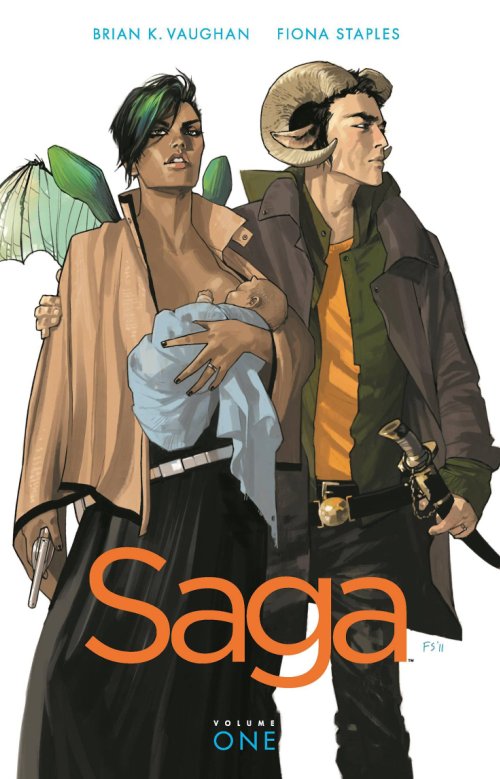
Thus, allow me to suggest another gateway, one that’s fresh, ongoing, and just released its 50th issue – Saga.

Created by Bryan K. Vaughn (words) and Fiona Staples (images), it’s a sprawling science fantasy saga with a heavy helping of just plain weirdness. Vaughn and Staples take full advantage of their chosen format to give the story a scope and a visual sense that would be impossible to pull off in another format. In the same way that 2001 epitomizes what a motion picture can be (an completely immersive audio-visual experience), Saga is the apex of what comics can be.

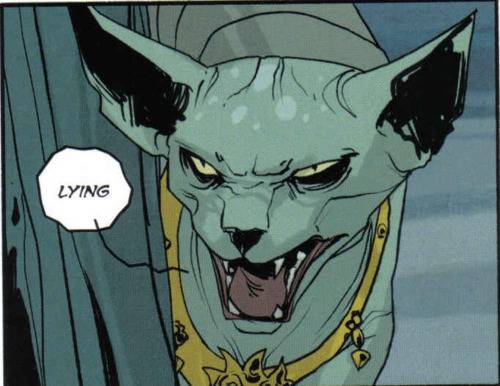
As amazing as Staples’s art is, Saga wouldn’t be worth reading without a compelling story and characters we care about. The basic setup is simple – a world, Landfall, has been at war with its moon, Wreath, for years. In the middle of the war, Alana (from Landfall) and Marko (from Wreath) fall in love and produce a kid, Hazel (who is the narrator), who really shouldn’t have been able to happen. They try and survive in a world where damned near everyone wants to hunt them down, from soldiers to bounty hunters with sentient lie-detecting cats.

Lying_Cat_Saga_001

Along the way, as they blast from world to world in a spaceship that is also a tree (did I mention this is science Fantasy? Definitely a capital “F”), collecting other outcasts to form a very bizarre, very fractured, but very sweet extended family (as this article points out, Saga is almost impossibly diverse in its characters). Vaughn has said that’s what Saga is really about:

I now have two kids. I first starting thinking about this while waiting for our first kid. And I always used writing as an outlet to talk about my fears, concerns, and passions. I really wanted to talk about creating new life. And I found talking to my friends who are strangers to the fatherhood experience—I would watch them start yawning or looking at their watch–difficult. If you’re outside of that world you don’t really give a shit. When you’re living in it, it’s really exciting. So I wanted to find a way to make people who don’t have kids or who never intend to have kids feel what it’s like to be a parent.

That’s where Saga was born.

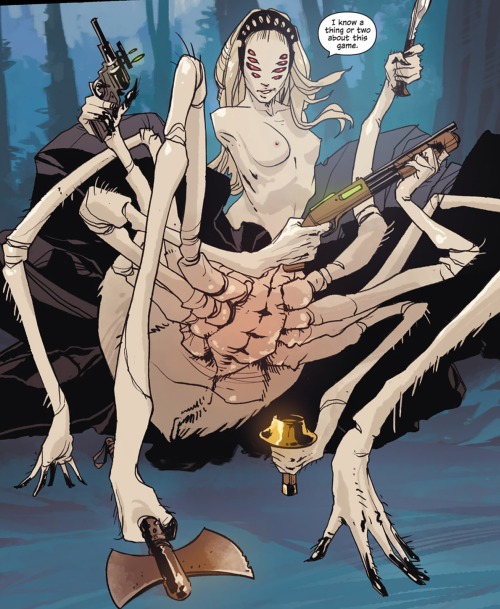
Not having kids I can’t say whether having them makes Saga more meaningful, but it does emphasize the foundation of the story. All the amazing art and “holy shit” concepts don’t add up to much if the characters aren’t ones we care about in the first place. That’s true of good fiction in general, but particularly good speculative fiction. At bottom, it’s a story about love, fear, and survival. The tree ships and arachnid bounty hunters are just gravy.

saga-the-stalk

What I’m trying say is that Saga isn’t something I recommend to comic newbies because it’s a classic (although it’s on its way to becoming that) or because it’s something, to channel one of my high school English teachers, “that well read people know.” It’s because it’s a great story, involving people you will care deeply about, told across a stunningly inventive backdrop. I mean, really, what else do you need?

SagaVol1

Weekly Read: Children of Time

One of the great things about speculative fiction is that you get to write about characters who aren’t human. One of the hard things, as a result, can be making readers care about characters who, at least on the surface, aren’t anything like them. To be able to pull that off is something special.

Children of Time starts off with human characters who seem all to relatable. A ship is in orbit around a planet that’s been freshly terraformed. A scientist is making ready to start a bold experiment – seeding the planet with a group of monkeys, followed by a spiffy nanovirus that will help jumpstart and guide their evolution. To “uplift” them, in the David Brin sense of the word.

Needless to say, things don’t go as planned. The experiment is disrupted before it’s really begun by a quasi-Luddite faction that things humanity going to the stars was a mistake. The monkeys burn up over the planet. The nanovirus . . . well, what becomes of the nanovirus is what Children of Time is all about.

You see, just because the monkeys didn’t make it to the planet doesn’t mean other life didn’t. Instead of finding its intended host, the nanovirus finds a species of spiders into which it can insert itself. It does and, for half the ensuing chapters in Children of Time, Adrian Tchaikovsky puts us in the brains of various spiders as their society develops over thousands of years. That society itself is a supreme feat of imagination on Tchaikovsky ‘s part, but what really matters is that you come to care for these non-human beings, creatures that are more likely to conjure nightmares than sympathy.

That’s certainly true for the crew of Gilgamesh, the humans who make up the other half of the chapters. After the experiment at the beginning of the book goes awry humanity itself follows suit. Eventually, the only humans left alive are the crew of Gilgamesh and its “cargo” – hundreds of thousands of people in suspended animation.

It’s no spoiler to say that the humans and spiders have a coming together (two of them, sort of) and while the ultimate confrontation is wonderfully done, the paths they take getting there are equally fascinating. While the spiders slowly develop a technologically advanced society (the things they do with webs), humanity on board Gilgamesh is slowly falling apart. As seen through the eyes of a “classicist,” who gets woken up every so often to observe another crisis, it’s like the entire universe is falling apart at the seams. By the time the end comes the desperation among the humans is palpable.

Along the way, Tchaikovsky uses his characters to explore lots of big issues in a classic sci-fi way – religion, politics, and the like. More than anything, however, it shows how two intelligent groups can nearly destroy each other based mostly on the fact that they don’t have accurate information about the other group. The ending keeps this from being completely depressing, but it is kind of bleak. The day is saved by something the real world doesn’t have, after all.

There’s a lot to unpack in Children of Time. It doesn’t shy away from the fairly bleak state of the human condition, while suggesting that it’s not something specific to humans. And it does offer some hope, for while the source of the ending isn’t real, the effects could be. Either way, this is one of the best books I’ve read in a while (and I don’t see any way to adapt it to film). I was completely blown away. Highest recommendation, of course.

ChildrenofTime

Weekly Read: The Long Way to a Small Angry Planet

There are a lot of things to like about The Long Way to a Small Angry Planet. It’s set in an interesting universe where humans aren’t dominant and there are lots of interesting alien species to deal with. The characters, for the most part, are interesting and fun to spend time with. And the writing it pretty quippy and moves at a good clip. It should be a fun read and it is, but it doesn’t go much further than that.

I’ve read a lot of commentary about the book that it’s about characters and not plot. While that’s true it wouldn’t be correct to say “nothing happens” in the book. Several things – exciting things! – happen. It’s just that they’re resolved fairly easily and don’t really have any impact on things going forward.

Take, for example, an early crisis. The ship, Wayfarer, is off on the titular long trip in order to bore a new wormhole in space. Fairly early in this journey they’re set upon by pirates! A sticky enough situation, made all the more so by the fact that the ship’s captain is a pacifist and, thus, everyone on the ship is unarmed. That is a fantastic twist on a typical space opera trope. It’s not really a spoiler to say they talk themselves out of it. It’s a pretty exciting scene.

Yet it has almost no residual effect. One character has a brief bit of PTSD, but it goes away just as quickly. More annoying, our heroes escape the pirates by giving them some of their supplies – supplies which, apparently, were completely superfluous to the main mission. Thus, while there’s talk about getting reimbursed for them, there’s no complaint that it will make their job harder or require extra stops along the way. It’s a problem, it’s solved, and the book plows ahead.

The effect is kind of like an old-fashioned TV show from before the current golden age of serialized TV. Each episode is basically a standalone story, with little ongoing plot to drive things along. Thus, along The Long Way . . . we get “episodes” for just about all of the Wayfarer’s crew that all play out the same way – some crises appears, it’s resolved, and everyone goes on their merry way.

Consider Rosemary, who if not the main character of the book (it bounces POVs around a bunch), is at last our audience surrogate, the new person on the ship who has to learn how things work (our Tim Bayliss, if you will). We know from the beginning that she has a big secret in her past. If she’s not running from something, she’s at least in search of a new start in a new life. We find out why about halfway through (her father’s a war criminal, in essence) and she worries this will impact the life she’s made on the ship, cost her friends. It doesn’t, because everyone on board is so incredibly understanding – even the alien chef/doctor (another neat touch) whose species is about to be extinct due to the war Rosemary’s father fueled. A great potential for tension is completely squandered.

And so it goes. With the exception of the ship’s algae specialist (that’s what fuels the ship – don’t ask, it’s never explained) everybody gets along swimmingly through the voyage. When his “episode” comes it falls flat because we suddenly need to care about somebody nobody else does (particular shame given the issues it raises). The goal of the actual “long trip” basically disappears once they embark, only to rear its head at the very end.

I’ve seen lots of references to “imagination” in reviews praising The Long Way . . . and that’s a spot on description. Becky Chambers let her imagination run wild in creating the universe in which the book is set. It’s just a shame more interesting things don’t happen in it. In that way it reminds me a bit of The Goblin Emperor, another book with a fascinating setting and interesting characters that didn’t really amount to much.

There’s something to be said for an author who just takes her readers and drops them into a fascinating place filled with interesting characters. Ultimately, I want a little bit more than that. Others might not care so much and, so, your mileage may vary when it comes to The Long Way to a Small Angry Planet. Still recommended, if with a little hesitation.

LongWay Cover.png

New Cover, Same Great Stories!

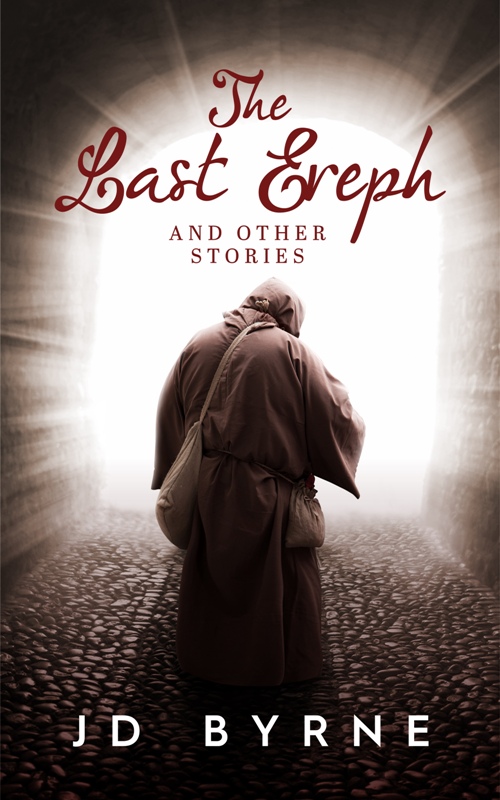
Releasing my first book, The Last Ereph and Other Stories, was a huge learning process for me. One of the things I learned was that I’m not very good when it comes to the visual side of things. I thought I could bang out a good cover all on my own. Others do it, right? How hard can it be.

Really fucking hard, it turns out. As I’ve moved forward and released other books I’ve looked back on The Last Ereph . . . and wanted to give it the suit it really deserved. Now I have:

Ereph Cover 2.0 (KDP) 500 x 800

This one is courtesy of James at GoOnWrite. But rest, assured, the stories inside (ten in all) are the same high quality as before.

Get the new, more stylish, The Last Ereph and Other Stories here:

Kindle
Barnes & Noble
Kobo
iBooks
Inktera
Scribd
Playster

The Fate of The Messenger

Last month you’ll recall I talked, in rather gushing form, about The Messenger, my project for National Novel Writing Month last year. It was a bold experiment in terms of craft – I was flying by the seat of my pants, rather than working in my more plotted out way – and in terms of style – it was to be a sci-fi romp, something a bit more fun and light than my normal stuff. November was great – I “won” NaNo – and December was all about finishing the thing up.

Well, let me tell you, December sucked. In the words of my perhaps ancestor Robert, things gang aft agley. Hard.

I expected progress to slow down some, without the motivation of NaNo breathing down my neck. For about two weeks I did pretty well, but soon enough my lack of planning caught up with me. Mind you, I didn’t even know how this story would end when I started it, which is startlingly rare for me. Even if the middle bits are squishy I usually start with an idea of the beginning and the end. The more I pushed into The Messenger the more I realized I didn’t know where it was going.

I also started to worry more and more about continuity in the story. Things are always a little out of whack with first drafts, but usually I have copious notes to fall back on. Here I didn’t and it made it easy to get stuck in particular scenes, since I had to dig back through what I’d already written to try and tie things up. More often than not I was finding that I couldn’t tie them up, not in this draft anyway.

So, just as things were getting a little grim, the Christmas break showed up. I was off the entire time between Christmas and New Year’s Day, as was the wife, so plenty of time to finish up The Messenger, right? First I got sick (Merry Xmas, huh?), then the wife took her turn. Any motivation I had for writing dried up quickly. All the doubts I was having about whether I could finish this draft piled on and, as sometimes happens, The Messenger became a smoking crater. It’s dead, at least as a complete first draft.

What does that mean going forward?

Well, for one thing, it means The Messenger is on the back burner for the time being. Hopes of having a solid draft just in need of polishing are out the window. It will take some serious work to get right, work that I’ll be putting in on The Orb of Triska and its sequels for the near future.

For another, it means my experiment with pantsing proved one thing conclusively – I can’t do it. I went out, performed without a net, and fell flat on my face. Oh well, lesson learned.

Another lesson learned is that, maybe, writing big space-based science fiction isn’t for me. I never intended for it to he “hard” sci-fi. In fact, it has a disclaimer at the beginning about how it’s more “Dr. Who than Dr. Asimov” and sticklers looking for strict scientific accuracy should look elsewhere. Nonetheless, when you start flinging characters (of various species) across the galaxy things to worry about pile up. It’s entirely possible that The Messenger may wind up as a fantasy, rather than spacey sci-fi, story.

I still like the basic story of The Messenger. I like some of the things I created to fill in the universe in which it was told. None of that’s going to go to waste, but I can’t say it’ll wind up being what I intended it to be going in. That’s the frustrating joy of writing – almost all the time you wind up with something other than what you intended.

Failure

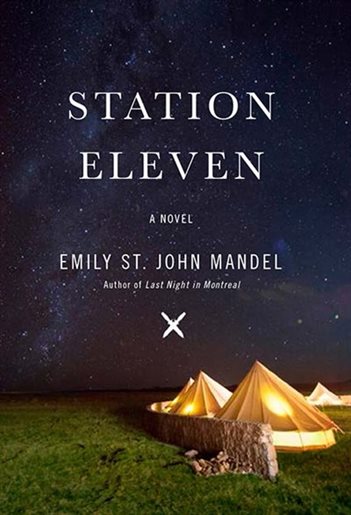
Weekly Read: Station Eleven

Usually when a book is set in a post-apocalyptic world, it’s telling one of two stories. Either it’s the story of the fall – how did society get into this fucking mess? – or it’s the story of the gritty challenge to survive just after the fall. Few stories contemplate what might happen a decade or two later, once basic survival is figured out. What then?

That’s the brilliant conceit of Station Eleven.

Sometime in the near future a global pandemic called the Georgia Flu (named after the country, not the state) roars across the planet killing off 99 percent of humanity. Using a time skipping narrative worth of an early (aka “good”) Atom Egoyan flick, Station Eleven tells the interlocked stories of several survivors trying to make sense of an empty world about twenty years in the future.

Note the word “survivors.” These aren’t just people lucky enough to be immune or otherwise avoid the flu. These characters have made it a couple of decades in this new world and have become competent at getting by. If they hadn’t, they’d be dead. Instead, they’re able to devote themselves to larger questions. How important is art and culture in a post-apocalyptic world? Pretty damned important is the answer, one I’m not compelled to argue with. It would have been nice if “art” meant something beyond Shakespeare and classical music, but it is a limited sample, after all. If there’s a Travelling Symphony out there in a wastelands doing King Lear and playing Mozart, I’d like to think there’s a band knocking around playing King Crimson and Zappa, too.

The other big question that rears its head over and over again is how much these people should remember the world as it was and try to pass along information about that world. Two decades on there are adults, either born shortly after the flu or who were young children when it happened, who know nothing of electricity and the Internet and flying aircraft. Is telling them about what they’re missing inspirational, something to make them rebuild? Or is it calcifying nostalgia, dragging them down? Theories are floated and arguments are made, but nothing’s decided. How could it be?

The time-skipping structure works really effectively. The goal isn’t to reveal some big secret, to build to a Shamalan-style “a ha!” moment. Instead it’s a way of drawing connections between characters, even as they become spread around the modern world. It leads to some disjointed spots – there’s one character in particular, front and center in the beginning just before the flu hits, whose story doesn’t really seem a part of the rest – but otherwise it’s a treat.

Where the book falls down a bit is in the overall arc of the story. As I said, there are no big moments and the closest thing to a bad guy is dispatched cleverly, but without it feeling like it’s the moment it should be. That and one section set among survivors at an airport (later turned into a “museum of civilization”) that drags on too long keeps Station Eleven from being knock out of the park great.

This isn’t a gritty survival story. It’s not a whodunit about why the world came to an end. It’s a lyrical, atmospheric, meditation on what it means to be alive in a world where so many others aren’t. Big thoughts, ones worth pondering for a bit.

Also, it led to perhaps the greatest Goodreads Q&A I’ve ever seen:

Station11Q

Needless to say, that’s not at all what this book is about. Good thing, too.

Station11

Genre Bias Rears Its Ugly Head – It’s Science!

While I was of NaNoing last month an interesting bit of news came out with regards to science fiction and other types of fantastic literature. Put simply – people don’t put as much effort into reading those stories as other types.

ReadingHard

The study went like this:

Their study, detailed in the paper The Genre Effect, saw the academics work with around 150 participants who were given a text of 1,000 words to read. In each version of the text, a character enters a public eating area and interacts with the people there, after his negative opinion of the community has been made public. In the ‘literary’ version of the text, the character enters a diner after his letter to the editor has been published in the town newspaper. In the science fiction version, he enters a galley in a space station inhabited by aliens and androids as well as humans.

After they read the text, participants were asked how much they agreed with statements such as ‘I felt like I could put myself in the shoes of the character in the story’, and how much effort they spent trying to work out what characters were feeling.

The results were, on the face, disappointing:

‘Converting the text’s world to science fiction dramatically reduced perceptions of literary quality, despite the fact participants were reading the same story in terms of plot and character relationships,’ they write. ‘In comparison to narrative realism readers, science fiction readers reported lower transportation, experience taking, and empathy. Science fiction readers also reported exerting greater effort to understand the world of the story, but less effort to understand the minds of the characters. Science fiction readers scored lower in comprehension, generally, and in the subcategories of theory of mind, world, and plot.’

Readers of the science fiction story ‘appear to have expected an overall simpler story to comprehend, an expectation that overrode the actual qualities of the story itself’, so ‘the science fiction setting triggered poorer overall reading’.

In spite of some of the breathless comments I saw online the study does not, as someone points out, imply that reading sci-fi makes you dumber, but implies that people who don’t like sci-fi won’t give it its full attention. It’s nice to have some science to back this up, I guess, but is that any surprise?

That’s the whole reason literary writers, whom I’ve complained about before, don’t like admitting that they write sci-fi or fantasy. This came up against just recently after I finished Emily St. John Mandel’s really excellent Station Eleven (Weekly review forthcoming). It’s a story about survivors of a global pandemic striving to maintain a life that’s something beyond mere survival. It’s a quintessential piece of sci-fi (or, more broadly, speculative fiction), although the author is having none of it:

Thus when Station Eleven was nominated for the National Book Award – it also won the Arthur C. Clarke awards, so take that! – some eyebrows were raised. But when something that is “literary” is it prevented from being something else? I tend to agreed with this:

And yet confusion reigns in this debate, which feels strangely vague and misformulated. It remains unclear exactly what the terms ‘literary fiction’ and ‘genre fiction’ mean. A book like ‘Station Eleven’ is both a literary novel and a genre novel; the same goes for ‘Jane Eyre’ and ‘Crime and Punishment.’ How can two contrasting categories overlap so much? Genres themselves fall into genres: there are period genres (Victorian literature), subject genres (detective fiction), form genres (the short story), style genres (minimalism), market genres (“chick-lit”), mode genres (satire), and so on. How are different kinds of genres supposed to be compared? (‘Literary fiction’ and ‘genre fiction,’ one senses, aren’t really comparable categories.) What is it, exactly, about genre that is unliterary—and what is it in “the literary” that resists genre? The debate goes round and round, magnetic and circular—a lovers’ quarrel among literati.

Listen, I get the concern of writers like Mandel – slap a “sci-fi” or “detective” genre label on a book a certain group of people won’t take it as seriously. But rather than run away from the tag and deny the reality of what you’re writing, why not embrace it? Doing so would help smash conceptions about what genre fiction is and can be. Stand up for the slighted genre kids, rather than lean into the bully who just wants to put them down.

Thoughts From an Experimental NaNoWriMo

Right – so where were we?

Oh, yeah, National Novel Writing Month, also known as NaNoWriMo. Did I have a good month? I’d say I did.

NaNo-2017-Winner-Twitter-Header

The book I started for NaNo, The Messenger, is different for me in a lot of ways. For one thing, it’s pure space-based science fiction. While I’ve written some near-future sci-fi short stories, I’ve not done anything this long or, well, spacey. For another, I started the project having done very little prep work. So to be past 50k words and looking at another month’s writing (at least) to finish it is making me a little giddy.

HappyPuppy

Not an actual picture of the author. Think metaphorically, people!

Let me explain why.

Writers generally like to divide themselves into two groups – plotters and pantsers (putting to one side the ones who don’t accept either label). Plotters, as you might imagine, are people who do a lot of work before they actually start writing a first draft. They outline, develop characters, build worlds and all that kind of stuff before ever sitting down to write “it was a dark and stormy night.” (LINK). Pantsers are the complete opposite – they do little prep before writing and are, as the name implies, flying by the seat of their pants. In truth, I think most people are a little of both. Anybody who writes exactly the same book they planned to write or really sits down with a completely empty noggin and pours out a book are few and far between.

I tend to be a plotter. Lots of that is down to writing fantasy and the heavy lifting of world building. I like to get that stuff out of the way so I can let the story develop against a fairly fixed backdrop. Still, things never go precisely as planned, even when (as with The Bay of Sins, my last NaNo project) you lay out all the chapters you think you’ll need from the beginning. I suspect it’s something like attorneys say about oral arguments – there’s the one you plan to make, the one you actually make, and the one you wished you’d made after the fact.

So The Messenger was a very different experience for me. I had about a page of notes, compiled from thinking about the story over the years, but it was lacking lots of important things. Like, for instance, the names of the main characters or any of the names of the planets or alien races they’d encounter along their way. As for the way? I had an idea of how things began, but after that? I decided to let it see where it went. I’m glad I did, because I don’t think I would have come up with some of these things ahead of time.

It’s particularly interesting to do this one right after finishing the first draft of The Orb of Triska. That has a lot of work done on it before I started writing and I always felt like I knew where I was going. I think that first draft is a much better, more coherent final product, but, of course, neither one of them are “finished” after a first draft. It will be interesting to see how the final products compare once they’ve been polished up.

So that’s how I spent my November.

Also, we got new puppies:

ZariaKalindi

Zaria (L) and Kalindi (R) are ready for their album cover.

How you all been?