Same As It Ever Was

On my old blogs, where I discussed legal stuff more often, I talked about how conflicted defense attorneys are about defendants who “roll” on each other – that is, who testify against another defendant in return for either a reduced sentence or beneficial plea bargain from the prosecution. That conflict came to mind while reading about a similar situation that occurred on the other side of the planet.

The Master of Confessions is journalist Thierry Cruvellier’s account of the trial of “Duch” before the name, the international court currently trying former members of the Khmer Rouge for crimes against humanity. Duch was the lead interrogator at the Tuol Sleng prison I mentioned a while back, also known as S-21. Duch’s job was to get people to confess not only their crimes against the revolution, but to rat out others in their “line,” a process known as denunciation.

One of the interesting things about the book is that Cruvellier isn’t writing history. He’s writing about it, but he’s doing it from the vantage point of his own observation of the trials (and other similar trials around the world). Thus, it gives him room to make astute observations that might not be so well placed in a work a pure history.

On the subjection of denunciations, he writes (paragraph breaks added by me):

The court openly hates the very idea of denunciation. Given that at S-21 thousands were tortured and mercilessly killed, the court vehemently rejects the validity of the denunciations obtained there. But in other circumstances, the international legal establishment can be more accommodating.

Mandatory denunciation (though obtained without torture) is a crucial element in many confessions made before international tribunals and, in these circumstances, lawyers find that their consciences remain quite untroubled by it. On the contrary, they actively encourage it. A defendant who pleads guilty to a UN tribunal is told to denounce his accomplices if he wants to win over the prosecutor and earn the judges’ leniency. He isn’t forced to name names under torture, of course, but if he wants to make the most of his guilty plea and obtain a lighter sentence, then he has no real choice but to comply.

Rwanda’s community courts, known as Gacaca courts, which have been so misguidedly praised over the past ten years, feed off of mass denunciations. Though they don’t torture people, snitching is inextricably linked to confessions in Gacaca courts. The result is an all-consuming, rampant, and poisonous judicial operation that had produced more than a million suspects. Throughout Rwanda, the pressure to name one’s accomplices has given rise to slander so great it wouldn’t be out of place in the archives of S-21.

‘Denunciation is another form of lying,’ Francois Bizot, a survivor of imprisonment by the Khmer Rouge, says in court. International justice, it seems, only hates lying in certain circumstances.

This captures the essential issue when it comes to defense attorneys and rolling codefendants. On the one hand, their testimony is inherently suspect because it’s being given in return for something of value – more lenient treatment. Indeed, a federal court once recognized this for what it is – bribery – but swiftly backpedaled upon realization that banning the practice would bring the criminal justice system screeching to a halt. On the other hand, providing what the federal system calls “substantial assistance” is often the only way one of our clients can help reduce their sentence.

Which goes to show, I guess, that “justice” and what it looks like isn’t so different, whether you’re dealing with petty drug dealers in West Virginia or the architects of mass murder in Cambodia.


Not Getting It Right Versus Getting It Wrong

A little while back someone in one of the online writers’ forums I haunt asked about what, within our particular area of real life expertise, makes us throw up our hands when we see it in fiction. This was particularly in a sci-fi and fantasy context, so my own area of expertise – criminal law – doesn’t really come into play. But reading the discussion and thinking about the question made me realize there is a fine line in fiction between not getting something right and actually getting it wrong.

Exhibit A, since it’s right in my wheelhouse – Law & Order. I’m talking the mothership here, the one that effectively split its time between the courtroom and the police investigation. To put it bluntly, Law & Order very rarely actually got things right, but it didn’t very often actually get things wrong. The former is forgivable, understandable, and even to be encouraged in the interest of drama. The latter just makes me want to punch the TV.

An episode that was on the other day while I was knocking around the house provides great examples of each. “Charm City” is the first part of the first crossover between Law & Order and my favorite cop show of all time, Homicide: Life On the Street. A gas bomb attack in New York has ties to a similar attack years earlier in Baltimore, bringing Baltimore detectives to town to crack the case.

The eventual trial provides an example of the first situation – not getting it right, but in the understandable service of the narrative. Curtis testifies at trial and, among other things, tells the jury that a partial thumbprint was found at the crime scene and it matched the defendant. In no way would a detective testify about this in a real trial. That evidence would come in via an expert witness, probably from the state or city’s crime lab. But we’ve never seen a crime lab expert in this episode, so it’s a waste of narrative resources to introduce an entirely new character to pass on this single (uncontested) fact. Curtis is a main character, by contrast, so give it to him to carry. It’s not right, but it’s not all that wrong, either.

By contrast, earlier on is the kind of thing that Law & Order routinely does that makes me howl. The two New York detectives question the suspect, who gives up nothing. Their boss lets the Baltimore guys take a run at him. Homicide viewers knew that Pembleton’s great skill was extracting confessions in “the box,” and, he does, but only after the suspect says he “can’t talk about it.” Pembleton responds, “you mean you’re unable to talk about it, or you just don’t want to talk about it?”

The confession winds up getting suppressed because, in the Law & Order universe, “I can’t talk about it” is an invocation of the right to remain silent and the right to counsel. There’s even a good back and forth about how it doesn’t matter that such things will “fly” down in Baltimore. In truth, such things “fly” everywhere that Supreme Court precedent controls. Invocation of counsel, or the right to remain silent, has to be explicit before it keeps the cops from barreling on with their inquiries.

The ruling was, simply, TV-land bullshit, an attempt to throw an obstacle in the path of our heroes. This was getting it wrong, seriously wrong, more than just not getting it right. And, in the end, it didn’t really make a difference (the guy was convicted anyway, without much drama). The overly-defense friendly law is a staple on Law & Order, but it’s usually at least closer to getting it right than this.

In the end, does it really matter? No, because the vast majority of people watching Law & Order aren’t lawyers, much less criminal defense lawyers who might zero in on that kind of thing. For most viewers it’s just an obstacle for our heroes to overcome. That, after all, is why we’re watching. Which is why it’s important for “experts” to back off a little bit and give fiction some room to breathe. Everybody sing along:


Weekly Read: Dead Wake

On May 7, 1915, a torpedo struck the liner Lusitania off the coast of Ireland. It sank in less than 20 minutes, taking almost 1200 lives. It was a cause célèbre during World War I, a conflict that was just settling down into a lengthy stalemate of trench warfare. Not for nothing did those lost include dozens of American citizens. The United States had not yet entered the war.

That the sinking of the Lusitania is tragic is without question. That the people killed were innocents who had nothing really to do with the war being fought around them is equally without question. One would think their story might make for a gripping read. Maybe it is, but Dead Wake isn’t it.

Erik Larson is one of the stars of popular history. In books like The Devil in the White City (about the 1898 Chicago World’s Fair and the serial killer who stalked it) and Thunderstruck (about Marconi’s development of wireless technology, and its relation to a grisly murder), he weaves multiple story lines together in a way that sheds light and provides dramatic structure for whatever historical event is the main focus. He does the same in Dead Wake, but it just doesn’t work as well.

Part of that, sad to say, is because he spends an awful lot of time aboard Lusitania before it sinks. To be blunt – the people he introduces us to just aren’t very interesting. To be more specific, the only thing interesting about their journey – their story in this book – is that the boat sinks. But we already know that, so where’s the dramatic interest? Much as I hate to say it, perhaps a fictional story is the better way to do this, ala Cameron’s Titanic.

That compounded by the fact that, looking back with a hundred extra years of history between now and then, the sinking of Lusitania doesn’t seem like the great crime it once was. After all, we’ve seen the incineration of entire cities and indiscriminate terrorist attacks since then. Lusitania being sunk was a horror, but (1) it wasn’t a neutral ship, however much time Larson spends on how the Germans dealt with such; (2) it was carrying armaments; and (3) it sailed into a declared war zone after specific warnings about the danger of doing so.

Also, for all the furor that the sinking caused, it didn’t really change anything. We spend a lot of wasted time in Dead Wake with a love-struck Woodrow Wilson, presumably because of the impact Lusitania’s sinking had on the American entry into the war. But that didn’t come until two years later and, at any rate, was part of the (arguably more interesting) aftermath of the sinking which Larson sails past (pun intended).

In addition to the strands of the Lusitania and Wilson, there’s a third bit where the book is at its best – on the U-boat that sunk the ship. Larson does great work in describing the nature of submarine life at that time. Not only does he cover the technical aspects, but his descriptions of the innards of the boat (and the sweaty guys aboard it) really come to life. He touches on the issues submarines brought to the rules of war, but only briefly. I wish he had spent more time diving deep into the philosophical depths on that one.

As I mentioned above, what’s arguably most interesting about the sinking of the Lusitania is what happened after the ship disappeared beneath the sea. The UK, in the middle of a war, had good information about what exactly happened, but tried to frame up the ship’s captain anyway (for reasons that are unclear). Americans were outraged, but did nothing about it – hard to imagine such restraint prevailing now. And there are so many unanswered questions about the sinking that conspiracy theories have sprouted up, fed by the continued secrecy of various sources of information. This would have been a fertile area for exploration, more so than the dull daily lives of passengers on board the ship.

One thing that Larson does through the book is highlight the power of coincidence and, for lack of a better word, “luck.” Lusitania was delayed about two hours on its way out of New York because it had to stop and get passengers from another liner. Had it not, it would have passed by the U-boat in the fog, preventing any attack. The ship’s captain, unaware of the U-boat lurking nearby, unwittingly turned the ship in a way that made it the perfect target. Things like that reinforce the randomness that often helps produce momentous events.

Dead Wake isn’t a bad read. It’s quite informative in spots and well written (as always). But it pales in comparison to Larson’s earlier work.

DeadWake

My Watery Bridge Too Far

I’ve talked before about the flying snowman point, the point at which a reader or viewer is no longer willing to suspend disbelief to enjoy a story. There’s a similar thing that happens when certain things are depicted in the narrative, things that are so off putting that they ruin things, or at least leave a sour aftertaste.

I’ve read some people for whom that thing is rape, either survivors who don’t want to relive their trauma or people who just think it’s something that is too casually thrown around in fiction. For my wife it’s animal abuse or neglect. She can rarely push past that, once it comes up. I’ve always thought of myself as tougher than that, able to shrug off anything in the service of a narrative. A reader’s version of a cast iron stomach. Apparently, I was wrong.

Last year my wife and I took our belated honeymoon in Cambodia. It’s a beautiful, historic place, filled with friendly people. But it’s also the scene of one of the worst authoritarian regimes of the 20th Century. During the reign of the Khmer Rouge in the 1970s up to 2 million Cambodians died, either worked to death in a program of rural fixation or outright murdered as enemies of the state.

While we were in Phnom Penh we went to the Killing Fields outside the city, as well as the Tuol Sleng prison, from which many of those doomed people came.

TS1

Tuol Sleng is a former school and it’s been left largely in the same condition in which the Vietnamese found it when they rolled into the city in 1979. In fact, rooms in which prisoners were murdered just ahead of the Vietnamese advance still have blood on the walls and ceilings. Of the 17,000 of people sent to Tuol Sleng only a dozen survived (we met one of them). It’s easy enough to be horrified at the place just be using your imagination.

Not that you’re limited to that. Several rooms are given over to exhibits about what went on there. In one room there are implements of torture, as well as paintings done by a survivor of the various torture techniques. Take a look at this picture:

TS2

See the painting in the right, behind the rack upon which victims would lay while their fingernails were pulled out? It depicts waterboarding, simulated drowning, which was a crime against humanity when the Khmer Rouge did it, a war crime when the Japanese did it in World War II, but mere an “enhanced interrogation technique” during our glorious War on Terror. Whatever it’s called, it’s torture and the thought that it’s been done in my name turns my stomach.

Which brings me to Channel Blue, a comic sci-fi novel by Jay Martel. In the book a down and out Los Angeles screenwriter, Perry, accidentally learns that the Earth is actually a huge reality TV show run for the benefit of an alien race. Even worse, ratings are down and the show’s been cancelled – in other words, the Earth is to be destroyed. Perry does his best to save it, but each attempts tends to fail miserably and leads to Perry suffering in all kinds of ways.

The other night, while going through another of these episodes (it gets kind of tedious), Perry is identified as a potential terrorist, taken to a secret location, and waterboarded. Not for any good reason (he’s back on his way quickly enough), but, there it is – a depiction of waterboarding in what’s otherwise been a funny, light bit of entertainment. It stopped me cold.

It’s not that I object to any depiction of torture in literature or film. But it’s one thing to depict it as part of a serious work, perhaps shedding light on the brutality of the whole process. It’s quite different to put it in a comedic work even if the act itself wasn’t played for laughs.

But if that’s true, what about one of my favorite books (and others) of all time? Very early on in The Hitchhiker’s Guide to the Galaxy the entire planet Earth is destroyed. It’s played completely as a joke – the Earth is destroyed to make way for a hyperspace bypass. Billions of people are killed. That’s never bothered me – why not?

I think it comes down to realism, oddly enough. Realistically, the Earth is not going to be destroyed, certainly not to make way for a hyperspace bypass by an alien race spouting awful poetry. The idea is so absurd that it’s not worth taking seriously. By contrast, waterboarding of alleged terrorist suspects is something we’ve done, and not in the recent past.

I’ll admit this is probably not a rational response. Most things like this are more visceral than intellectual (although not all). There’s nothing wrong with that, so long as people recognize it. I guess I do now.

Weekly Read: The Final Empire

As I said the other day, I’ve finally gotten around to discovering the work of Brandon Sanderson. He’s perhaps best known as the guy drafted in to finish the Wheel of Time series after Robert Jordan died. But he’s a prolific author in his own right and one of the hottest fantasy writers going (I swear there was one of those “a bunch of fantasy series that should be adapted for TV” lists that was made up mostly of his stuff).

Mistborn appears to be Sanderson’s magnum opus, comprising two trilogies and some other associated works. The Final Empire (or simply Mistborn, in some quarters) is where it all began. It’s a pretty fun read that does a good job of setting up the world in which Sanderson is playing, but it’s not without its faults.

The most intriguing feature of Mistborn is it’s system of magic (if that’s what it is), which is tied to the use of metals by particular people. The main branch is called allomancy and allows a person to “burn” a particular metal (already ingested) in order to enhance physical and mental abilities. A few people can use one particular metal with skill (although, naturally, the book is full with characters who can). But a very select few, the Mistborn, can burn all of them, turning them into, essentially, superheroes. There’s a less developed system, feruchemy, that also allows people to use metals in interesting ways.

Sadly, this system is dropped into a world that plies fairly common waters, with a black-hearted despot ruling a country full of put-upon subjects. To be fair, said subjects aren’t really bucking for rebellion (at least at first), which is a change. But the overall arc of the story is pretty clichéd. I thought, for a while, the big bad, the Lord Ruler, might be a more complex character than it appeared, but that didn’t come to fruition.

Allomancy also suffers from what I find to be a common fault in fantasy – it’s not very democratic. That is, you’re either born an allomancer (and of noble blood) or you’re not. And while it’s certainly up to each person to develop their inborn talents, there’s no question of someone really upsetting the magical applecart. Compare, for instance, the magic system in Jonathan Strange & Mr. Norrell, which implies that anyone with sufficient knowledge can perform magic, regardless of birth or station.

Taking us through this world, naturally, is the young allomancer just coming into her powers, Vin, and her swashbuckling mentor with a dark past, Kelsier. At least they each have some interesting things to work through. Vin, in addition to being a budding allomancer, gets thrown into the deep end as an undercover agent in the halls of the aristocracy, while Kelsier has to deal with the growing quasi-religious reputation arising from his cheating death well before the book begins.

Kelsier’s main problem, however, is that he’s too damned competent. That’s particularly apparent once he’s dead (you read that right). There’s a point where it appears the grand plan to which our heroes have been striving is in tatters, almost a complete failure. It’s a setback that, nonetheless, presents some opportunities, if seized. Turns out, this was all part of Kel’s grand plan, which means it wasn’t in tatters at all. It comes across as trick on the reader and, worst of all, doesn’t even serve as a good basis for what Vin eventually does to win the day.

There’s also one technical issue, an odd choice from Sanderson that I can’t quite figure. For almost all of the novel the two point-of-view characters are Kel and Vin. We see everything through their (allomantically enhanced) eyes. Yet, as the book winds toward a conclusion, a couple other POVs pop up. These aren’t new characters, but ones who have been around all along. The new, scattered, POVs don’t really add to proceedings and threw me on my back foot because of the switch. A head scratcher, that.

One funny thing about The First Empire. As I read comments on Goodreads and whatnot, the more negative comments focus on how “slow” the beginning is and how exciting the climax is. I’m just the opposite. I loved the early world building and thought the ending felt rushed too by-the-numbers. To Sanderson’s credit, the book actually ends, while easily setting up the next volume in the series. That’s too rare a find these days.

The Final Empire isn’t without its flaws. But Sanderson’s built and interesting world, one I’m interested in revisiting. Hence, I already have the next two volumes downloaded, ready to consume – the ultimate endorsement!

Mistborn-cover

Weekly Read: Darkness at Noon

An awful lot has been written about Darkness At Noon, Arthur Koestler’s searing portrayal of a Communist revolutionary brought down by the inevitable logic of his own ideology. Hell, this review in the New York Times when it initially came out in 1941 sums things up pretty well. It’s fascinating, thoughtful, and ultimately tragic. On that most people agree, so I’m not going to waste time going on about its strengths here.

I’m more interested on a couple of things that popped into my head while reading it about Rubashov, the doomed protagonist. The TLDR version of the plot is that Rubashov was one of the leaders of the Russian Revolution (the country isn’t specifically named, but it’s identity is hardly concealed) who, during the pre-World War II purges by Stalin was caught up in the machine he helped create. It’s not much of a spoiler to say that it costs Rubashov his life, as it did Nikolai Bukharin and the other Old Bolsheviks upon whom the character is based.

Rubashov spends the entire book in prison, although we learn about his earlier life through flashbacks. What we see is someone who is an experienced, if not practiced, prisoner. He knows to calmly pace around his cell as a means of exercise and as a way to keep his mind clear. He has no problem using code to talk with the prisoners on either side of him through the walls of their cells. More than anything else, he doesn’t freak out.

In fact, that’s what is most interesting about Rubashov as a character. The typical person thrown in prison by a tyrannical state, mentally tortured, and force to confess to ridiculous crimes is a fighter, a person in constant resistance. We see how he spits in the face of authority, struggles to retain any control over his life that he can. In other words, he goes down fighting. Rubashov doesn’t do any of that. It would be wrong to say he accepts his fate. He does spend most of the book trying to talk his way out of execution, after all. But he does it with the knowledge that it will most likely be futile.

The futility is due to the system itself, in which he played a major role. Not only was he an early loyal fighter for the Revolution, he was a philosopher of sorts, particularly good at spreading the message to others. But when you’re fighting for the Revolution, everything gets viewed through the prism of whether it’s revolutionary or anti-revolutionary. Not only is there no middle ground, there are no topics that are immune from its grip. To paraphrase Christopher Hitchens, ideology poisons everything.

That’s best exemplified by a fellow prisoner, Bogrov, who was convinced that the nation should build fewer, bigger submarines (with a better range), as opposed to building more, but smaller, submarines. As Rubashov’s interrogator explains, both positions were valid from an engineering and economic point of view, but they had radically different impacts on Revolutionary theory. Larger submarines with more offensive capability meant prioritizing a global Revolution, while the smaller and more numerous submarines signaled self defense and strengthening the Revolution at home. Number 1 (Stalin) favored the later course, so poor Bogrov was branded counter revolutionary and dealt with in the only way such things can be dealt with – “liquidation.”

What’s amazing is how much this part of Darkness At Noon still resonates today. In modern American politics there are very few issues where there is a reasonable middle ground, at least when it comes to pundits and shouting on social media platforms. The other side isn’t just loyal opposition, it’s the enemy. Their policies aren’t just wrong, their evil, immoral, and (in the terms of the novel) anti-revolutionary. Regardless if you’re on the left or right, you think you’re the revolutionary one, of course. Not only does such simple minded mudslinging make it difficult for anything of importance to be done, it leads to reductive thinking about the other side. If they’re evil, if they’re immoral, if they’re leading the nation to ruin, then liquidation really isn’t that farfetched as a solution is it?

That’s why I’m a little disappointed to see some readers (in Goodreads commentary and whatnot) dismiss Darkness At Noon as a product of its time, an interesting historical curiosity, but not much more. While it’s true that the specific ideology on offer in the book is largely a thing of the past, the risk of what unchecked loyalty to an abstract ideology can become is very much a lesson that transcends the specifics of the Russian Revolution. Ideologues become obsessed with purity, an obsession that will inevitably turn on fellow ideologues once the people who everybody agrees are impure are purged at the beginning. Nobody is ever pure enough.

The snake will always eat its tail, unless its tempered by some contrary vision and some humanity. That’s a lesson worth learning, regardless of the specifics of how it’s taught.

1995darknessnoon-cover-400

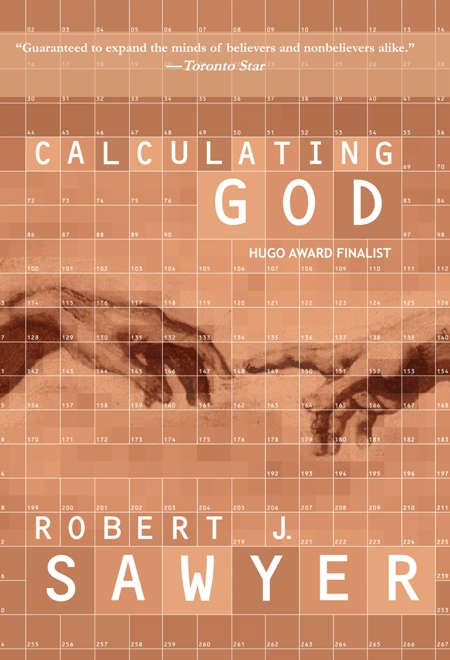
Weekly Read: Calculating God

It’s a hell of an opening for a book. A six-legged alien lands on earth. He doesn’t land in Washington, DC in front of the White House. No, he lands in Toronto in front of a museum. And he doesn’t ask the nearest passerby to “take me to you your leader,” he goes to the front desk and inquires of the security guard if he might speak to a paleontologist.

So begins Calculating God, Robert Sawyer’s twist of one of the most beloved tropes in science fiction.

That trope is the alien who comes to earth to share the advanced knowledge of his species with humanity, often for good, though sometimes for ill. Think Klatuu from The Day the Earth Stood Still or the Overlords of Arthur C. Clark’s (and SyFy’s!) Childhood’s End. Hollus, the alien in question for Sawyer does the same, but with a twist – she’s come to share the Good News.

Well, not quite. But she’s looking for God. Actually, she’s a believer, certain that there was an intelligent designer. Her cancer-riddled human counterpart, Tom Jerrico, is not. Thus the usual frame of received wisdom from aliens is flipped. Thus ensues a lot of talking, of the vaguely scientific and philosophical variety, about the possibility of an intelligently designed universe.

To be certain, this is not a serious exploration of the issue. That’s because Sawyer stacks the deck, adding in a few additional “facts” known to the aliens but not us that pushes well beyond the basis for modern intelligence design or “Goldilocks” theorists. Rhetorically it’s a cheat, but dramatically it’s quite interesting. Tom, after all, is a man of science as well as an atheist and skeptic. If anyone should be open to new evidence about a feature like the existence of God, it would be him (contrary to popular belief, most of we atheists don’t claim to know for certain God doesn’t exist, just that we haven’t seen proof of his/her existence). Given that, it’s silly for people to get upset about the arguments presented and Tom’s eventual “conversion,” given that, to paraphrase MST3K (talk about resurrections!), it’s just a book and folks should really just relax.

In this sense, Sawyer’s book hasn’t aged well. In 2000, when the book came out, it might have been possible to give the benefit of the doubt to those arguing “intelligent design.” However, just five years later in a landmark court decision, it was revealed that intelligent design purveyors are simply religious folks trying repackage creationism into a “science” they can shove into public schools. The hilarious find and replace evidence in that case speaks for itself.

Not that those people are interested in the same kind of designer as the aliens Sawyer constructs. Their designer is just another advanced alien intelligence, one so far ahead of the rest of us as to appear magical (kind of like the Vorlons from Babylon 5, now that I think of it). The aliens aren’t interested in saving souls, condemning sinners to hellfire, or purging heretical ideas. That the book ignores that this is true for so long is one of its primary faults.

But far from its only one.

For one thing, the book is awfully talky. Which makes sense, as the main interest is in Hollus learning about Earth’s history and how that plays into her theories about a created universe. But it can be kind of dull and doesn’t have any real tension to it. In addition, Tom is a pretty bad foil for Hollus (he turns Occam’s Razor from a guidepost into dogma) – more stacking of the deck. For most of the book the only breaks are Tom’s maudlin asides about his cancer, which don’t add much to things.

Sawyer does something about this in the last third of the book, but in incredibly ham-handed fashion. He introduces to Arkansas Christian terrorists – one is even named Cooter (the other is JD – thanks Robert!) – who bomb abortion clinics and, eventually, shoot up a bunch of priceless fossils at the museum. Putting to one side how these rednecks ex machina manage to get into Canada after first blowing up a clinic in Buffalo (but, remember, this was before 9/11), their stories end when they’re both killed at the museum, so they come and go so quickly and without any real impact that you’re left wondering just what the point was.

The second attempt at action fares better, but makes you wonder why it hadn’t come earlier. A celestial event that should destroy life on Earth (and the other alien worlds) is blocked, literally, by the hand of God, leading the aliens to pick up and head to that part of space. Naturally, cancer-ridden Tom comes with them – who wants to spend your last days with your loving prop family, anyway? What plays out frantically in the last bit of the book might have been interesting with some more room to breathe, but it’s so rushed that you just don’t care.

The jaunt to the stars also highlights how the alien technology conveniently moves at the speed of plot. Yes, they’re advanced enough to travel at near light speeds from star to star. No, sorry Tom, they’re not any more advanced than late 20th century Canada when it comes to treating cancer – not only do they not have a cure, they don’t even have a better way of treating it. But, good news! In spite of the fact that you’re lurching toward your death bed, they can put you in suspended animation (twice!) for the space trip! It just doesn’t make much sense.

All this makes the book sound worse than it is. It’s a fairly quick read, has a fun premise, and raises a couple of interesting ideas. It could have been a lot more engaging and epic, however.

CalculatingGod

The Trouble Of Quantifying Art

It’s received wisdom that movies adapted from written material are, to steal a phrase from an excellent album by The Tangent, not as good as the book. I tend to agree with that wisdom, but there are some notable exceptions (Dangerous Liaisons, The Sweet Hereafter, LA Confidential). Is there some way we can tell, with math and numbers and stuff, which ones work better than others?

No. No there isn’t.

That doesn’t keep people from tying. Back when the last part of The Hunger Games film saga came out, stats guru Nate Silver purported to identify the 20 “most extreme cases” of film adaptations that failed to live up to the quality of their book source material. When I clicked the link I was actually hoping Silver might have broken out of his usual routine and embraced the ambiguous in the world.

Alas (footnotes omitted):

there are extreme cases where book-lover rage is justifiable. Which cases? I pulled the Metacritic critic ratings of the top 500 movies on IMDB tagged with the “based on novel” keyword. I then found the average user rating of the source novel for each film on Goodreads, a book rating and review site. In the end, there was complete data for 382 films and source novels.

The results are kind of fun to look at. Remember, Silver’s most interested in the divergence between good books and bad movies, and vice versa, so a great adaptation of a great novel kind of falls through the cracks. Still, who knew that Up in the Air was so much better a film than the novel? But that list points out some of the problems with Silver’s undertaking. Is it completely accurate to call Apocalypse Now an “adaptation” of Heart of Darkness, or is it simply inspired by it? And Dr. Strangelove, while it may have adapted the plot of Red Alert, it turned the ideas of it on their head, playing it as dark satire, rather than serious, suspenseful drama (it got that from Failsafe). The reverse list is a little easier to understand, for the reasons Silver mentions.

But the real problem isn’t in the particular results, it’s in the method. Mainly, Silver is comparing apples and oranges. He somewhat admits this in a footnote, when he admits that there isn’t a critic aggregator for books like there is for films in Rotten Tomatoes. But he falters in then assuming that there isn’t a like to like comparison he can make. IMDB also has user ratings, numbers generated by fans that are more like the Goodreads ratings than Metacritic averages.

The difference is important. Every few years you’ll see a think piece like this one about how film critics don’t appear to have much influence on what movies people go see. They routinely trash the kind of big summer popcorn movies that do billions of dollars in business. It doesn’t suggest that the critics are wrong or right, just that they have a different frame of reference than fans. A critic sometimes sees a dozen movies in a week, whether they appeal to her likes and dislikes or not. The typical movie goer, on the other hand, sees one or two and tends to pick stuff he thinks he’ll enjoy. So comparing book fans to movie fans would have been a baseline for a survey like this.

Another problem, that Silver doesn’t approach at all, is one of scale. Put simply, even really popular books are read by orders of magnitude fewer people than see adaptations of them. Going back to Up in the Air, how many people read that book? Yet it did more than $166 million dollars in box office. My thought is that book fans tend to be more passionate than movie fans, more invested in their favorites. Not to mention, if most of the people who see an adaptation never read the source material, how can they compare one to the other?

Ultimately, that’s all nitpicking. Trying to reduce art to numbers is a fool’s game. Fun to play sometimes, but ultimately like trying to light a cigarette in a hurricane.

UPDATE: Or, as James Poniewozik puts it in a New York Times write up of the best in television for 2015:

Art isn’t math.

Amen.

Weekly Read: Machine Man

A few weeks ago I wrote a review of the new 3rDegree album, Ones and Zeroes Volume 1, which is about great leaps forward in life extension technology, overseen by a powerful corporation, that ultimate results in the uploading of human consciousness into a computer. I have no idea of the guys in the bad are familiar with Max Barry’s Machine Man, but they really ought to talk.

Two key refrains from Ones and Zeroes kept running through my head while reading Machine Man. One is the plea, “tell me what it means to be human?” The other is the observation that “life is needing more.” Good science fiction, of course, deals squarely with “what it means to be human” and Barry does just that in Machine Man.

Dr. Charles Neumann – Charlie to those lesser beings he allows to get within speaking distance – is a research engineer at Better Future, the kind of soulless, mega corporation that would have to have a name like that (it reminds me, over and over, of Veridian Dynamics from the all-too-short-lived series Better Off Ted). One day he loses a lower leg in an industrial accident. He gets a prosthetic leg, but isn’t much taken with it (he’s much more taken with the protheticist, Lola). As an engineer is apt to do he starts  tinkering, building a better fake leg. So good, in fact, that he decides he’s really being held back by his other “good” leg. So off it comes.

Rather than being locked away in an asylum or left penniless and unemployed because of his antics, Better Future sees Charlie as a visionary, someone who can open up a whole new market for them selling medical products to people who aren’t actually sick. It’s a neat setup, but one that only really works because of a decision Barry makes that is both fascinating and limiting.

Machine Man is told entirely from Charlie’s point of view. We are in his head (or whatever passes for his head) from beginning to end. This works really well in putting us  inside the mind of someone who comes up with a nice justification for a desperate act and follows that down the rabbit hole. On the other hand, it means we’re stuck with Charlie. In addition to being kind of a dick (we will tell you what’s wrong with everything, including you), Charlie is incredibly naive. He never thinks twice about the broader problems that Better Future’s plans may cause – indeed, he frequently protests that he only ever wanted to build parts for himself and fuck anybody else. That allows Better Future to have a hold over Charlie that a more thoughtful character would be able to shake. It’s not fatal to the book, but it is kind of aggravating.

To Barry’s credit, the devotion to Charlie’s POV means there are no bits of the narrative that devolve into a pro/con argument about Charlie’s augmentation. The argument is there, but it’s more subtle and comes from his interactions with Lola and the fact that we can’t get away from his very selfish and limited view of the world. It’s argument by example, rather than rhetoric, and works pretty well.

Which makes Machine Man seem like a dour trek. In fact, it’s very funny. Darkly funny, but still. The opening chapter, in which Charlie’s resolve to find his cell phone (without which he’d be lost) leads to the loss of his leg, is hilarious. It gets less so the further things go, but Barry never lets go of the fact that he’s telling a story that is absurd and getting more so the longer it goes on.

It’s not perfect. It’s just not believable that the goings on in Charlie’s lab – his army of assistants undergo quit the transformation – could have stayed contained within Better Future in the YouTube age. Someone would have talked or tweeted or Instagrammed and all hell would have broken loose. Barry gets away with a setting that’s almost hermetically sealed from the rest of the world. And it goes on a bit too long, with the emotional punch of a potential ending giving way to a happier conclusion.

Nevertheless, it’s a good read. One that’s bound to put music in your head, whether it’s this:

or this:

MachineMan

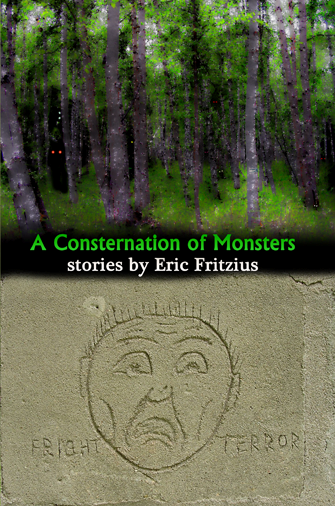
Weekly Read: A Consternation of Monsters

A group of crows is a murder. A bunch of lions hanging around is a pride. So what do you call a group of beastly, ghostly, ghoulish things all packed into one place? A consternation, of course.

In this short story collection Eric Fritzius introduces us to a whole host of supernatural creatures, some more monstrous than others. In fact, he does a really good job of weaving in stories full of humor and cleverness among the more serious and terrifying. It would be easy for a collection of monster stories to devolve into variations on the same them. Fritzius studiously avoids that.

In fact, my favorite story in the collection is a funny one, “. . . to a Flame,” which stars (although that’s not the right word) one of West Virginia’s native monsters, Mothman. Particularly, it involves a local who accidentally kills one. There are problems of disposal and the lurking possibility of a visit from Men In Black, but the heart of the story, for me, is the conversation between the shooter and the narrator in which the shooter goes to great lengths to explain his error.

My other favorite is less directly funny, but has a bit of comedic irony at its core. In “The Wise Ones” we meet an old woman and her dog who are, naturally, not quite what they seem. The story works so well because this mystical woman, when stripped of her powers, is still clever and ruthless (and, one suspects, has a killer sense of humor).

A pair of stories, “The Hocco Makes the Echo” and “Puppet Legacy” involve the same character in a different way. Aaron is a child in “The Hocco . . .” when the titular beastie makes its appearance. Then in “Puppet Legacy” we see an older Aaron who discovers a monster of an entirely different type in his own family. It’s interesting to see the two stories play off against each other.

Add to all that stories about the real fate of Elvis, the strangest boating disaster you’ve ever heard of, and a wolf with a view of some very human monsters and there’s a lot to sink your teeth into here. It being a short story collection some stories work better (as I’ve said before) and some just don’t land, but the ratio of what worked for me versus what didn’t was very high.

A Consternation of Monsters is well worth the time if you like weird tales filled with weird creatures. Just don’t read it alone with the lights off!

Consternation Cover