Weekly Read: Kindred

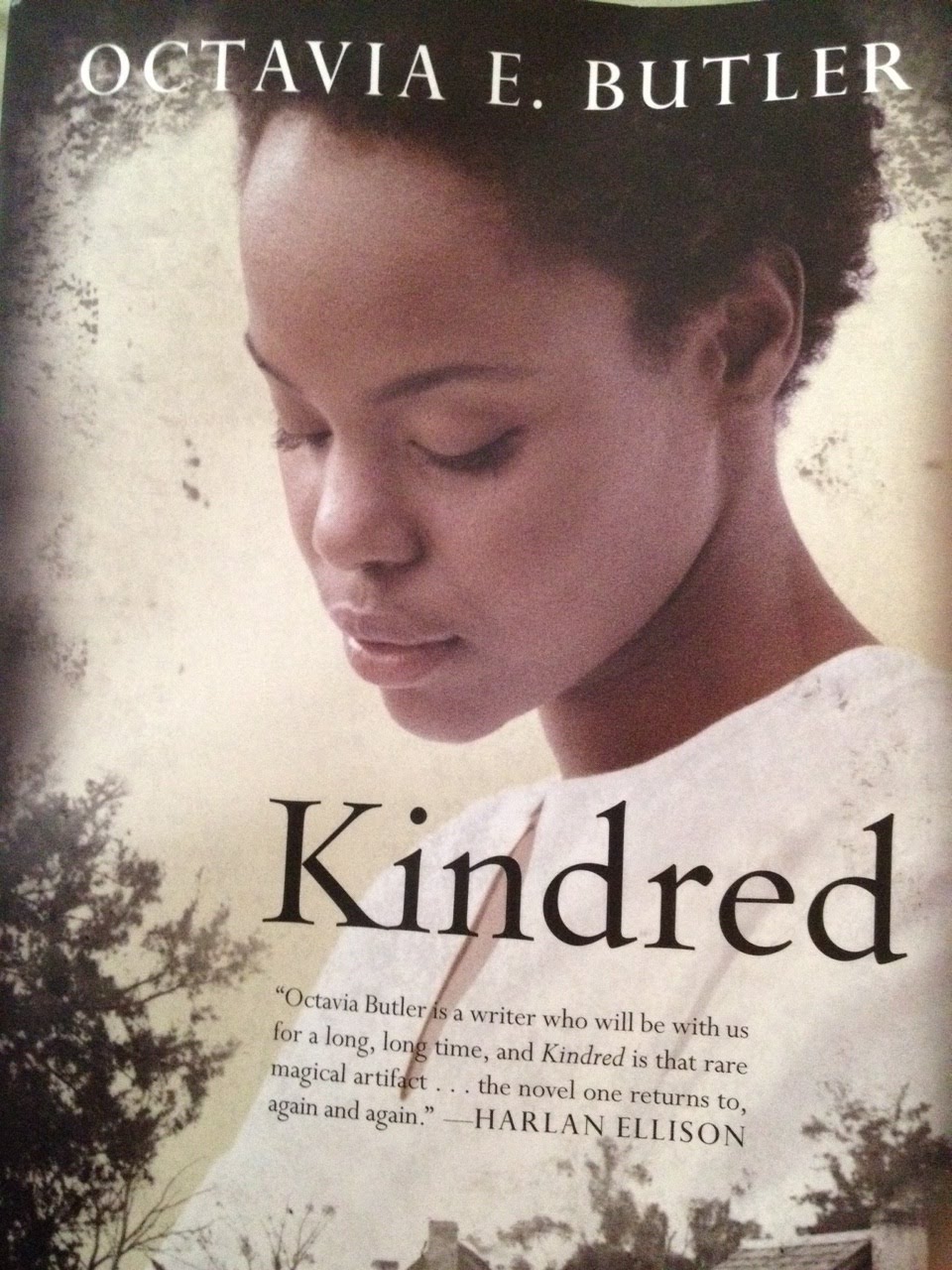
It was completely coincidental – honestly – that I started reading/listening to Kindred when the latest national debate about the Confederate battle flag sprang up. Still, the timing was auspicious. In a world where 12 Years a Slave can bring the brutality and savagery of slavery into your living room it’s worth remembering that reading is the best way to really get inside someone else’s experience.

Dana is a modern (the book is set in 1976) African-American woman living with her husband in Los Angeles. They’re both writers, she having just sold her first short story (to The Atlantic – ah, how nostalgic!). Everything’s great until, one day, Dana is pulled back to a Maryland plantation in 1819, drawn there by the peril of a boy named Rufus Weylin. He’s drowning. Dana saves his life. Dana is then repeatedly drawn back to save Rufus at various times in his life.

But here’s the thing – Rufus’s father is a slave owner who has numerous people in bondage to work the plantation. Oh, and also? Rufus is Dana’s distant relation. Meaning, if he dies before he produces the offspring that is also Dana’s ancestor, she may die, too. As a result of all this, Dana eventually spends months on the plantation experience life as a slave.

Thus, Kindred is much less a time travel adventure than it is an attempt to give a modern reader a means by which he or she can experience a historical period. Aside from the generalized concern that if Rufus dies Dana might cease to exist (Back to the Future style) there’s little emphasis on the time travel itself. Butler was much more concerned with the day to day life of slaves, which Dana is able to both comment on and experience.

The experience, needless to say, is brutal. There are beatings. Families are destroyed as sons and daughters are sold away, usually to slave caravans heading for the deep south. There is a constant treatment of human beings not only as lower than their masters, but not really human at all. Rufus and his father routinely justify their conduct as merely dealing with property. It sounds as bad as it is.

What makes the litany of abuse even more profound is that Dana isn’t, really, a slave. After all, she’s not bought from someone else and nobody ever tries to exercise legal authority of her as such. Still, her position as an African-American – and a woman, to boot – leaves her with little agency over her own life when she is sucked back into the past. But it lets Butler play with the idea of how slaves (and others in similar positions) can find some agency in their own survival.

All of this works on many levels (as you can see here), but one that occurred to me is that Kindred works as a metaphor for the way we as a nation talk about our birth. Early on Dana explains the story of her family line, born from the taboo relationship between a white man and a black woman in the antebellum south. It’s presented in an idealized fashion, a story of true love defying the system and triumphing over long odds.

The truth, as Dana learns, is much messier. The man, Rufus, owned the woman, Alice. Not only that, Alice was actually born free but was brought into slavery by Rufus after she was caught running away with her husband. She is, for the rest of her life, property. Rufus rapes her, repeatedly, producing multiple children (including, eventually, Dana’s direct ancestor). He beats her. Her only way out is to kill herself. Love doesn’t even get on the field of battle, much less conquer all.

So, too, our view of the country’s founding. We like to think of the American Revolution as a bold strike against tyranny, a fight for freedom. While there’s some truth to that, it’s a freedom that’s limited to a fairly narrow group of people. Only about a third of American colonists supported Revolution, after all. Furthermore, after the lofty rhetoric of the Revolution itself, the Founders enshrined slavery in the Constitution, along with a certain bit of dysfunction that hampers us more than two centuries later. History is complex and messy, on a national level no less than the familial one. I doubt it’s a coincidence that Dana’s ordeal ends on July 4, 1976.

Since I was waffling on about genre here the other day, I should say a word about where Kindred fits in. I’m a bit surprise to see it repeatedly referenced as “science fiction.” Sure, time travel is a beloved sci-fi trope, but Butler doesn’t make any attempt to “science up” Dana’s travel. That’s not her focus, so why bother? Jo Walton at Toris right that this is “fantasy time travel, not science-fictional.”

Not that it really matters in the end. Butler is doing what the best sci-fi and fantasy writers do – using the tools of the genre to explore humanity itself. In this case, it’s to hold a mirror up to a shameful part of our past that continues to resonate decades after Kindred was first published.
bc4c5-kindred2bbook2bcover

What Does “Being a Democracy” Mean, Anyway?

We tend to think of types of governments in stark terms. A democracy means a nation run by the consent of the governed, right? But how does that work in the real world?

David Frum had a column in The Atlantic recently wondering what the world might have been like had the Allies lost World War I. It’s less an interesting experiment in alternate history than another facile argument for further American intervention in the Middle East, but he does kind of stumble into an interesting question when he unpacks Woodrow Wilson’s claim that the “world must be made safe for democracy”:

Not ‘democratic’ – ‘safe for democracy.’ Wilson wasn’t promising to impose democracy on Imperial Germany. He was promising to defend democracy from Imperial Germany. The First World War had not begun as a conflict between democracy and authoritarianism. Great Britain was not a democracy in August 1914. Tsarist Russia certainly was not. Ditto Japan, Italy, and Romania—all fought for the Entente, none had governments elected by more than a small fraction of the population. Even in France, the most democratic of the original Allies, elected leaders did not fully control the government (never mind that the Third Republic ruled over a vast colonial empire and denied the vote to women).

Of course, that description is equally true of the United States at the time, which disenfranchised most folks that were adult white men. Nonetheless, if someone’s voting on who runs the place, isn’t that democracy? It’s a far sight more democratic than a monarch who rules because God says so (or “some watery tart lobbed a sword at you”) or a dictator who holds power by sheer force. What’s the tipping point?

And if there is a tipping point, do any modern societies actually meet it? After all, “universal” suffrage isn’t truly universal. Most countries, at least, restrict the franchise to citizens and to those of a certain age. But the young and the alien (assume, for purposes of this argument, legal and fully documented) are subject to the authority of the government just as much as anybody else – does cutting them out of things make the system less “democratic?” What then of places where felons or the mentally infirm are banned from voting, sometimes for life?

Beyond those restrictions there’s the very real question of apathy. If, as Frum posits, most of our allies in World War I weren’t democracies because only a “small fraction” of the population could vote, what of when only a small fraction of eligible voters actually bother to participate? Only 58.2% of eligible voters cast ballots in the last US presidential election. Put another way, just over 129 million people cast votes – in a country with a population north of 320 million. When only 40% of the governed people vote, is that really a “democracy” under Frum’s test?

And that’s just the presidential election, which tends to attract higher turnouts. What percentage of the governed populace is actually voting in races further down the ballot? As a for instance, 453,659 West Virginians voted in the 2014 election that sent Shelly Moore Capito to the US Senate, out of a population of over 1.8 million. In other words, about a quarter of the state’s population voted in that election. Is that truly “democratic”?

Obviously, a lot of this is pure semantics and the political science equivalent of figuring out the right dance steps for angels on pin heads, but there’s more to it than that. We often do our worst when we’re motivated by the mythology we’ve built around ourselves. Confronting reality might make us think twice about going off half-cocked on various crusades.

In other words, if we’re going to lecture the rest of the world about the values of democracy, we better damned well make sure we’re practicing them ourselves.

Weekly Read: Fields of Blood

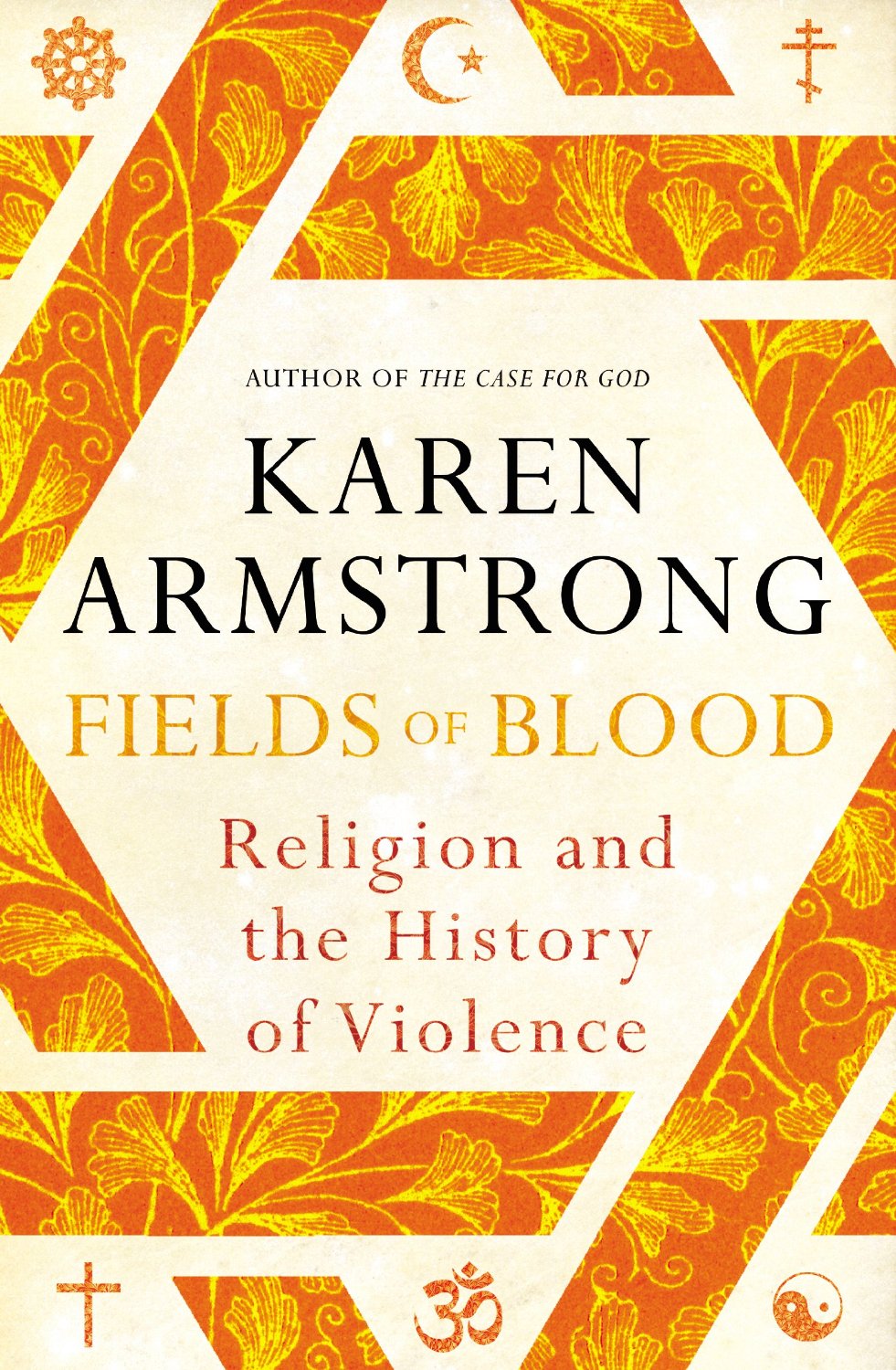
I spent most of my time reading Fields of Blood, Karen Armstrong’s epic history of violence and religion, waiting for the other shoe to drop. Just what was Armstrong’s end game? She leads off repeating the straw man argument that religion is responsible for all wars on the planet (an argument she places on the lips of anonymous folks rather than actually quoting one). But surely, if that’s all she was up to, it wouldn’t take more than 500 pages and 5000 years of human history to debunk. That would be rhetorical overkill.

A secondary argument to counter – one I’ve actually seen in the wild, at least – appears in the afterword, identified by Armstrong as the idea that religion is responsible for more death than any other cause. It’s another pretty easily rebutted argument, but one that, curiously, Armstrong can’t defeat, due to the way she frames the entire book.

The frame, essentially, involves two foundations. First, civilization – not just modern civilization, but all civilization – is inherently violent. Coercive violence is inherent in civilization and its development because without the ability to take other people’s stuff no upper classes will ever develop that will then have time to do things like invent stuff, ponder the great questions, and write large tomes about the history of religion. Second, until a few hundred years ago (in Europe – other places caught up later) religion was intrinsically linked with the rest of life, including politics. The idea of “religion” as a separate thing just didn’t exist.

As a result of all this (and we’ll assume, for our purposes, that her foundations are accurate), we can’t single out “religion” as the cause of any nasty things because it’s just part of a society as a whole that’s doing them. Religion, Armstrong argues, is an attempt by humans to give meaning to their lives, including the horrible violent things they do. Sometimes, it might even reign in our worst impulses. Having said that, she admits near the end that those attempts usually fail.

The upshot of all this is that not just religion in general, but specific religions, are made up of various strains that are at odds with one another, even if they arise from the same holy text. Armstrong does a good job at showing how particular religions throughout history morph from one form to another in order to keep up with prevailing times.

One particular example comes from Judaism, in which the Talmudic stories of King David and the conquest of Palestine – written at a time when such conquering was going on and needed justification – were retconned by future rabbis after the Romans brutally put down a Jewish revolt and destroyed the temple in Jerusalem. In other words, presented with evidence that a more martial glaze on the old stories wasn’t working, they changed their meaning into one of metaphorical struggle of an oppressed people.

Now, here’s the thing – that’s actually good. People who change their minds when new evidence comes to light are rational, thoughtful, and should be applauded. But they weren’t just revising a political philosophy, they were recasting stories of an allegedly divine origin. This is something Armstrong never deals with that distinguishes religion from other schools of thought. Religious texts are (mostly) based on the idea that they are pipelines to a higher truth. If that’s true, they shouldn’t be so malleable in human hands. Otherwise, what’s the point?

Having said that, it’s hard to disagree with Armstrong, so far as her basic thesis goes. As an atheist, I certainly agree that religion is a human construct, not the product of revelation or supernatural spiritual insight. It’s a messy contradictory thing precisely because it’s rooted in humanity. But I’m not sure what that gets her, since she appears to be trying defend religion from unfair criticism.

Armstrong can’t win the second argument noted above with this conception of religion. If it has been, for millennia, an integral part of society, so much so that people didn’t have a separate concept of it, then it’s as responsible for past violence as society as a whole. So what is Armstrong’s goal in doing all this?

It winds up being a gargantuan No True Scotsman fallacy, in which Armstrong suggests that people who claim religious motivations for violent acts are, in essence, bad a religion. This is most clearly evident in her discussion of Al Qaeda and the September 11 attacks.

After a lengthy examination of how a lot of modern Islamic fundamentalism is a response to ham-handed colonial policies (on that theme I think she’s right), Armstrong notes how many of the 9/11 hijackers were fairly Westernized. Nor, she argues, were they particularly devout Muslims before becoming involved with Al Qaeda. This is not unusual, as she cites a study of more than 500 people involved in carrying out the attacks that shows only 25% fit the mold of holy warriors when they joined Al Qaeda.

However, she then struggles with the fact that, once a part of Al Qaeda, they did become holy warriors engaged in jihad, filled with tales of martyrdom. To her, the problem wasn’t religion itself, but not enough of it – had the hijackers really known what the Koran said, they would never have carried out the attacks. She specifically concedes that the hijackers themselves surely saw themselves as religiously motivated, but that’s only because they were bad at Islam. In Armstrong’s telling, religion never fails, it is only failed by the humans acting in its name.

Armstrong returns to this defense – “but the book says . . .” – over and over again, but it doesn’t do her any good. First, it presumes there is one correct way to read any holy text. As her own history extensively shows, different people read the same texts very differently. Second, it ignores the fact that actions matter more than words. In another example, she notes that a particular group of terrorists in the Middle East thought themselves bound by Islamic law to avoid violence against civilians. Nonetheless, she explains how they took civilians hostage, which is a violent act in anybody’s book. Actions, not words, are what counts.

Third, and most troubling for the entire book, is Armstrong wants to view religion’s role in violence as simply as the critics to which she is responding. If it’s not THE cause, she seems to argue, it is exonerated. She ignores (or breezes right past) the role religion can play in making killing of the other guy all right, even if the underlying cause isn’t religious. The American Civil War is an example of a war that was purely political, but both sides thought they were doing God’s work. Ever listened to the “Battle Hymn of the Republic”? It’s all about how righteous the Union cause was.

Another issue that pervades the book is Armstrong’s problems with actually deciding what “violence” is, as seen in her discussion of American fundamentalists. They, compared to their overseas counterparts, are not violent, Armstrong says, ignoring the various instances (Ku Klux Klan, Jim Crow, abortion-related murders and bombings, gay bashing, etc.) where they have been. But then she turns around and charts their rise partly to a reaction against “psychological violence,” which she defines as, essentially, modern secularists saying mean things about them. By stretching the term to meet an immediate rhetorical goal, it loses all relevance.

I think the biggest disappointment with Fields of Blood is that I actually agree with a lot of points Armstrong makes. She’s absolutely correct that the causes of conflict are numerous, complex, intersecting, and can’t be reduced to sound bite descriptions. Similarly, the irrationality that can be the hallmark of religion can be replaced with secular variants of irrationality, too, such as cults of personality or the aftermath of the French Revolution (not to mention the otters). Nor is she wrong that secular states – like the United States – have a record of violence that is nothing to be proud of.

In fact, I think Armstrong and I would agree a lot on what’s wrong in the world and how to fix it. On this issue, however, she’s just not able to get around the fact that some people do horrible things to other human beings (to quote Frank Zappa) “’cause they don’t go for what’s in the book / ‘n that makes ’em bad.” Until she confronts that, Armstrong has a massive blind spot that even a tome like Fields of Blood can’t fill.

Fields of Blood

In Defense of “The Cold Equations”

My first exposure to “The Cold Equations,” a short story by Tom Godwin first published in Astounding magazine in 1954, was in a college sci-fi and fantasy class.  I didn’t take the class – my roommate did.  But he shared the story with me and we talked about it quite a bit.

The story, very briefly, is this: a pilot is guiding a small spacecraft to a distant colony carrying medicine to help stop a fatal disease outbreak.  The ship is lean and purposeful, with just enough fuel to do the job with the expected payload.  Problem is, there’s a stowaway – a teenage girl who wants to see her brother, one of the colonists.  After some agonizing, the pilot does what the rules – and the laws of physics, the nominal cold equations – require him to do: push her out an airlock.  For, you see, with the extra weight of the stowaway there isn’t sufficient fuel for a safe landing.  Save the girl, the ship crashes, and all the colonists die.

The ending of the story has caused arguments since it was first published, I imagine.  My roommate and I had a good one, with me taking the side of, “this is stupid, there should have been something done to prevent this from happening.”  It was one of those things that college arguments are built on.

This time last year Boing Boing maven and sci-fi writer Cory Doctorow wrote a piece for Locus Online essentially taking the same position I did all those years ago.  Doctorow is entirely correct, as I was years ago, that things could have been set up differently to allow for a happier ending – one where the stowaway survives and the colonists don’t die of a nasty disease.  But I disagree with him when he concludes that the absence of those things makes the story a failure. Two of his arguments don’t quite sit right with me.

First, after setting forth all the ways that the story sets up the pilot’s dilemma, he writes:

It is, then, a contrivance. A circumstance engineered for a justifiable murder. An elaborate shell game that makes the poor pilot – and the company he serves – into victims every bit as much as the dead girl is a victim, forced by circumstance and girlish naïveté to stain their souls with murder.

* * *

‘The Cold Equations’ is moral hazard in action. It is a story designed to excuse the ship’s operators – from the executives to ground control to the pilot – for standardizing on a spaceship with no margin of safety. A spaceship with no autopilot, no fuel reserves, and no contingency margin in its fuel calculations.

That’s an odd accusation for a fiction writer to make.  Fiction is the ultimate contrivance.  Writers move pieces around and put them together in particular ways to tell particular stories.  That’s why in a legal drama the hero isn’t just defending an innocent man charged with murder, but his brother, or why the cute girl the guy hooked up with the night before isn’t just in the same line of work, she’s the main rival for the new account.  It can be a cheap way of ramping up the conflict, but it’s hardly unheard of.

Obviously one can critique a story for being overly contrived and unrealistic, but we are talking about a short (10,000 words, about) tale set on a spaceship.  There’s not a whole lot of room to explore the facets of this universe that don’t focus on the central conflict.  It’s a story about the rather obvious, yet compelling, theme that space is a dangerous place and it doesn’t care about the humans caught up in it.

The second argument is more implicit than explicit, but it comes up when Doctorow cites the litany of means the story could have used to avoid the tragic ending, from better engineered spaceships to better medical care at the distant colony in the first place.  All of these are true, of course – something could have been done.  But that misses a key point – is it unreasonable to think that in the universe of “The Cold Equations” such things might not happen?

Assuming the story is set in a future period of our own history it certainly isn’t.  History is riddled with tragedies that occur when some entity cuts corners on safety.  I don’t even have to look beyond West Virginia to find plenty of examples – mine explosions, the Buffalo Creek flood, the Hawks Nest Tunnel disaster.  All caused because safety was sacrificed for something else, either profit or political expediency.  Or just plain dumb assery.  Is there any reason to think the powers that be in the universe of “The Cold Equations” are better human beings than we are now?

After all, there was a sign warning unauthorized personnel not to enter the ship.  Is it too harsh to say anybody who ignored that sign got what she deserved?  Yeah, but that wouldn’t stop people from saying so.  Scour any Internet comment section in the wake of some tragic accident and there are plenty of people willing to blame the injured for their predicament.  Again, there’s no reason to think citizens in the universe of “The Cold Equations” would look at the incident any differently.

In the end, Doctorow’s main criticism of “The Cold Equations” seems to be that it’s not set in the best of all possible worlds, one where everything possible to prevent such a tragic event from taking place would be done.  But that world is a fantasy, one harder to believe in that most of what’s on sale in the bookstore.  Perhaps one of the reasons it’s endured all these years is that as readers we know it’s all too plausible.

Weekly Watch: Enemies of the People

My wife and I recently returned from our belated honeymoon in Cambodia. It’s a fascinating place, filled with beautiful landscapes and wonderful people, but it’s still laboring to escape one of the greatest calamities of the 20th Century.

In April 1975, the Khmer Rouge – a radical faction of a one pan-SE Asian communist movement – stormed into Phnom Pehn. Over the next three-plus years (until the Vietnamese rolled in), the Khmer Rouge regime embarked on a brutal plan of forced ruralization to complete their revolution. Anyone seen as a dissident or potential traitor was killed. Starvation swept the countryside. Millions died, although the exact number will never be known.

Enemies of the People is a film by Thet Sambath, whose mother, father, and brother were all killed by the Khmer Rouge. Earlier this century he spent years gaining the trust of a small group of Khmer Rouge functionaries and getting them to talk about what they had done. A few were the lowest level foot soldiers, the ones who did the actual killing. But the big target was Nuon Chea, also known as Brother Number Two, the Khmer Rouge’s second in command. After years of rapport building talks, he finally confesses to ordering the killing (along with Pol Pot, aka Brother Number One).

The film is thus both about how a victim of the Khmer Rouge has come to terms with this history, but also how the killers themselves have done so. Unlike the subjects in the similar film from last year, The Art of Killing, the responsible parties here all express regret for what they did. Perhaps understandably, the ones who did the actual work – which they relate in horrifying detail – are the most contrite. Nuon Chea himself is sympathetic (particularly after Sambath reveals his family’s history), but still clings to some ideology that suggests it was something he had to do for the sake of the nation.

A formal apparatus for dealing with the Khmer Rouge’s crimes didn’t arrive until the Extraordinary Chambers in the Courts of Cambodia were formed in 1997 (the post-Khmer Rouge unrest in the country didn’t end until 1998). Progress at the court has been slow and both of our guides questioned whether it would ultimately bring any kind of justice to Cambodia. Nuon Chea, at least, has had his day in court – he was convicted of crimes against humanity in 2014 and sentenced to life in prison. It’s clear that the country as a whole is still struggling with this bloody legacy.

Enemies of the People is a small film. Sambath begins by wanting to answer the question of why the killings happened, but he never really gets there. The best he can do is get answers from the men with (literally) blood on their hands (they would have been killed had they not followed orders) and the higher up who equivocates enough that you can see the monster behind his eyes. That it doesn’t find the answer to the big question doesn’t make it any less powerful.

Weekly Read: King Leopold’s Ghost

Yeah, I know, I should really start this feature out with a work of fiction, right?  But this is the last book I read and it was so powerful that I wanted to highlight it.  Besides, it could be worse – I could talk about a progressive rock album!

In 1877, Leopold II, king of Belgium, essentially bought what today is the Democratic Republic of the Congo.  For the next three decades, he ruled it like a fiefdom, exercising the kind of control he couldn’t in Belgium itself (pesky parliament!).  Along the way, he made a fortune exploiting the land and the native people, particularly once demand for rubber increased.  It’s estimated that half of the native population died, through direct violence, forced labor, and other means.

King Leopold’s Ghost, by Adam Hochschild, traces the machinations of Leopold in obtaining the Congo and the international movement that sprang up to oppose his rule there.  It was one the first, if not the first, modern human rights campaigns, waging an international battle in the press and halls of politics on behalf of an oppressed group of people.  Hochschild also does a good job of highlighting the horrible abuses of the Congo (severed hands feature prominently) without falling into simply cataloging them.  There is such a thing as atrocity overload, after all.  Nor was it limited to the Congo.  As Hochschild points out in the end, a lot of what happened there happened, in various forms, in other parts of Africa and Asia.

One interesting thread that runs through the book is the impact of the United States on the Congo.  The US was the first nation to recognize Leopold’s claim on the Congo (although we might have been duped, somewhat) and, while the Congo reform movement was born and led from the UK, major players also came from the United States, including George Washington Williams, an African-American historian who had the bright idea to actually go talk to Africans about all this.  Sadly, the thread runs all the way through Congo’s colonial days to the birth of the modern DRC and includes a CIA backed assassination of the country’s first democratically elected Prime Minister (too socialist) and the support of multiple presidencies (from Kennedy to at least Bush the Elder) for the military strongman who eventually replaced him.  Both the good and bad, then, of Congolese history is bound up with our own.

hochschild-adam-king-leopolds-ghost