Now That’s Art

I’ve got a fondness for micronations, those tiny bits of land that someone has declared a small, independent nation that nobody else in the world really recognizes (aside from other micronations). My favorite, up to this point, has been the Principality of Sealand, which is actually an old offshore platform in the North Sea off the British coast.

Sealand even has its own soccer team (there’s an entire World Cup for unrecognized nations) and, I’m pretty sure, inspired an excellent song by Orchestral Manoeuvres in the Dark Song:

That’s interesting and quirky and all, but is a micronation art? It certainly can be.

Welcome to the Republic of Zaquistan:

You might think it’s just a few acres of scrub in the Utah wilderness (and you wouldn’t be wrong), but it’s also a project of artist Zaq Landsberg. I found out about him via this article in the Washington Post about his statue “Reclining Liberty,” currently installed in Arlington, Virginia, in which he translates the Statue of Liberty into the form of the reclining Buddha you can find all over Southeast Asia.

I like the whole vibe of it:

one of the piece’s goals is to be accessible — Lady Liberty is relaxed in the grass, not towering above viewers from a pedestal. It is easy to interact with her, and he hopes that people will.

‘There’s plaster layers, the copper, the patina, but really, the last layer is the kids climbing on it,’ he said. ‘This thing, it’s on the ground, there’s no pedestal, there’s no admission ticket, there’s no velvet rope.’

So something like Zaquistan is right up his alley. He’s filled the scrub with various sculptures and installations, including a “port of entry” and Victory Arch. My favorite, though, are The Guardians of Zaquistan, a couple of large 1950s-style robots. According to the place’s website they were installed in 2006 and “[t]o this day they steadfastly protect Zaquistan’s borders from intruders.”

My wife and I don’t see eye-to-eye when it comes to visual art. She prefers the look of more traditional painting and sculpture, things you can look at and see recognizable people and things. I prefer more modern and abstract stuff, things that aren’t even particularly “arty” at first glance. Our trip to the Tate Britain earlier this year spawned a good round of “is this art?” discussions. They often go like this:
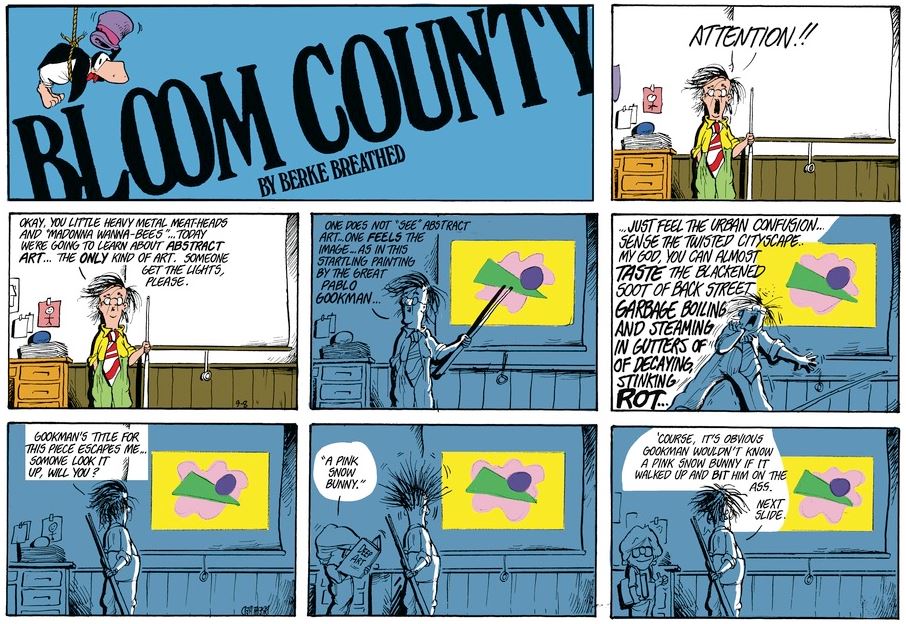
I think part of what I like about the more modern stuff is that it inspires in me a sense of playful wonder and awe that more traditional works don’t. I can certainly appreciate the artistry of Renaissance statuary or paintings by the great masters, but I find myself more interested in the details of what’s being depicted by them than the art itself. More modern stuff hits me right in the gut, however, and almost demands that I deal with it on its own terms, without concern for what it’s “about.”

When I was in law school I got to go to Chicago for a mock trial competition. One afternoon, a teammate and I wandered through the Art Institute, which was probably the first big art museum I’d ever been to. Around one corner we walked into the wildest thing I’d ever seen, an installation called “Clown Torture,” which:

consists of two rectangular pedestals, each supporting two pairs of stacked color monitors; two large color-video projections on two facing walls; and sound from all six video displays. The monitors play four narrative sequences in perpetual loops, each chronicling an absurd misadventure of a clown (played to brilliant effect by the actor Walter Stevens). In ‘No, No, No, No (Walter),’ the clown incessantly screams the word no while jumping, kicking, or lying down; in ‘Clown with Goldfish,’ the clown struggles to balance a fish bowl on the ceiling with the handle of a broom; in ‘Clown with Water Bucket,’ the clown repeatedly opens a door booby-trapped with a bucket of water that falls on his head; and finally, in ‘Pete and Repeat,’ the clown succumbs to the terror of a seemingly inescapable nursery rhyme. The simultaneous presentation and the relentless repetition creates an almost painful sensory overload.

This is not an inaccurate description, particularly the “almost painful sensor overload” part (and particularly if you don’t know what you’re walking into!). Now, I’m not going to say I loved “Clown Torture,” but I love the idea of it and I love that it completely unsettled me and made me think “what the fuck?” for a good long time afterward (still does, sometimes). In some instances that’s all art has to be about.

The Republic of Zaquistan is nowhere near as disturbing as “Clown Torture,” but it gives off similar “what the fuck?” vibes and so I kind of love it. It’s weird and its funny and it kind of makes you reconsider the world around you. If that’s not art I don’t know what is.


Art Isn’t Easy, But It Must Be Human, Right?

Like most writers (I think) I have way more ideas than I can handle, meaning that promising concepts often languish for years while I work on other things. You always think there will be time to go back and develop the good ones, but that might not be true. The sudden explosion in art generated by artificial intelligence makes me think a future I dreamed up years ago is here now, for better or worse.

The idea I had was that a group of computer scientists had built a super computer that, when fed with enough examples of a particular kind of art, could then produce the “perfect” example of whatever it had been fed. The computer, at the time the story would have started, had already written a best-selling mystery novel and created some impressive visual art, too. For its next project it would take on music, leading the cranky main character to show the world that music was a human endeavor that machines could never match. I actually started this story a couple times, but it never got very far.

If I were to try and finish it now it would become more historical fiction that sci-fi, as AI art is really getting its moment in the sun. I’d seen some people on Twitter playing around with various programs where you give it a text prompt and it produces a picture. Some of them were kind of neat, others were horrifically creepy in an unintentional way. It all seemed like a lark until somebody took one to a state fair.

A guy named Jason Allen submitted an artwork called “Théâtre D’opéra Spatial,” which, from the presentation of it in this New York Times article, looks like something from a sci-fi or fantasy cover from the 1970s or 1980s. That’s no criticism – it’s pretty cool and I could see it prompting some interesting stories.

Allen submitted the work in the Colorado State Fair’s art competition, specifically in a category for “artistic practice that uses digital technology as part of the creative or presentation process.” The “digital technology” in this case is an AI program/website called Midjourney. It and similar setups work this way:

Apps like DALL-E 2 and Midjourney are built by scraping millions of images from the open web, then teaching algorithms to recognize patterns and relationships in those images and generate new ones in the same style. That means that artists who upload their works to the internet may be unwittingly helping to train their algorithmic competitors.

In other words, a user like Allen feeds text inputs into Midjourney, which then comes up with an image attempting to match the prompt. The process itself sounds like it could be excruciating, tweaking terms one word at a time to see what impact it might have on the final process (as someone who does that with legal search terms every day, I sympathize).

As an experiment, I found a freebie one of these to play around with. I fed it “Attack ships on fire off the shoulder of Orion” and got back these:

Pretty nifty, huh?

All of this would have had the air of a neat experiment or side story, had Allen and his work not won the category (and the $300 that went with it). For what it’s worth, I think Allen is clearly right that he didn’t break any rules. They apparently didn’t define “digital technology” to exclude AI or to only include tools wielded by humans on art they created, so good on him for exploiting the loophole.

But that isn’t the real question. The issue that has people upset about Allen’s win is whether his AI-generated painting is really “art” at all and what it means for human artists. The objections seem to break down along two lines.

The first is, well, that machines just can’t make art or, rather, “art” made by machines lacks something that human-made art does. As someone who at least tries to make art, of the written and aural variety, I’d like to think there’s something to this. On the other hand, as someone who makes electronic music specifically, I’m well aware of the history of musicians (and others) panicking at the onset of some new technological advance. British session musicians in the 1960s were initially super pissed at the Mellotron, one of my favorite instruments, because it was going to put them out of work. It didn’t, of course, because Mellotron strings or flutes or voices never sound quite real, which is part of its charm. Sequencers and drum machines, too, got similar hate for not being “real,” which ignores the fact that what makes them interesting is that they don’t sound “real” in the first place.

But in those examples there’s still a human being pushing the buttons, doing the work. But isn’t that what Allen did? He apparently tried numerous strings of search terms before getting images he liked, tweaking them as he went along. Is that so different than finding a synth patch you like, then using the tools of the synth to shape and sculpt it into something unique and personal? It’s not as if Allen sat down, had a conversation with the AI about what he was looking for, and the AI went away and created. All is doing was responding to prompts Allen gave it which is, for practical purposes, all any artistic medium does.

 The second objection feels more immediately justified, but doesn’t quite hold up under close scrutiny. As I said earlier, these AI image generators work by “scraping” millions of images already on the internet and using them as grist for the images the AI generates. This, to some, sounds a little like machines stealing the work of real human artists. Admittedly, I’d be pissed off if I found out some AI writing thing had scraped some of my stories as fuel for its work. But is that gut reaction reasonable?

After all, what are artists if not meat machines that absorb as influences the works of those who came before them? There’s even a well-known saying to the effect that “good artists copy, great artists steal,” although who said it is a mystery (I heard it from Zappa first, I think). Granted, a computer algorithm can absorb a lot more data than a human brain can in a lifetime, but does that make a difference? We’re hashing that out in the legal realm with regards to the Fourth Amendment and whether computers doing what police would never have the time to do themselves raises questions about the constitutionality of searches. Is the difference between Allen feeding the AI prompts and sitting down with a human artist and saying “here’s the kind of stuff I like, can you do one in that style?” one of kind or degree?

Which is where, I think, humans have it all over machines. As slick as any AI is, all it can do is what people have programmed it to do. A machine has yet to wake up one day and decide “I’m going to paint a flower.” I’m not sure they ever will, although I’m not sure I’d bet against it. There’s something to be said for humanity for having the creative urge in the first place.

Ultimately, this issue is one more in the long line of humans worrying about becoming obsolete. Machines and computers do more and more of our jobs. They’re getting to be a bigger part of law enforcement. And now they’re coming for the arts. It was probably inevitable. It’s worth shifting, then, to wondering not whether AI can make art, but whether it can appreciate it. Show a group of humans the same painting or movie or play for them the same song and you’re likely to have numerous reactions to it. Maybe it’s the reaction, not the creation, that is indelibly human?

Not Exactly The Thomas Crown Affair, Is It?

Art heists are great fodder for movies and books. The stakes are usually pretty high, involving unique, priceless works of art. Daring do is often required to pull them off. And it provides a good opportunity for suave characters to behave suavely.

This isn’t one of those stories.

In February 1965, Salvador Dalí painted a version of Christ on the cross – in an hour and a  quarter – and donated to Rikers Island, New York City’s notorious jail complex. Dalí was supposed to meet with some inmate artists, but wasn’t feeling well, so he sent the painting instead. It was hung in the cafeteria, where it proceeded to collect stains from various jailhouse food fights. In 1981, somebody realized what it was (and had it appraised for $250,000) and took it down.

After a short tour around the country and some time in storage, the painting was hung up again at Rikers – but not where the inmates could actually see it. Instead, it was put up in a lobby where jail employees went in and out. In 2003, a group of those employees (four guards) decided to steal it.

The plan was to create a couple of distractions and allow the leader of the scheme to take the Dalí while replacing it with a fake. It didn’t go well:

It was noticeably smaller than the original, an instant tip-off, but the reproduction was also one that, based on descriptions, not even a child would have wanted to claim. Plus, the reproduction of the cafeteria stains were an entirely different color. It was bad.

Then, of course, there was the painting’s presentation. Yes, the glass case had been locked back up with the copy safely inside. But where the original had been displayed in its gold frame, the fake was simply stapled to the back of the box, sans frame.

The whole plan was amateurish at best, but when you factor in the location—a prison teeming with law enforcement officials who spent their days gazing at that exact painting (there were two guard booths in direct view of the Dalí)—it was stupidity at its finest.

The very next day, several guards reported that there was something wrong with the Dalí.

They all got caught, of course, although the ringleader managed to get a not guilty verdict at trial (the others were convicted).  As for the Dalí itself? One of the thieves says that the ringleader got nervous and destroyed it.

On second thought, maybe there is a great story here, in the tradition of a Coen Brothers “heist gone wrong” kind of thing. I’d watch it. I’ll even suggest a theme song:

https://youtu.be/KKQco9y87Bo

Dali