Widows of the Empire: The Unaru & the Knuria

In the run-up to the release of Widows of the Empire, I wanted to highlight a few things about the world of the Unari Trilogy (for more background on the trilogy, the setting, and the characters, see this post I did before Gods of the Empire came out). Today, we look at the two largest and most important parts of the Unari Empire – the Unaru itself and the Knuria.

Being an empire, of course, the Unari Empire is composed of several disparate regions, all brought under Imperial rule. That said, there are two main ones that occupy a lot of the history of the Empire and the books in the trilogy.

The Unaru is, essentially, the original Unari Kingdom, composed of the areas around the Imperial capital of Cye. If we’re going to analogize to the Roman Empire, then Cye is Rome and the Unaru is the Italian peninsula. It’s made up of a fairly homogenous people in terms of culture and ethnicity with historical ties to the area and to the rulers who have sat in Cye for centuries.

The Knuria, by contrast, is a vast expanse of rolling farmland and rugged hills, without any real coherent cultural identity. Conquered during the expansion of the Empire, it has had second-class status ever since. If you remember when our heroes (well, some of them) wound up near a mined out bosonimum pit in Gods of the Empire, with its crumbling mining town nearby, you can get a sense of what I mean. Likewise, if you detect a bit of West Virginia in the Knuria you’re not wrong. It’s a breadbasket and extractive resource region of the Empire. Going back to the Roman Empire comparison, the Knuria is like the other parts of Europe that the Romans eventually conquered – culturally and ethnically diverse, brought to heel by force.

An aside here to say that, when I was conjuring up the Unari Empire, I was less inspired by Rome than I was by the Soviet Union. In a way, the Unaru is like Russia proper, the Knuria like the other Soviet republics – part of the USSR, but arguably separate states – and then there are other states that are within the sphere of influence. For the Empire that includes the states north of the Knuria, where some of our heroes found themselves in the second part of Gods of the Empire.

The Unaru and the Knuria are separated by two major mountain ranges. The smaller of the two, the Rampart Mountains, is north of Cye and forms the northern border of the Unaru (along with the related Rampart River). The much larger of the two, the Granite Curtain, is a huge range that runs most of the rest of the border between the Unaru and the Knuria. They’re basically impassable, a favorite hangout for outcasts and, once upon a time, gods.

Given all that, people from the Unaru look down on those from the Knuria a bit. It’s less an active discrimination than a deep-seated belief that the Knurians are just a little less developed, less civilized. It’s the urban/rural divide writ large, as there’s no place in the Knuria that can come close to Cye.

We see that a little bit with the contrast between Aton and Belwyn, our two main characters. Aton is a Cye native, an Unaru, who really hasn’t travelled outside the city (and the surrounding area) before his current work hunting down ancient artifacts of the gods. He’s “worldly” in the sense that he grew up in a large, bustling city. Belwyn, on the other hand, is Knurian, having grown up in the small lakeside town where, at the start of Widows of the Empire, she is imprisoned. That said, they both start their stories as a little bit sheltered to the realities of the wider world. They both get an education during Widows of the Empire in a way that, I hope, broadens and deepens the world they’re moving around in.

The bottom line is that the Unaru needs the Knuria and the Knuria needs the Unaru. They may not quite realize it yet.

Widows of the Empire

Out November 10

Wherever fine ebooks are sold

September Siesta

Not really, but I am going to be taking a break from the blog for this month. I’ve got some traveling to do, a couple of big work things, and the next draft of the final book of the Unari Empire Trilogy that all need attention this month.

When regular programming resumes in October it’ll be focused primarily on Widows of the Empire as we move closer to the November 10 release date. What do you want to know about the new book before it’s released? Let me know!

Timing Isn’t Everything, But It’s Something

The Godfather came out in 1972, its sequel in 1974. I was born right in between, in 1973, which is to say I had no chance to experience these Coppola epics when they were fresh. In fact, it wasn’t until sometime 15 years ago or so that I actually managed to watch them. By that time I’d already consumed a good amount of mob stories, from Goodfellas to (most of) The Sopranos and many others.

It sort of makes sense, then, that I wasn’t exactly overwhelmed by the first two Godfather movies (I’ve never seen the third). They’re really good, don’t get me wrong, but by the time I saw them a lot of what made them exceptional had bled through into popular culture. The idea of morally conflicted mobsters was certainly a trope by 2005 or so. Likewise, the stress of familial obligations in the mob operation had been done and done by then. This is no fault of the original films – it’s just that by the time I experienced them they weren’t as timely as they once were.

I thought about The Godfather while I was reading Soon I Will Be Invincible by Austin Grossman.

As you might guess from the cover, it’s a superhero story. Why did it make me think of The Godfather? Because it came out in 2007 and I was reading it fourteen years later.

To give some context, the first MCU installment, Iron Man, came out in 2008. That same year is when The Dark Knight, the second of Nolan’s Batman movies came out (to be fair, we’d also had a few X-men movies). In other words, this book came out just as a huge chunk of the movie and TV landscape shifted to super hero stories. By the time I got around to reading it I’d consumed most (although not all) of them. And as a result, the book very much had a “been there, seen that” feeling to it.

Invincible plays out across two related points of view. One is Fatale, a fairly new cybernetic superhero who joins The Champions, a group of superheroes who have their own dysfunctional baggage (including a failed marriage between two members). That side of the story leans into that dysfunction and highlights the personal toll that being superheroes takes on each of them (from OCD to drug use and the like). It’s more personal and intimate than, say, The Avengers in the MCU, but it’s in the same league. There’s even a corporate element that reminds me of The Boys, although it’s not so cynical.

The other point of view is that of Doctor Impossible, who, conveniently enough, breaks out of prison for the dozenth or so time just as the book starts. He embarks on another scheme to take over the world, along the way diving into his own history as well as those of the heroes who have crossed his path over the years. What we get is a narrative in which the villain is fairly sympathetic, in that he’s a put-upon smart guy who channels his frustrations into evil. Again, this is pretty common these days in super hero properties. The era of the mustache-twiddling bad guys is a thing of the past, thankfully.

None of this has anything to say about Invincible as a book. It’s pretty good and darkly funny in parts (naturally, Doctor Impossible has all the best lines), but I can’t help but thinking that it might have felt really fresh in 2007 or a few years later. Today, sadly, it comes off as a bit tired. Is there anything Grossman could have done to prevent my reaction to his book? Not at all.

Is being timely something writers should worry about? Probably not. Certainly, if you were thinking of writing a book like Invincible today, you’d have to take into account how prevalent super hero stories are these days. One more similar story probably won’t attract a lot of attention. That’s a different discussion than trying to figure out how well something might age in the future. Unless you can predict what’s going to happen in years to come – in which case, why are you writing books? – it’s just not something worth worrying about.

Sometimes I see authors wondering about whether particular references – to pop culture things or news events – will “date” their work down the road. That always seemed very presumptuous to me, since it assumes anybody will be reading your work in years (or decades) to come. This issue is more of the flip side – how do you keep you work from being swallowed by general trends? You can’t – write what moves you and let the broader market sort itself out.

You can’t fight time – you can only hope to survive it.

Can Anybody Write a Book?

A couple of weekends ago, scouring Twitter, I came across an interesting Tweet by a fantasy writer named Sara Scarlett:

I’m going to both agree and disagree with her here. I think that if somebody’s response to your news that you finished a book is “anybody can do that,” they’re an asshole and they are downplaying your achievement. That said, I think the truth of the matter actually is that anybody can write a book and it does writers well to embrace that fact.

First, we need to define some terms. When I say “anybody can write a book,” I don’t really mean any particular human on the planet. Some people, due to physical or mental limitations or educational deficiencies, won’t be able to read a book, much less write one. So, for “anybody” in this discussion, read “anybody who wants to and has a minimum skill set to do it.” That said, the “book” we’re talking about is defined pretty expansively – it doesn’t mean “good,” it doesn’t mean “best seller,” and it doesn’t mean “beloved by a small but passionate fan base.” It means a book – a collection of tens of thousands of words that tells a story. Leave quality judgments out of it.

With that said, it should be pretty clear that anybody can write a book. There’s nothing about writing a book that is inherently difficult – you put words on a page, you do that some more, and, eventually, you have a book. What matters most when it comes to writing is that you actually sit down and write. Orders of magnitude more people will start to write a book than will finish it, but there’s nothing mystical about the ones who finish – they just keep working. The same is true for any art, really – for most folks, it’s more perspiration than inspiration.

There’s another question, somewhat related, that I’ve seen elsewhere on the Internet, which is “can writing be taught?” This seems like a question with an obvious “yes” answer, but it hints at something deeper about creative endeavors. You can learn the skills necessary to do just about anything, but you still need the creativity to be able to do something interesting with it.

One time, my wife and I did one of those “drink wine and paint a picture” things, which we really enjoyed. I immediately analogized the blending of paints to create certain colors and effects with the way you blend and sculpt sounds on a synthesizer. I was enthusiastic that I could add this creative element to my arsenal – my wife even got me some painting supplies for Christmas. I never did anything with them. Not because I wasn’t excited by the process, but because the creative spark never came. I couldn’t figure out anything to do visually, the way I get ideas for stories or rhythms and melodies pop into my head. But could I bear down and crank out a painting? Sure, but would anybody care about it?

Ultimately, that’s why someone saying, “oh, anybody can write a book” can sound so hurtful. It’s usually said by someone who’s never even tried to do it, much less accomplished it, to someone whose passion, creative drive, and tenacity resulted in a work they’re proud of. They probably gave up time with friends and loved ones while working on it. They bled for it (metaphorically – I hope) and this is the reaction they get?

You know what? Fuck those people. It’s probably true that anybody can write a book. It’s also true that most people won’t even try. You did and you succeeded. Take pride in that and move on to the next one. Keep on working.

Getting Creative In Court

Lawyers, in general, write a lot in their work. I write even more, given that I specialize in appeals and other sorts of post-conviction cases. Over the two-plus decades I’ve been doing this, I like to think I’ve developed a good skill with words, with creation of sentences and paragraphs that convey meaning and argument while still being a pleasant read. The days of legal writing filled with “heretofore”s and meaningless Latin phrases (seriously, if you see any sentence with “inter alia” in it, cross it out and tell me how that sentence is any different) are long gone, thankfully.

Still, there’s only so much creativity you can squeeze into legal writing. For one thing, you’re limited by the realities of the facts in your case (particularly in an appeal) and you can’t really beef up the plot or characters of you brief to make them more persuasive. For another, you have to consider the audience. The truth of the matter is that judges (and their clerks) are busy, have countless things to read on a daily basis, and are interested in being persuaded as quickly and clearly as possible. An appellate brief is no place to play with the form of words and sentences, to be coy about meanings, or to roll out mysteries for readers to ponder.

That’s one of the reasons I started writing fiction, especially fantasy. What better escape from the horrible facts of real life cases than worlds where I get to make up anything I wanted to? Strange new worlds! Interesting creatures! Cultures and histories never before imagined! This is where my creativity gets to thrive, not in court.

Right? Maybe not, if I could draw anything beyond a stick figure.

Third Planet Sci-Fi and Fantasy Superstore is a comic book and related merchandise business in Houston. From the Google Street View image you can see that it’s a wide, one-story building next to a busy street. You may also notice that it’s next-door neighbor is a high-rise Crowne Plaza hotel that towers over the place.

Third Planet is suing its neighbors because . . . well, because there tend to be a lot of assholes staying there. According to a third (!) amended petition filed in state court, hotel guests frequently make use of the hotel’s open-air balconies and fire escape to “throw all manner of projectiles off those landings and onto Third Planet’s roof and parking lot. It goes on to describe one particular day:

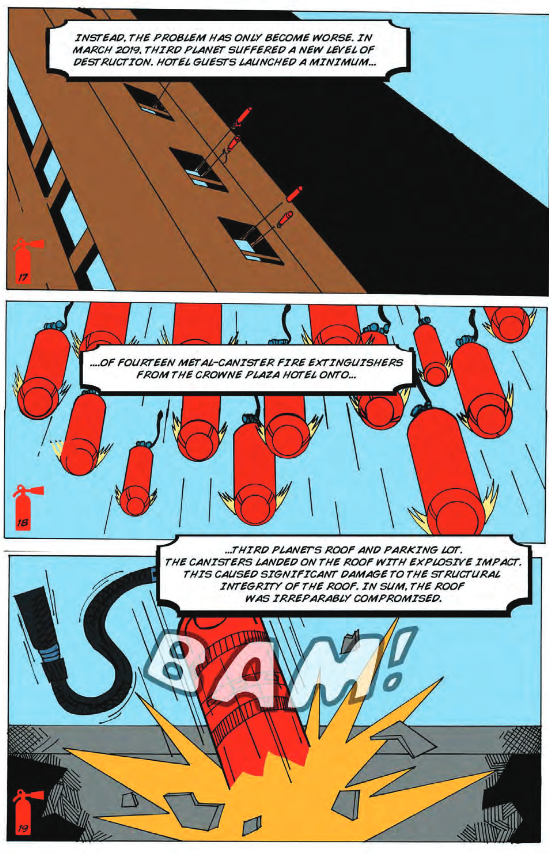
On or about March 3, 2019, matters escalated to a new level of destruction. Hotel guests, residents, tenants, patrons, customers, or visitors launched at minimum fourteen large metal-canister fire extinguishers from the Hotel onto Third Planet’s roof and parking lot. The canisters landed on the roof with explosive impact. This caused significant compromise to the structural integrity of the roof. In sum, the roof was irreparably damaged.

The next paragraph simply says: “Then came the rain.”

Pretty compelling stuff, right? Nonetheless, according to the petition, the defense “has previously filed special exceptions, complaining that it could not sufficiently understand the claims and allegations against it.” So what does Third Planet’s counsel do? They write a comic book to lay out everything.

Over the next 13 pages, the comic tells the story of Third Planet, its bowling champion owner TJ Johnson, and the store’s history in Houston. As for those flying fire extinguishers? Well . . .

The whole complaint is here, with the comic part starting at page 6. It’s a bold brilliant move and, without knowing anything about the actual legal merits (property law is not my specialty), I hope Third Planet wins and wins big.

Bold as it is, Third Planet’s resort to visual aids in a pleading is not unprecedented.

A comment to the Volokh Conspiracy post that brought this to my attention pointed to an article from the ABA Journal in 2012 where a lawyer did something similar in federal court.

The case involved the United States’ antitrust complaint against numerous publishers for fixing ebook prices and an attorney wanted to file an amicus (friend of the court) brief taking issue with some of the Department of Justice’s positions. He originally filed a 24-page motion with a 29-page proposed amicus brief attached. The court said he could file an amicus brief, but it could be no longer than five pages.

Which he did, taking a more comic strip approach:

The comic complied with all the usual formatting rules for pleadings in that district (font size, margins, etc.), but that didn’t keep the US Attorneys working on the case from dealing with it without a lot of effort (and the settlement they were seeking was eventually approved). Still, it was pretty clever (you can read the whole five pages here).

Like I said, making your argument in pictures is a pretty bold gambit (easier to do when you’re not actually representing a client). If it works, it’s brilliant. If the judge takes offense, thinks somebody’s diminishing the process, it can be a disaster. Come to think of it, probably for the best that I steer my wilder impulses into fiction.

Widows of the Empire – Coming November 10!

So remember when I said I hoped to see the end of a particular tunnel by the time July rolled around?

Well, guess what?

Widows of the Empire, book two of my Unari Empire Trilogy is finished and I’m shooting to release it on my birthday, November 10! Of this year!

Okay, so not quite finished, but the main text is done. Needs formatting and a couple of final flourishes, but, barring tragedy, you’ll be able to reach more of Aton and Belwyn’s adventures as the Unari Empire begins to come apart this fall.

When the Character Has No Deep Dark Secret

There’s been a lot of press recently about the 20th anniversary of the release of Shrek and its impact on the culture. One of the most memorable parts of the movie is when the main character explains that ogres are like onions, as they have layers. It’s more than a nice message about not judging people for their looks, though. It suggests that fictional characters are supposed to be the same – they should have layers that peel away the more time we spend with them. Some of them, maybe most of them, wind up with deep dark secrets that motivate their actions or hold them back.

So what happens when you find a character that has no layers at all? The surface they project to the world is exactly who they are. How do you handle a character like that?

A Beautiful Day In the Neighborhood is, in one way, a movie about Mr. Rogers. With a title like that, how couldn’t it be? But in a more accurate way, it’s not about him at all. The main character is a (fictional) writer sent to do a short puff piece on the children’ TV legend. Cynical, bitter, and having just had a drunken punch up at a wedding, he’s the one with layers.

Mr. Rogers is . . . well, he’s Mr. Rogers. He’s kind and patient and he cares about this guy’s well being. The writer is an investigative journalist, so he (and, by proxy, the audience) thinks that some dark reveal is just around the corner. Surely Mr. Rogers will curse like a sailor in private or abuse his staff in petty ways or something like that. Nope. All we see of him is that he’s a nice, kind guy and that’s all there is to it. Not at all like this:

That made Mr. Rogers great guy. It doesn’t make him a great character to build a movie around. That’s why he’s not the lead in the movie that’s practically named for him.

There’s an interesting comparison here to the Showtime series Kidding, which stars Jim Carey as a children’s TV icon named Mr. Pickles. He is very much the main character of this story and, as expected, he has layers that the series digs into as it goes along – he suffers from a kind of stunted development, his marriage dissolves after the death of a child, etc. It’s funnier than it sounds (in a very dark way), but it has what you’d expect out of a central character.

Which is what makes A Beautiful Day In the Neighborhood such a nifty work of leger de main. It is undeniably Mr. Rogers’ movie (as played by Tom Hanks, again, how could it not be?), but it can’t be about him, right? So let another character be our focus, our entry into that world, and let the rest seep in around the edges. Which it does, in spades. Bottom line is, a movie about Mr. Rogers that isn’t really about Mr. Rogers has no business working as well as it does. It’s something to consider when planning out stories.

And I have to say, every time I think of Mr. Rogers this is actually what jumps into my head. I blame my brother, Todd, who does, indeed, play the bass:

What Makes a “Heist” Story, Anyway?

One of my semi-regular podcast listenings is The Rewatchables from the folks over at The Ringer. In each episode they take a deep dive (sometimes too deep – the episodes can tend to sprawl) into a movie that they can watch over and over again. It’s good fun if they’re talking about a movie you’re familiar with.

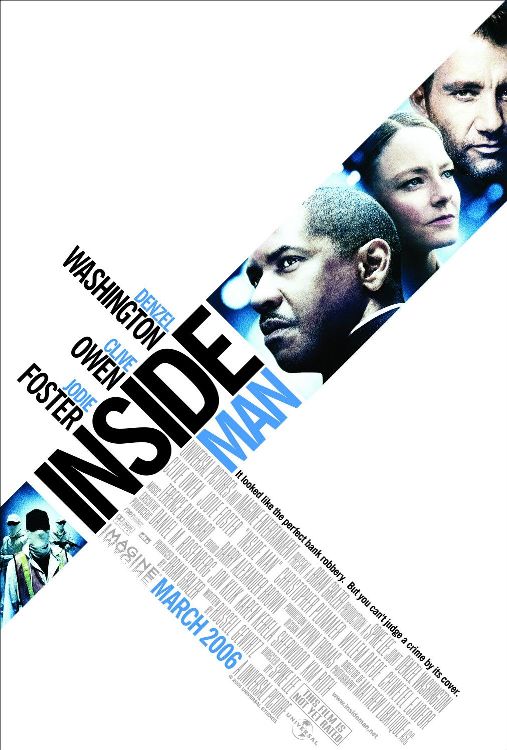
Recently, they did an episode on the 2006 film Inside Man. Directed by Spike Lee and starring Clive Owen, Denzel Washington, and Jodie Foster (among others), it’s about an elaborate bank robbery that’s about much more than money.

What really got me thinking, though, was the introduction to this episode, where they talked about “heist” movies and how great they were. No argument from me – but is Inside Man really about a heist? What makes a heist, and therefore a heist story, anyway?

Maybe Inside Man fits, if we’re just going by dictionary definitions. The Oxford English Dictionary defines heist as “a hold-up, a robbery.” Far be it from me to disagree with the OED, but at least when it comes to storytelling, “heist” means something quite different than “robbery.”

I should say here that when I think of robbery I’m thinking of it in the legal sense that I deal with everyday – that is, the taking of property from the person of another by use or threatened use of force. Other thieving is something different. Think of it this way – if I go into a bank and point a gun at the teller, I’m committing a robbery; but if, as an employee, I secretly steal money without anybody noticing, I’m committing embezzlement. Both felonies, but quite different from one another.

The distinction, for me at least, comes down to brute force. A robbery can be elaborate and kinetic and exciting – think the beginning of The Dark Knight – but, at the end of the day, it’s “your money or your life.” It’s simple, effective, and brutal. “Heist” conjures up something more clever, more deeply thought out. It’s about getting the object of the robbery without the violence. It’s a better, more elevated, kind of crime, if you will.

I’m thinking of things like The Thomas Crown Affair or Ocean’s Eleven and its sequels. Those movies are about the scheming to pull off the job, not just rolling up with guns and forcing people to do your bidding. To be sure, sometimes the scheme goes sour and the heist goes bad, so I suppose it’s a question of intent. If the thieves are trying to get away with it without using violence, it’s a heist. Otherwise, it’s not.

There are also things that don’t fit in either category. There’s a new(ish) Neflix documentary called This Is a Robbery about the 1990 theft of the Isabella Steward Gardner Museum in Boston in which over $500 million worth of art was taken. On the one hand, it involved a clever ruse – the thieves posed as Boston cops and got in by saying they were responding the report of a break in. On the other hand, they tied up the two night security guys pretty violently, so there’s that. Is that a heist story or not? Honestly, I’m not sure.

As I’m writing this I’m watching/listening to a 2017 in-studio performance by Monobody, a band whose music is really hard to classify. In one of the interview breaks the guitar player talks about genre labels as a necessary label, since they help people talk about things like art. But, ultimately, they’re meaningless when considering whether any piece of art is enjoyable or not. So whether I think a story is a heist story or not is irrelevant.

And I’m completely will to admit I’m full of shit about this. Such is life.

On Leaving Things Unsaid

Twice in the past couple of weeks, while channel surfing, I’ve come across Fargo, the 1996 Coen Brothers classic right at that point where there’s enough left to make it worth watching the rest, even if it’s not the beginning. For what it’s worth, that point – both times! – was after Jerry’s unsuccessful parking lot pitch to his father in law, after which he has a little freak out in the parking lot.

Fargo is one of my favorite movies and I’ve seen it over and over, but I still get new things out of it. These two times around one thing jumped out at my writer brain that hadn’t registered before. It has to do not with what was on screen, but what wasn’t.

What drives the plot of Fargo is that hapless car salesman Jerry Lundegaard needs money and is willing to do just about anything to do it. He tries to scam his wealthy father-in-law to “investing” in a parking lot development deal. He’s running some kind of game with the GMAC finance people, too. And, of course, there’s the eventual plot he hatches to have two goons kidnap his wife (who’s wealthy father will then pay an inflated ransom to get back) that ends with a lot of dead bodies.

We know all this. We see the machinations, see the wheels turning. One of the best scenes in the movie is after the kidnapping when we hear Jerry on the phone calling his father-in-law to tell him his wife has been kidnapped. Only he’s not on the phone (the shot starts with him off screen) – he’s rehearing the call he’s going to make, getting his scheme down pat. We hear him fend off the GMAC guy on the phone. And we see him deal with the two goons.

What occurred to me rewatching recently is what we don’t see, what we don’t learn. For a start, we have no idea how much money Jerry needs. It must be substantial, as he’s only going to pay the goons $40k initially on the kidnapping, while setting the ransom at $1 million and that’s only one of his many ongoing schemes. Still, we don’t know a number. Nor do we know to whom Jerry owes a substantial debt. It could be a bank, the result of a failed legit investment or business, or it could be gambling debts that he owes to the mob. Again, we just don’t know.

I think this is a pretty brilliant bit of storytelling. Typically, story gurus will say, you should give your main character a clear goal that they struggle to achieve through the course of your story. But sometimes the rule needs to be broken and I think Fargo is one of those places. If we know how much Jerry needs, the story shifts from being one about a scheme spiraling out of control to one about whether Jerry is going to succeed. If we know why he needs the money it shifts our perception a bit and we’ll be more invested in Jerry’s success. We probably don’t want the mob to break his legs, right?

What all this does is keep us as viewers from getting too close to Jerry, from caring about him succeeding. I think it’s a conscious choice by the Coens to keep us from empathizing with him, as you normally do with a main character. You could certainly try to produce a story where the readers or viewers try to empathize with a guy who gets his own wife, not to mention half-dozen other people, killed as his scheme goes off the rails, but that would be a different story than Fargo. This also allows the moral center of the film to be Marge, who doesn’t even show up until about a third of the way in (coincidentally right after I found the movie on TV these past times).

This isn’t the way to go for most stories. Certainly if you want your main character to be viewed as a hero, even a flawed one, you need to let readers know why they’re doing what they’re doing. But sometimes that’s not what you want. Sometimes you want the guy who sets in motion the disposal of a dead body in a woodchipper to just be a bastard through and through. Who needs to get on board with that?

On Horror . . . IN SPAAACCCEEE!!!

I love a good dust up over genre boundaries. Whether it’s sci-fi versus fantasy or prog rock versus anything, I get sucked into these things. Part of it’s a genuine curiosity about where the lines are drawn. Part of it, honestly, is see what can be some spectacularly wrong takes.

So it was that, last week, I was drawn to a Twitter dust up of an interesting opinion – can you have horror is space?

It started this way:

The first response seems about right:

Makes sense, right? I mean, it’s a movie where a monster – which happens to be an alien – kills victim after victim in a single locale – a spaceship – forcing the hero to pull it together and kick ass. It’s a horror flick. It’s sci-fi.

Not to the original questioner, who followed up:

I’m not sure I’m convinced, mainly because I think “horror” is both a genre unto itself and also a type of story.

Let me make an analogy to progressive rock. At its inception, prog was a descriptive term, a generic label for all kinds of music that was pushing the boundaries of what was contemporary rock at the time. When the genre’s popularity tailed off it wound up giving birth to a particular idea of music defined by a handful of stereotypical features – long songs, focus on instrumental passages, mythical/literary lyrical topics. Later on, newer bands influenced by the original wave of prog started making their own music in the style of those original bands. Thus, “prog” became both a descriptive term and a style.

Horror is kind of like that. There definitely is a genre of horror stories, but there’s also the fact that horror stories can be told in all kinds of different settings. Some may involve supernatural elements, some may not. Some may be set in modern times, other may have a historical setting. Relevant to the discussion here, you can also have horror stories set in the future and, yes, in space. They may be sci-fi (or fantasy), but that doesn’t keep them from being horror stories, too.

In the end, that’s one of the cool things about speculative fiction. Whether sci-fi or fantasy, it’s more of a setting or milieu than a story type in itself. Either genre can support stories from romance to mystery to satire to daring heist caper. Given that, it doesn’t make any sense to say that being a sci-fi story precludes that same story from being a horror story, too.

For what it’s worth, the final vote tally was like something out of one of those “dictator for life” elections somewhere:

Oof.