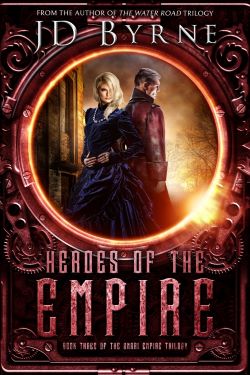
Heroes of the Empire – An Excerpt

Here’s the first of two excerpts I’ll be sharing from Heroes of the Empire over this month (for a third, exclusive one, join my mailing list!). In this one, Belwyn shrugs off an old nemesis and is introduced to a new ally.

As Neven approached, Belwyn asked, “Is there a problem?”

“Only that you haven’t signed on yet,” Neven said. She was more pleasant than Belwyn remembered her ever being in Annanais. She was enjoying this. “I realize that’s not likely.”

“The gods returning to Oiwa is more likely.”

Unfazed, Neven said, “I wanted to thank you, before we’re done.”

“Thank me?” Belwyn chuckled. “For what?”

“You did the right thing, much as it surprised me. Not when you ran away from us and not when you put this rabble together, but at least when you realized where all this might be heading, you finally did the right thing.”

“And where is this heading?” Belwyn was generally curious what Neven might know, or just suspect, since she was apparently still in Chakat’s good graces.

“I don’t know,” she said with a sigh. “These loyalty oaths are not coming as quickly as was hoped. The emperor himself is going to relocate to the Imperial offices in Jerrod Square to take them personally. He thought it was going to bring the Empire together, but there is so much unrest out there.”

“That’s because the Empire is pulling apart,” Belwyn said. She was already an outlaw, what additional risk was there in telling Neven what she really thought? “It’s largely Chakat’s fault, of course. If he’d listen to the peoples’ complaints . . .”

Neven put up a hand. “I’m not here to talk politics, Lady. All I’m saying is that the women who stay behind, including yourself of course, will continue to be outlaws. If the emperor feels the need to deal with you more forcefully, he won’t hesitate.”

“That’s the risk we’re willing to take to get the answers we want, the change we need.” Belwyn did her best not to show that she was getting sick to her stomach. Visions of soldiers with more loyalty to Chakat gunning down ranks of marching, chanting women filled her head.

One of Neven’s underlings got her attention, and, without saying any more, she returned to her post.

Belwyn walked back into the woods, telling Valpari to come find her if anything else happened. She went to her tent, where Coleman, Granger, and a few others she didn’t recognize had congregated.

“How goes collaboration with the enemy?” Granger asked with a sarcastic smile.

“I’m giving the women who want to leave the chance to do so without risk,” Belwyn shot back. “I genuinely care for their safety.”

Before Granger could say anything else, Coleman jumped in. “How many are leaving?”

“Some,” Belwyn said, being deliberately vague. “When all is said and done, we’ll still have a sizeable host. And we’ll know that everyone left is completely committed.” She decided to shift the focus of the discussion. “Neven told me that Chakat is going to start taking these oaths in person?”

One of the young men Belwyn didn’t recognize nodded. “He’s moving to Jerrod Square in the next few days.”

“Then it really isn’t going as well as Chakat thought,” Belwyn said. “At least that’s something.”

“It’s promising,” Coleman said, “but it’s leading the vigilance gangs to step up their patrols, recruit new members. Now they can demand papers, require people to show their loyalty cards, and hand out beatings to those who don’t have one.”

“Good gods,” Belwyn said, leaning against the end of the table. “Don’t people have more time to sign them?”

“Of course,” Granger said, “but Chakat isn’t getting the obeisance he wanted, and the vigilance gangs are an extension of his dissatisfaction. He wants more oaths, given more quickly. How better to assure that than to throw in the threat of a random beating?”

Belwyn shook her head. Things were getting worse. “We can’t keep waiting for some perfect situation to move. Are your people ready?”

“Almost,” Coleman said. “Another few days.”

“I’m not sure we have it,” Belwyn said as Brixton ran up, out of breath. “What is it?”

“Someone to see you, says he has an offer,” he said. “He managed to get here from Cye without being seen and avoided the queue out by Neven’s table, all her men.”

Belwyn stood up, scowling. “Another offer? About what, this time?”

Brixton shrugged. “Hagan’s waiting with him near the edge of the camp.”

Belwyn was bone weary from the day. She didn’t want to deal with another distraction, but what choice did she have? “No more than a few days, Coleman. We can’t let things get away from us.” She left without giving him a chance to object.

Brixton led her through the camp, to the opposite edge from the location where Neven’s sign-ups were underway, where the valley met the high hills that helped define the outskirts of the city.

When they arrived, Hagan was standing with a thin man about her age, with prominent ears. No hat.

“Lady Belwyn,” he said, extended a hand. “Or is it just Belwyn these days?”

“Just Belwyn. And you are?”

“Aton Askins,” he said, shaking her hand. “I think we might be able to help each other.”

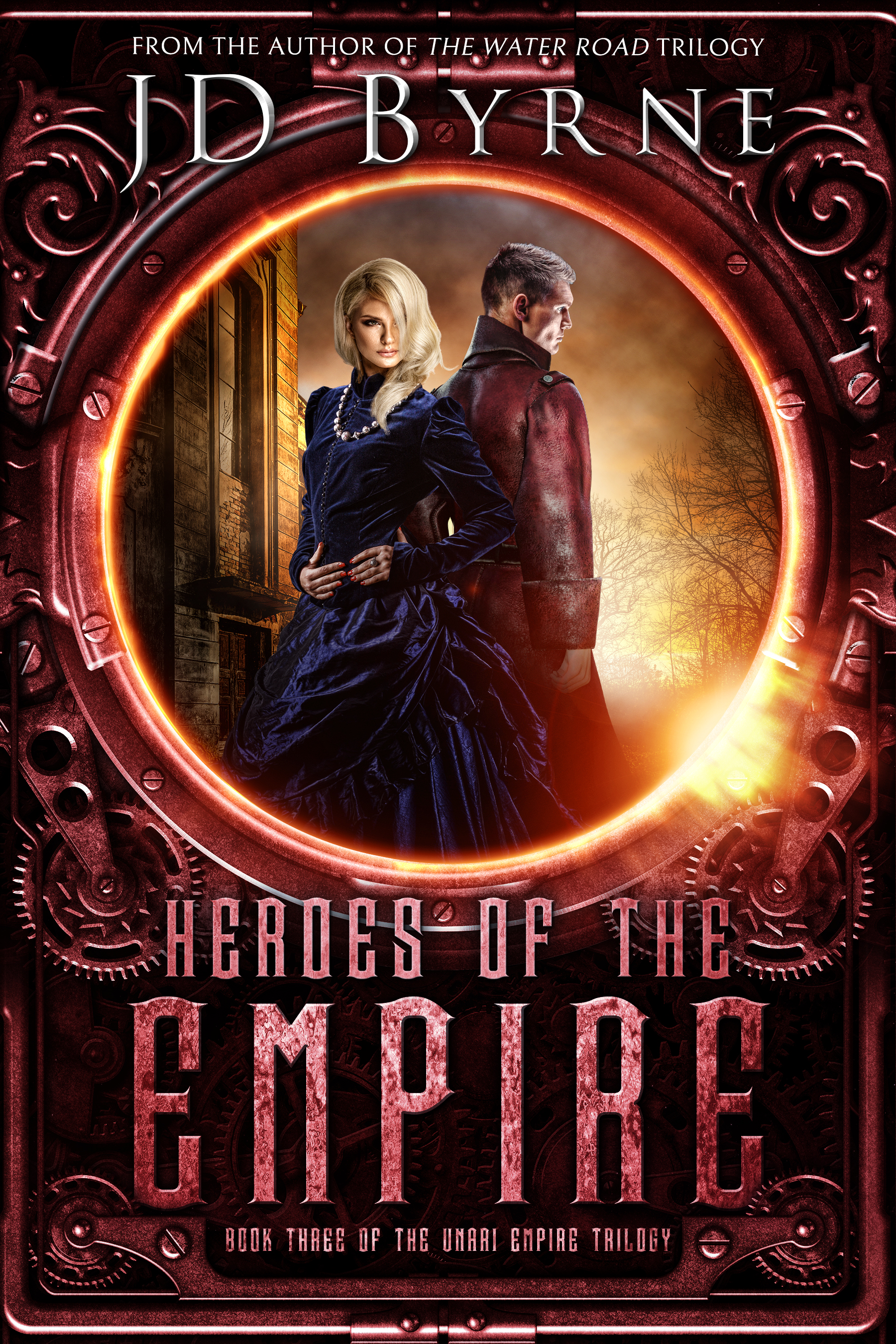
Heroes of the Empire – Out June 7. Preorders available here for Kindle and here for other ebook formats.

Coming June 7 – Heroes of the Empire

I’m very happy to announce that Heroes of the Empire, the final installment of the Unari Empire trilogy will release on June 7 on Kindle and other eBook formats and then in paperback shortly thereafter.

The world is falling apart around Aton Askins. His childhood friend is rotting in a cell for a crime she didn’t commit. There are soldiers in the streets of Cye and an army of angry widows waiting outside the city. His mystery employer might be using him to gather artifacts of the ancient gods to build some kind of weapon. Now he’s been given one last job, one last artifact to find, supposedly on a mythical floating island halfway around the world. He needs to stay in Cye to help his friend, but he needs to finish his work so he has the money to take his family away from the city. Most of all, he needs to keep those he loves safe from what’s coming.

The Widows Army is restless and may be slipping away from Belwyn of Annanais. Stuck outside of Cye, unsure of what to do next, she needs to do something, anything, to make sure the promise she made to these women to find answers about their loved ones doesn’t go unmet. When an unlikely ally presents himself, she uses the opportunity to enter the city and finally find the evidence she needs to show the world the truth of the Port Ambs bombing. All the while, the currents of protestors and revolutionaries are threatening to overtake her.

Lives collide and the fate of an empire hangs in the balance in this thrilling conclusion to the Unari Empire Trilogy.

Revisiting the Need to Change the World

A few years ago, off the back of reading N.K. Jemisin’s The City We Became, I wrote about whether stories that involve magic that are set in the “real world” need to have a meaningful impact on that world.

I had started thinking about that issue thanks to an observation by a legal blogger (of all people!) about Lev Grossman’s The Magicians, in which he concluded that:

it therefore strains credulity to believe that powerful sorcerers have been around for centuries, yet have never revealed themselves to normal humans, seized political power, or had any impact on history.

As I said in my post, I’ve wrestled with this in developing (or not) some of my own ideas. If the story is set in our world, but with magic, shouldn’t magic change things?

I was set to thinking about this again after reading R.F. Kuang’s Babel, which is up for a Hugo.

Babel is set in an alternate history version of England (for the most part) of the early Victorian era, just on the verge of the First Opium War in China. The main characters are training as “translators” at Oxford who practice a form of magic whereby they engrave pairs of words on silver bars that are then used to do particular things. Some of them are completely magical – there’s one that explodes someone’s heart, for example, and another that can heal the sick. Most of them, however, merely make things that already work do so more smoothly and efficiently – carriages travel more smoothly, gardens are more pleasurable, factories require fewer employees, etc.

For our purposes, what all this means is that the British Empire is precisely the same thing that it was in our real history – a globe-spanning colossus that exploited its colonial territories and other weaker, developing nations for fun and profit. There’s nothing about the world of Babel, in broad strokes, that is different from our world. Does that matter? Is it a flaw in Kuang’s world building?

At one time I would have said it was, or at least leaned that way, and you can certainly find reviewers on Goodreads who find that to be a major flaw. But I think what Kuang has done is use the fantasy element to crystalize the themes she wanted to talk about that are very real in our world and our history, namely colonialism and its legacy. In Babel the raw silver needed to fuel the magic works almost like spice does in Dune, a purely extractive industry conducted in a faraway place for the benefit of entrenched, moneyed interests back home. Sure, the actual silver trade did that, too, but the magical gloss heightens the inequity of it.

Could Babel have told the same story without the magic? A few specifics would have to change, but in general, sure it could have. It’s a book about a character who at first thinks he’s been plucked from a dead-end life to live a life of learning and privilege who slowly learns what that privilege is based upon and rebels against it. Magic isn’t required for that, but it doesn’t hurt, either. There’s also the possibility, of course, that what Kuang is saying is that whatever resource we’re talking about, including magic, was going to fall into the service of the most wealthy and powerful anyway, which is not wrong.

In my conclusion back in 2020 I suggested that writers are leaving some interesting ideas on the table by not playing out the impacts of their world’s fantastical things on the world as we know it. I still think that’s true, largely, but I’ve come to accept a caveat – that, sometimes, what you’re after isn’t a big world building “what if?” exercise and trying to do so would just take away from the story you’re trying to tell. As usual, the focus should be on what best serves the character and the story, not anybody else’s idea of how world building should be done.

Weekly Watch: The Man Who Shot Liberty Valance

Sometimes the ideas the animate a movie are better than the movie itself.

As with many films of the 1930s-1960s I’ve seen recently, I stumbled into The Man Who Shot Liberty Valance on Turner Classic Movies.

Not only that, it was part of a slate of movies programmed by Steven Spielberg, so there was a little intro discussion between he and Ben Mankiewicz about the film. It was the last of the great westerns directed by John Ford (a huge influence on Spielberg, among others) and they talked about how it confronted issues about the transition of the West as a conflict between an older regime built on violence and self-sufficiency to a new order based on the rule of law. As a lawyer, and someone with a degree in history, that sounded like something I should just eat up. Damned if the actual movie didn’t get in the way of that.

The “old” West is represented by none other than John Wayne, whose performance here spawned a million impressions punctuated by the word “pilgrim.” He plays a rancher, Tom Doniphon, who has made a hardscrabble living out of the land and thinks everyone needs to be capable of using a gun to protect themselves (he is, naturally, a crack shot). The “new” West is represented by Jimmy Stewart as Ransom Stoddard, a lawyer from the east who believes in bringing civilization to the West. They go back and forth about the best way to handle the titular Liberty Valance (Lee Marvin), a local brigand who furthers the interests of big cattle ranchers who don’t want the unnamed territory to become a state.

That setup is fine so far as it goes, but Ford doesn’t really do a lot with it in the end. Stoddard’s stagecoach is robbed on its way into town by Valance. When Stoddard complains to the town marshal about it he dodges responsibility by pointing out that it occurred outside of town and therefore outside of his jurisdiction. But we later see Valance do all sorts of criminal things right in the middle of town and not only does the marshal do nothing, Stoddard never demands that he do so. Stoddard never tries to take the job and be the law. Hell, we never actually see him practicing any kind of law in the movie (he does some school teaching, though). No, what does Stoddard do? He pretty quickly gets himself a gun and starts practicing how to shoot.

It’s no great spoiler that Valance winds up on the wrong end of a gun (it’s right there in the title, people), although it’s a little unclear precisely who “the man who shot Liberty Valance” is, in the end. Both Doniphon (from the shadows, we later learn) and Stoddard shot AT him, but it’s unclear who hits him and which shot is the fatal one. Regardless, what is beyond clear is that Stoddard fully joins in the game of dealing with Valance through violence, leaving any real pretense of the law behind. And it’s Stoddard who gets the honor of being that man, even if he doesn’t really want it (which is a really interesting conflict that could have been explored more deeply).

So the movie kind of fizzles in its portray of the “old” versus “new” West, but how is it otherwise? Well, it’s a tale of two movies.

The first, which focuses on the leads – Wayne, Stewart, Marvin, and Vera Miles as the love interest – is pretty good. All those performances are good and the have good scenes together. Marvin, in particular, is really menacing as Valance (and has a young Lee Van Cleef as a sidekick). The love triangle between Stoddard, Doniphon, and Miles’ character is underbaked (Doniphon is building an addition onto his house for her, but she doesn’t have any apparent desire to move in), but, hey.

The other movie is the weirdest feast of overacting I’ve ever seen. There are multiple characters – the Cowardly-Lion-esque town marshal, the drunk town doctor, the (also drunk) newspaper publisher – who perform so broadly that had they wandered off this set onto the one for Blazing Saddles Mel Brooks would have told them to tone it down. If you’ve seen the episode of Futurama where Zoidberg’s uncle directs a “serious” movie but demands that the background actors run around throwing pies at each other, you’ve got the picture. Big ideas can be great drivers of a story, and fiction can be a fantastic way to explore how people grapple with those big ideas. But the idea is not the story. The story is the characters in it, what they do, and why they do it. The biggest and most important idea can be felled by a poorly executed story. That’s what’s the most frightening for us creative types – the big ideas are the easy part, but there’s so much left to do once you’ve hit on one.

When Copyright Kills

A couple of weeks ago John Oliver pointed out that the original version of Mickey Mouse is about to slip into the public domain and out of copyright control. Naturally, he has plans for this, but it’s worth remembering that the last time Steamboat Willie was in danger of passing out of copyright control Congress snapped into action and extended the term for copyright protection. I haven’t seen anything indicating they’re going to do it again, but I wouldn’t be surprised if the idea was at least floated (probably without success, given the current GOP jihad against Disney), particularly given what’s happened to poor Winnie-the-Pooh.

As a writer and musician I’m a fan of copyright. The basic idea is that allowing the producers of art to have a monopoly on its sale and distribution incentivizes the creation of more art. But there’s always been a question of how much copyright is too much and when works should move into the public domain and be free for adaptation by others. The Copyright Act of 1790 established a 14-year copyright term, renewable for another 14 years, but those terms were doubled in the 19th century. Then between 1976 and 1998 (when The Mouse roared) terms ballooned to the current life of the author plus 70 years or 120 years if a it was created by a corporation. So in the brief life of the United States we’ve gone from copyright that expired while the creator was not only still living but probably still creating to a term that runs for decades.

Weird things happen when copyright terms run so long that they outstrip the lives of the work’s creators. Recently there’s been controversy about changes to books by the likes of Roald Dahl and Agatha Christie to better reflect modern sensibilities (I talked a bit about the issue here). What’s interesting is that both authors made such changes in their lifetimes, presumably without much fuss. What makes it seem wrong now is that it’s not the authors making the changes but their current copyright holders, who didn’t create a thing. Without lengthy copyright terms that extend beyond the lives of those authors this wouldn’t be an issue – anybody who wanted to could publish the original versions or whatever bowdlerized versions they wanted.

Thanks to this in-depth video, I recently learned about another problematic case of long-term copyright. Remember “Down Under,” by Men at Work? Particularly the flute riff that repeats several times during the song? 

Released in 1981 it was a huge international hit, hitting number one in the US and UK. It wasn’t until 2007 when a TV quiz show noticed that part of the flute part matches almost perfectly the melody of “Kookaburra Sits in the Old Gumtree,” a popular Australian song. After the show aired, people called the company that held the copyright to “Kookaburra” about the similarities, resulting in a lawsuit against Men at Work and their record company for infringement. The company won, a result which Colin Hay has suggested helped speed flautist Greg Ham’s depression and death (Ham played the famous riff, but wasn’t actually one of the listed songwriters).

What makes the “Down Under” story so concerning is that this wasn’t a situation of the writer of “Kookaburra” herself, or even her descendants, making the claim, it was a company that bought the rights at auction after her death. It was purely a commercial maneuver and could not have contributed in any way to encouraging the writer to create more art (her being dead, after all). And while the riff has become fairly iconic, it’s hardly essential to the song, providing a little bit of extra flavor in the arrangement.

Questions on the persistence of copyright always bring me back to Spider Robinson’s Hugo-award winning story “Melancholy Elephants.” It’s that rarest of beasts, a sci-fi story about the law. In this case, it’s about a proposed law that would extend copyrights indefinitely, and the widow of a famous composer beseeches a legislator to not pass the bill – even though it would financially benefit her. She makes the point that there are only so many combinations of notes, rhythms and such out there (echolyn’s “Suite for the Everyman” covers this with sections titled “Only Twelve” and “Twelve’s Enough,” respectively) and if they’re all placed off limits for future composers people will eventually stop making new music.

The same is true for stories, whether they’re written in books or told on screens. New writers often worry about sharing ideas for stories, unaware that pretty much no “idea” is new. What makes a story worth writing is what you want to say with it, not what others have already said. Not only has Romeo and Juliet given birth to adaptations as diverse as West Side Story, a ballet, and a Dire Straits song (which produced its own amazing Indigo Girls cover!) – it was based on a history of similar stories dating back centuries. The idea of Romeo and Juliet was not new – Shakespeare’s presentation of it was.

It was Picasso who said “good artists borrow, great artists steal” – and even that wasn’t an original thought. That’s probably a bit flippant, but the core of it is true. Every creative person is the sum of their influences, the things they’ve read, heard, or seen. Placing those things eternally off limits will do more to stifle that kind of creativity than it will to encourage creators to create in the first place. Killing off creative endeavors altogether is probably too high a price to pay for some author’s grandchildren being able to live of their book sales.

As in nearly all things, balance is key. It’s just that I’m not sure we’re particularly well balanced at the moment.

There Be Dragons! Lots of ‘Em!

Sure you do! I’m happy to announce that my short story, “The Dragon of the Bailey,” is one of two dozen stories collected in a new anthology, A Flight of Dragons.

You can get your version in either Kindle or paperback.

“The Dragon of the Bailey” was inspired by the ravens at the Tower of London. Legend says that if the ravens leave the tower either the monarchy or the nation will fall. So, naturally, the clip the ravens’ wings! Ideas really can come from anywhere.

But What Is a Happy Ending?

As the Tears for Fears song goes, everybody loves a happy ending. That said, what makes an ending a happy one? Does that depend on the person doing the reading or watching? And does it matter whether we’re looking at a more meta or personal level?

I stumbled into these questions recently after finishing Paul Tremblay’s The Cabin at the End of the World, which became the movie Knock at the Cabin, directed by M. Night Shyamalan and released last year. It was the movie promos that made me want to read the book (I’ve not had good luck with Shaymalan’s movies over the years) so I was always interested in how the adaptation went. The endings of the book and movie differ quite a bit and raise some interesting questions about what constitutes a “happy” ending.

Needless to say, the post from here on out is going to be spoiler heavy, so if you don’t want to know about any of this, head away now.

The plot of the book and film are pretty close, until a certain point. They both start with a young girl playing outside a remote country cabin where she and her two fathers are on vacation. She’s approached by a large, friendly guy who winds up having three friends with him. He gives the family a startling ultimatum – the end of the world is upon us and the only way to stop it is for one of the family members to be sacrificed. It’s sort of a horror/mythical take on Sophie’s Choice.

Naturally, the family refuses to kill one of their own and the tension ramps up from there. The interlopers start to kill each other and there’s some evidence from the outside world (via TV) that maybe it really is the end of days. Tragedies are happening and the big dude in charge may or may not know of them in advance. In the book, at least (I haven’t seen the movie yet), it’s left very vague whether the intruders are religious fanatics, simply nuts (but I repeat myself), or are really telling the truth.

Here’s where things part ways, significantly, between book and movie. In the book there is a struggle over a gun that leaves the little girl dead. Eventually the dads escape (all the intruders die) and they confront the question of sacrificing one of themselves just in case the world is really ending (one is now more of a believer than the other). Ultimately they decide not to, essentially concluding that any kind of God that would require such a thing isn’t worth obeying, and they walk off into a brewing storm that may or may not just be a storm. In the movie, by contrast, the girl is not shot and one of the dads decides to sacrifice himself to save the world on her behalf. The girl and her remaining father leave and find evidence that the sacrifice really is stopping the world from ending.

Per this interview with the LA Times (via), Tremblay explains that while he generally likes the movie, he prefers his ending to Shaymalan’s. No big surprise there. Endings are hard and if you get what you think is a good one you’re kind of protective of it. But what really interested me was Tremblay’s explanation as to why:

I think the movie’s ending is way darker than my book. I don’t mean to say this flippantly. But politics aside, on a character level, the idea of, “What are Andrew and Wen going to do now”? Not only did they just kill Eric – how will they go on with that knowledge – but also with the knowledge that this supreme being that controls the universe was so unremittingly cruel to them? I would never write a sequel . . . but I’m actually weirdly interested in a story of what Wen and Andrew do now.

He further explains:

at a certain point in telling the story it didn’t matter to me if the apocalypse was happening because the story to me became, “What were Eric and Andrew going to choose?”

That was the story: their choice. Their ultimate rejection of fear and cruelty, whether or not the apocalypse is happening. What has happened in the cabin and what they’re presented with is wrong; it’s immoral, and they refuse. And I find that hopeful . . ..

This is weird on its face. The movie ending is clearly the happier one, right? The little girl lives. While one of her dads decides to sacrifice himself (which is honestly where I thought the book was going) at least we know it wasn’t in vain and it really did save the world. For a story full of psychological terror that seems like the best possible outcome.

But I think that framing depends on whether you look at the story from a personal or meta level. On a meta level this story is the trolley problem on steroids. Forget five strangers on the tracks versus one, we’re talking about survival of life on Earth – billions of people – against the life of one person who is, to you, particularly beloved. By pure utilitarian calculus this is a fairly easy call (the needs of the many, as Spock would say). Of course, that presumed that the apocalypse is really happening and the requested sacrifice could really stop it.

A similar dilemma animated the season finale of The Last of Us (and the end of the game, so far as I’ve read), in which Joel was faced with Ellie being operated on in a way that would kill her but that might lead to a cure for the pandemic that was ravaging humanity. Rather than give it much thought, he broke very bad (badder than before, at any rate) and killed anyone who got between he and Ellie. He saved her, thus potentially condemning the rest of the people on the planet.

Is that a happy ending? It sure is for Joel, who doesn’t have to go through the trauma of losing (in essence) another daughter. Is it for Ellie? Hard to tell, since she didn’t really get much choice in the matter (either way). Is it for humanity? If it was going to lead to a cure, fuck no, but if it wasn’t?

My point isn’t to take sides (although I have my preferences, like anybody), but to point out that any on person’s conception of a “happy” ending might not match someone else’s. In a way, that’s a great thing for writers. Endings are hard and the knowledge that people can interpret a particular ending so differently means it’s folly to try and please people. But in another, it means more to think about when trying to shoot for a happy ending.

As always, the best course is to think hard about what you’re going to do and why you want to do it. That way at least you’ll have a satisfactory conclusion to the story you want to tell.

Is Art the Stuff Nobody Needs?

We’ve all sat through movies, or slogged through books, that are too damned log. Did Uncut Gems really need two hours of shouty Adam Sandler? Wouldn’t 90 minutes have done the trick? Do any of the Song of Ice and Fire books need those long descriptions of food?. Couldn’t most of those Netflix true crime documentary series be cut to a feature length doc rather than four or five TV episodes? Isn’t in the obligation of the creators of these entertainments to be as efficient as possible?

Not so fast, argues author Lincoln Michel. Last month he made a strong argument that it’s the “unnecessary” stuff that makes art worth doing. I’m not sure that he’s completely correct, but he’s certainly not wrong.

Michel references people who complain about scenes of sex or violence, or, most hilariously, “those damn whale chapters” in Moby Dick, because “they don’t move the plot along.” Dubbing these folks “consumers” rather than readers, he suggests that their “ideal story seems to be a Wikipedia plot summary.” This might have many causes, from a modern obsession with efficiency to artists seeking short cuts to satisfy an increasingly fragmented audience.

For Michel, this is not a good thing:

Yet I would like to humbly suggest this thinking is entirely wrong. The unnecessary is most necessary part of art. Art is exactly the place to let your eye linger on what fascinates it. Art isn’t an SEO optimized app or a rubric for overworked teachers to grade five-paragraph essays. Art is exactly the space—perhaps the last space left—where we can indulge, explore, and expand ourselves. If we can’t be weird, extraneous, over-the-top, discursive, and hedonistic in our art, where can we be?

While recognizing that the seemingly extraneous stuff can have meaning in the work (by deepening understanding of a character, for instance), Michel goes so far as to claim that “I don’t believe art has ‘a point.’” In other words, for Michel, art is about the journey itself, not the destination and the tangents and dead ends that are explored along the way are as much a part of that as the jaunt down the proverbial Yellow Brick Road.

I like a lot of what Michel is saying here. I write fiction, but I also write briefs and other legal arguments in my day job and in that role, there is no doubt, brevity counts. Lawyers are famously long winded, I know, but you really want to convince the judge (or law clerk) reading your brief in the most efficient way possible, so you trim down the issues, trim down the facts to the bare minimum.

Fiction can certainly be different than that, but does it have to? I’m reading a book right now (no names – I’m not finished yet and it might turn around on me) that has a great idea at its center and would make for a really good short story or novella, but as a novel there’s just too much padding. What should be tense and horrific is instead kind of dull and plodding.

In a way it reminds me of the bloat albums went through when CDs took over as the main music format back in the 1990s. Whereas single LPs couldn’t handle much more than 45 minutes of music without quality issues, CDs can run all the way up to almost 80 minutes (a time chosen, apocryphally, so as to allow for the inclusion of all of Beethoven’s Ninth Symphony on one disc) and lots of artists took advantage of that. Here recently we’ve seen albums shrink again, back to where they were in the LP days and that seems generally like a good move.

That said, some of my favorite albums of that era are full to bursting and I wouldn’t have it any other way. Marillion’s Brave trimmed down to fit on one LP would be a travesty. I wouldn’t shave a moment off of the early Mike Keneally albums, all of which push the boundaries of CD capacity. And to the extent that other albums have filler, that doesn’t really diminish from the enjoyment I get from the really good stuff.

Heck, progressive rock writ large could be thought of as a celebration of what is “unnecessary” for rock music. Rock and roll, after all, is supposed to be direct, to the point, and emotionally blunt. Prog flouted that ideal, most obviously in songs that sprawled across entire albums sides (or more!), rather than be limited to 3 minutes or so. It’s that embrace of the excess, the unnecessary, that I love about prog.

That said, there’s an awful lot of lengthy prog that does nothing for me at all, same as books or anything else. Michel recognizes this, following his discussion of a favorite novel of his that is “plotless and essentially character-less” with the recognition that “[o]f course, it might not be interesting to you. If you don’t enjoy an artist’s vision, that is of course well and fine.” The problem, he argues, is transferring that personal dislike to objective truths about the quality of a work.

With that I agree 100%. As I’ve said here before, the reaction to art is inherently personal and what is one person’s work of genius is another’s pretentious twaddle. Where I part company, I guess, with Michel is that when I hear people say something is boring or slow or has unnecessary parts what I’m hearing is that the art, whatever it is, isn’t working for them and isn’t interesting to them. Because I don’t think there are objective truths about art I don’t take any one person’s reaction to any particular piece of it as being an attempt to deliver any truth other than their own. So I wouldn’t be as hard on people who think parts of books or movies or whatever are “unnecessary” because, to them, they are.

What’s most important, in the end, is that, as Michel concludes, there are spaces where artists and those who experience art can be free to be as excessive and unnecessary as they want to be. Not every work of art is for every taste and that’s not only okay it’s fucking fantastic. Find what you love and dive into it, then hope whoever is making it is willing to explore the unnecessary or the “boring” because when they do it you might think it’s the best thing ever. And creators – keep in mind that not everybody is willing to follow you down your creative cul de sacs – but I bet some folks will.

Weekly Watch: “Night of the Living Dead”

At the recent DualCon in Charleston, through sheer serendipity, my table wound up being next to that of John Russo, co-writer (along with director George Romero) of Night of the Living Dead, the horror film from which essentially the entire modern zombie genre sprang. After hearing him talk about the movie on a panel we did it occurred to me that I’d never actually seen the flick. Naturally, the wife and I remedied that situation that very evening.

The story of Night of the Living Dead is even more amazing than the movie itself, although it holds up pretty well after all these years. Made for about $100,000 by first-time film makers (Romero, Russo and others had a production company that made commercials and other short pieces in and around Pittsburgh – Romero even directed some segments of Mr. Rogers!) it grossed about $30 million worldwide, making it one of the most profitable movies ever made.

The movie itself takes a fairly common setup and ramps the dread up to 11. As Russo explained during our panel, he thought of Night of the Living Dead as the 1939 movie Stagecoach, “but with zombies instead of Indians” and that seems right. You take a group of disparate people with few prior ties to each other, put them in a stressful situation, and see whether they pull together and triumph or splinter and fail.

If the movie is not just that story, but a metaphor for society at large as it faces existential threats then we, in the words of Thinking Plague, “are so fucked.” Once the group is gathered in an isolated house while the zombie horde (sorry, “ghouls” – the movie never uses the Z word) approaches, the battle lines are draw over whether to remain on the main floor or barricade themselves in the basement. The arguments both ways are the kind that can never be right or wrong – the main level has multiple points of entry for the ghouls, but also multiple ways out; the basement is more secure, but if they break through that door you’re dead.

My first thought upon viewing was that Ben, the main character and the prime supporter of the main level argument, was proven wrong, because he winds up in the basement when the horde overwhelms the house, anyway. The more I think about it, though, I don’t think that’s the case. Less important than where they make their stand is that they make it together, is what I’m thinking now. That even he is killed, in the end, and not by the ghouls, makes for a very bleak viewing experience and comment on human nature.

Aside from the side effects of its low budget (beyond its role in launching the modern zombie genre, Night of the Living Dead is one of the foundational films of the modern independent film scene) it doesn’t feel “cheap” (this is not a Zappa-esque “Cheepnis” situation). The script uses radio and TV news reports, often playing in the background, to broaden the story without losing the focus on our characters and their locale. That also helps setup the very end, too. I also enjoyed the soundtrack, which is typical orchestral bombast, save for when the zombies are the focus, when is switches to a very cutting edge soundscape of synthesized throbs and scratches.

But my final takeaway from Night of the Living Dead is irony. My first novel, Moore Hollow, is a kind of zombie story. The backdrop is that a crooked West Virginia politician around the turn of the 20th century actually tried to raise the dead so they would vote for him. In the novel, a disgraced English journalist with family ties to the West Virginia coal fields comes to track down the mystery. The zombies aren’t monsters, but more a problem to be dealt with and, perhaps, damned souls who need protection. I gave him the last name “Potter” completely oblivious to the Harry Potter connection.

His first name? “Ben.” Just like the main character in pop culture’s foundational zombie text. Sometimes the creative mind really does some wild things.