Years ago – I mean years ago – I remembered Roger Ebert describing Michael Bay’s Pearl Harbor in this withering way:
“Pearl Harbor” is a two-hour movie squeezed into three hours, about how on Dec. 7, 1941, the Japanese staged a surprise attack on an American love triangle.
At the time I thought that was just a good burn on a bad, schlocky, blockbuster (surely less entertaining than the commentary track for whichever Kevin Smith film it was where they bust on co-star Ben Affleck relentlessly for it), but the more I think about it, Ebert’s observation identifies a key difficulty when it comes to historical fiction – are you telling a story about a historical event or about people in a historical time who might be impacted by it?
That dilemma hit me recently as I read a pair of books built around a period of local history known as the West Virginia Mine Wars. They take very different approaches to the material which left one much more successful than the other, at least for me.
The first was Rednecks, by Taylor Brown.
“Rednecks,” for those not familiar, was the term used to describe striking miners who would tie a red bandana around their necks (it was derogatory at first, then adopted by the miners). The book Rednecks acts almost as a kind of sequel to the great John Sayles’ film Matewan, starting with the “Matewan Massacre” that was the culmination of the film. It then tells of the events that led to the Battle of Blair Mountain, the largest armed conflict in the United States since the Civil War (so far, at least).
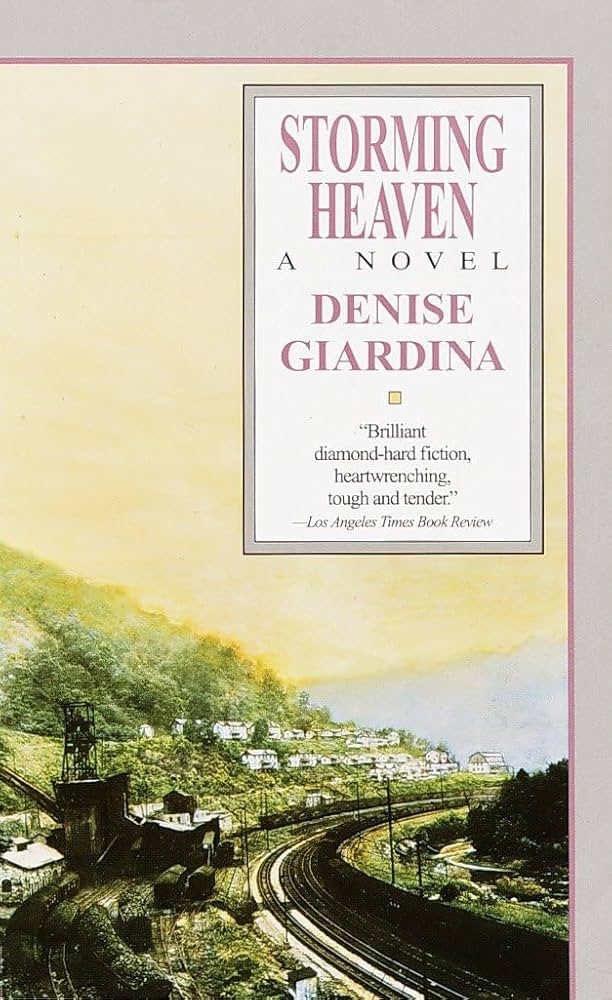
The second book was Storming Heaven, by Denise Giardina.
While it ends in roughly the same place as Rednecks, Storming Heaven covers the whole of the Mine Wars period, starting with the railroads coming into the West Virginia/Kentucky border area in the 1890s and buying up property using sketchy methods.
Beyond that, the two books differ in whose story is being told. The main characters in Rednecks are a local doctor (of Lebanese extraction, apparently inspired by one of the author’s ancestors) and a miner, both fictional, but lots of the smaller roles are filled by real people – Mother Jones, Sid Hatfield, and such. We get chapters from their points-of-view and some big speeches that are probably historically accurate. The downside is that they tend to drain the momentum of the main characters’ stories and can come off like one of those “you are there!” books for young readers.
By contrast, in Storming Heaven all the characters are fictional. They do occasionally interact with real people and some are fictional takes on real people – Sid Hatfield, for instance, gets a doppelganger who is also assassinated on the courthouse steps. In fact, the book takes place in a couple of fictional counties (one in West Virginia, on in Kentucky), but manages to interact with the “real world” enough to retain a sense of realism.
The result is that Rednecks feels like a book that was written to bring knowledge of a particular historical event to the public via fiction. That’s a noble pursuit and it’s certainly a mode of fiction that does a lot of work across literature, film, and TV. What it doesn’t really feel like is a story of people, characters, who feel alive and real in their own. I was far more engaged with Rednecks when it focused on the fictional doc and miner than when it leaned on actual historical figures.
Storming Heaven, by contrast feels like a fully fleshed out work of fiction that happens to be set during a particular historical period. I didn’t care about the characters because of the events they were living through, I cared about them as individuals. In the process, I think you get a better feel for what the historical period was like. No doubt, Rednecks is a lot more granular in terms of how Blair Mountain went down, but Storming Heaven hits harder emotionally, even with less historical detail.
I did an interview recently where I said that the most important element in good writing is building interesting characters. If you don’t care about the people to whom the events of the story are happening nothing else really matters. I think details of events are better left to non-fiction, to the work of historians and journalists. Historical fiction works best when it’s trying to capture the feeling of what it meant to live during the time period involved.
Or you can do what I do and plunder history for ideas and turn them into fantasy or sci-fi stories. Then there’s no worry about getting history “right” because the history is whatever you think it should be!



 JD Byrne