Sometimes It Just Doesn’t Work

NOTE: This post contains spoilers for the third season of The White Lotus, so if you care about that kind of thing come back later.

One of the things about oral argument is that appellate judges love hypotheticals. Even garden variety criminal appeals can present issues that will resound through multiple cases in lower courts, so judges like to use hypos to test the limits of potential holdings or outcomes in any given case. Judges hate it when they ask a hypothetical question and the answer from counsel starts with, “that isn’t this case, Your Honor.” No shit, counsel, now answer the damned question!

I got those kind of vibes reading some of the criticism of the season finale of The White Lotus and the reaction to it of the show’s writer/director/creator, Mike White.

So far, all three seasons of The White Lotus are setup the same way – we initially see a dead body at an outpost of the titular resort, then rewind to a week or so earlier as we see the events that lead up to that death. This season, the finale included a gun battle that ended in a higher-than-usual body count (five dead, by some reckonings).

Some folks (myself included) complained that the swift manner in which the episode and, therefore, season, ended felt rushed, as the main characters (who weren’t dead) departed on schedule and apparently unaffected by the carnage around them. It’s not unreasonable to think the Thai police would sweep down on the place and question these folks or that some of them might be so shattered by the experience that they needed some kind of assistance (a trio of main characters were right in the middle of the firefight!).

White’s response to that criticism doesn’t strike me as particularly compelling:

Mike White, the show’s creator, thought the armchair critics were being too literal, calling them the “logic police” in an interview with The Hollywood Reporter.

“This isn’t a police procedural, this is a rumination-type show,” he said. “It makes me want to pull my hair out. Is this how you watch movies and TV shows?”

There’s a fine line in criticism between knocking something for failing at what it’s trying to do and for not being what you think it ought to be (see, e.g, this review of Warfare that seems to condemn it for not being something other than it is). I’ve seen authors say they have a hard time reading for fun anymore because they can’t turn their writer-brain off and will try and think of how they’d have told the same story in a better, different way (I’m not casting stones – I can lapse into that mode, too). That seems to be what White is accusing critics of doing, but it doesn’t wash.

Nobody wanted or expected the show to turn into Law & Order: Thailand for the last half hour of the season (although a season arranged so that we know who died from the jump, with cops pushing rich dipshits out of their comfort zone, might be interesting), but it feels off to present not just on screen death but straight up murder (with multiple fatalities) and have it vanish into the atmosphere. Moreover if the show is, as White puts it, a “rumination-type show,” what event can cause more intense ruminations than witnessing a mass shooting? Granted they’re very different shows, but you can bet there’s some “rumination” going on among the characters of The Pitt following their mass shooting event.

Look, endings are hard and I understand that White had a lot of stuff left on the editing room floor due to time restraints, even with an hour-and-a-half finale. Still, sometimes it just doesn’t work or at least leaves people scratching their heads (as Bruce says, “not everything everybody does works all the time, son”). That doesn’t ruin all that came before it (it’s more about the journey than the destination, right?), but that also doesn’t mean people don’t have a point.

Sometimes you just have to accept the thing didn’t work and move on.

Thoughts on Rewatching “Homicide: Life on the Street”

Last fall one of the great injustices of the streaming world was remedied when the entire run of Homicide: Life on the Street (including the wrap up TV movie) was finally available to stream on Peacock.

Yes, some of the music cues had to be changed due to rights issues (miss my “No Self Control” drop!), but otherwise the show looks and sounds better than it has for years. Created by Paul Attanasio (with an assist from director and Balimore guru Barry Levinson) and based on a book by then-journalist David Simon called Homicide: A Year on the Killing Streets, the show broke a lot of ground for network TV and helped usher in the cable shows we now think of as peak TV, including Simon’s The Wire.

I wish I could say I was into Homicide from the jump, but the truth is I only remember being able to drop in here and there during the show’s original run. I liked what I saw, but it was harder to watch a specific show back in those days, kids (it was on Friday night for part of its run, for fuck’s sake!). Where I really picked up the show was on cable a few years later and, ultimately, by getting the entire series on DVD. In spite of having it right there, I hadn’t really watched it for years until it hit Peacock last year.

The relaunch on streaming led to a good deal of reportage on Homicide’s place in the TV pantheon, which caught my wife’s attention. She’d not seen much of the show, but decided it was worth diving in in light of the hype. How does the series hold up during a full-length rewatch after all these years?

Dramatically, Homicide holds up remarkably well. Part of that is due to the fact that it doesn’t look or feel like a product of 1990s network TV. If you listen to the (hopefully not gone for goode) podcast Homicide: Life on Repeat, Kyle Secor and Reed Diamond talk a lot about how differently the show was shot and other technical things that are, mostly, above my head. Still, it doesn’t feel like a TV show from thirty years ago, from an era with commercial breaks and network censors looking over everyone’s shoulders.

That extends to the storytelling itself, of course. The cops of Homicide are not (generally speaking) heroes out there braving the mean streets to make the world safe for democracy. They’re just men (mostly) and women trying to do a job and get through days filled with horror, pain, and uncooperative witnesses. Cases frequently remain unsolved (the “board” – a large dry-erase board that lurks to one side of the squadroom tracking open and closed cases – is practically a character itself). Unlike it’s NBC stablemate Law & Order things rarely go to court, so most often it’s the arrest, the clearance of the case, that matters, not ultimately whether justice is actually done. Homicide depicts police work as a grind, as a kind of assembly line, rather than a great, noble calling. It’s not unlike the practice of law, in my experience.

None of that would work without amazing work from the cast, both the series regulars and guests (again, like Law & Order, there are lots of “hey, they went on to . . .” moments). Secor, as Tim Bayliss, provides the perfect audience surrogate, the new guy to the squad who has to figure out the rhythms of the work and whether he should really be there are all. Andre Braugher rules as Frank Pembleton, master of “the box,” and the last person you want to sit down with for a chat. That the series doesn’t shy away from the fact that interrogations are often about tricking idiots into incriminating themselves adds a sleazy sheen to proceedings.

I’ve already mentioned Law & Order a couple of times and it’s impossible not to compare the two shows. I’m no Law & Order hater, in spite of my profession, but that show does seem to have a more upbeat attitude toward police work than Homicide does. A great example of that is two stories that dealt with suspects who really looked guilty, but the facts didn’t show it.

On Homicide, Bayliss’ first case as a primary is the sexual assault and death of a young girl, Adena Watson. Through most of the first season he and Pembleton try to build a case against a neighborhood fruit seller who really appears to be the best suspect, but they can never actually pin the murder on him. An entire episode is devoted to his interrogation, after which nothing has changed. The case remains unsolved (as did the real life inspiration in Simon’s book) and haunts Bayliss through the rest of the series. Viewers are left without any real closure, either.

Compare that to the Law & Order episode “Mad Dog” from 1997, in which a rapist prosecutor Jack McCoy had convicted years prior is released on parole, over McCoy’s furious objection. Shortly thereafter, there is a rape/murder in the neighborhood that bears the released guy’s modus operandi, but no real evidence to connect him. Detectives and prosecutors spend most of the episode deploying various tools of surveillance and coercion to trip the guy up, to no avail (McCoy is even chided by his boss for “dragging the law through the gutter to catch a rat”). It could have ended like that, with a sense of unknowing and asking serious questions about police conduct. Instead, a second assault is interrupted by the would-be victim taking a baseball bat to the skull of her attacker – who is, of course, the recently paroled rapist. In a flash we get closure and knowledge that not only had the cops and prosecutors been right all along, but that the bad guys’s dead, to boot.

All of this leads to an interesting question rewatching Homicide after all these years – is it copaganda? That is, do the stories it tells valorize police in a way that polishes their public image in a manner that can lead to the public letting police get away with stuff they never should get away with? Although it’s hardly a new phenomenon, I don’t remember “copaganda” being a term back during the show’s original run or it being discussed as such. There are certainly moments when the show leans that way – for all their faults, the cops are still fairly noble and have a sense of purpose as “murder police” (as Meldrick Lewis would put it), but overall it doesn’t really feel like it. These cops cut corners, unashamedly treat some murders as more worthy of solving than others, and worry about bulking up overtime. It’s not pure copaganda, at any rate, which makes sense given the issues many of the characters’ real-world analogues have had.

But I might be biased. For all the glory heaped upon The Wire, which is great, I always held Homicide in higher esteem. It seemed to get there first, but did it with constraints that would strangle a modern “prestige TV” series. After rewatching I still do. It’s an amazing achievement and, if you’ve not seen it, you owe yourself some binging.

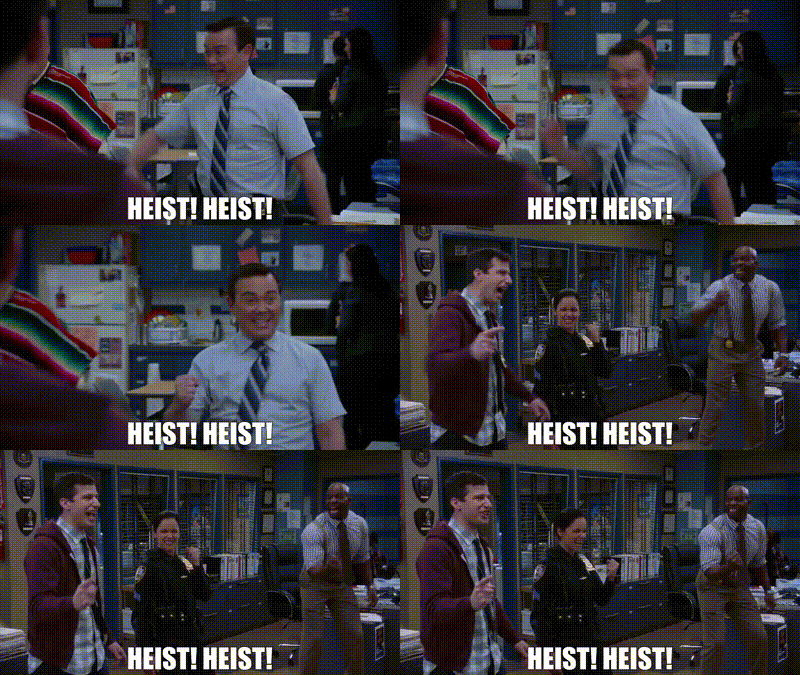
Revisiting the Concept of a Heist

A few years ago I wrote a piece about “heist” stories and what they are (or should be). My concept of the heist is narrower than it is for others (including the OED) and boils down to this:

The distinction, for me at least, comes down to brute force. A robbery can be elaborate and kinetic and exciting – think the beginning of The Dark Knight – but, at the end of the day, it’s “your money or your life.” It’s simple, effective, and brutal. “Heist” conjures up something more clever, more deeply thought out. It’s about getting the object of the robbery without the violence. It’s a better, more elevated, kind of crime, if you will.

The distinction came back to mind recently when the wife and I watched Heist, a 2001 David Mamet film starting Gene Hackman, Delroy Lindo, and host of others.

As you might expect, it involves thefts gone bad, but do they actually live up to my stickler’s definition of what a heist is?

There are actually two thefts in the movie, the first is more setup and the second the main event (the titular heist, one assumes). The first definitely doesn’t feel much like a heist to me. Yes, there is some subterfuge involved – the thieves drug the morning coffee of the employees of the jewelry store they’re going to hit, but that’s close to the line in terms of brute force (courts would consider the use of poison to be “violent,” in most instances). What clearly is brute force is the way they actually get in to the store – they just break down the door. Literally, it’s a forced entry. So I’d say this job is more a straight up robbery than a heist.

The second job is definitely more like it. The target is a bunch of Swiss gold on a cargo jet that’s about to leave the country. This is a heist, albeit one that doesn’t go off without a hitch. The plan is all subterfuge and distraction. The only violence involved arises because of an unexpected issue. When push comes to shove, Hackman’s character walks right in pretending to be somebody he’s not and walks out with the loot. Hell, the police response is more due to the diversionary explosion the crew uses at another part of the airport (this crew loves them some diversionary explosions) than the theft itself!

Indeed, that’s one of the neat things about the movie – there’s hardly any police presence in it. There are cops about (there’s one tense scene where a state trooper stumbles on their prep and a young hothead nearly turns it into a shootout), but there are no dogged investigators bearing down on the crew after the big score. Rather, they tear themselves apart in a series of betrayals and double-crosses. It’s too much (why care about what’s happening when it’s certain to be upended in a few minutes?), but it gets at another key element in distinguishing a heist from a garden-variety robbery – the ability to get away with the goods.

So, in the end, how heisty is Heist? Fairly heisty, I would say. The initial job is a straight up robbery, but the big set piece definitely has heist vibes. Doesn’t make it inherently more interesting than the first one, but it’s more compelling in different ways. It’s fun, which is a key to a good heist, in my opinion – even if the end result is an awful lot of dead folks.

New Short Story (from Me and Many Others)!

I’m happy to announce the release of Volume Two of Old Bones, the literary journal of Henlo Press.

Inside that cool cover you’ll find a bunch of stories (and other stuff) from writers from my neck of the woods – including me!

The story is called “Chord Change” and it’s based on an idea that’s been hanging around my brain for a while – what if someone’s solemn duty was to listen to the everlasting chord generated by the universe or the gods or whatever and the chord suddenly changed. The key to turning it into a story was to not make the listener the main character. Rather, it’s the guy she ropes into trying to help her talk back.

Here’s a snip:

Over the years, Kluvier had built up a repertoire of dozens of songs, from folk songs to cult hymns and chants. He would never be able to play with Andra’s finesse, but he had the ability to hear a song a few times, play it once, and then forever be able to retrieve it.

His first hour was always the same, a way to warm himself up and to gauge his audience. Some days the more modern, popular music was what people wanted. Other times the long, slow chords of cult hymns that had soaked into wider culture of the years provided the perfect background. Once that was out of the way, and Braax had his first break of the day, Kluvier would let his fingers wander, dipping in and out of known songs while taking tangents of variations on themes. During another break he heard a woman pass by whistling an odd-metered tune he’d never heard before. He worked on it, and several variations, for most of the next hour.

The predicted rain held off, which kept the traffic consistent. The coins dropping into the box were few and far between, but as the sun started fall behind the Great Library they at least started to clink against each other nicely when a new one was thrown in.

Kluvier let Braax off his turnwheel to attack a small bowl of water while he knelt and started counting the coin. He hoped to get everything counted and packed away before Valnu showed up to take his cut again. Kluvier was just about done when a human-shaped shadow fell across the box. Kluvier cursed under his breath, then a bag of coin thudded to the ground beside the box. He looked up.

“Is that enough?” It was Shyana. She was breathing hard and her robes, which had been so well put together yesterday, were dirty and mussed. There was a bruise starting to blossom under her left eye.

“What happened to you?” Kluvier grabbed the bag and stood.

“I did what I had to,” she said. “Is that enough?”

For more of that, as well lots of other great stuff, get your copy of Old Bones Volume Two here or here.

Storytelling Is Not Lying (Or Is It?)

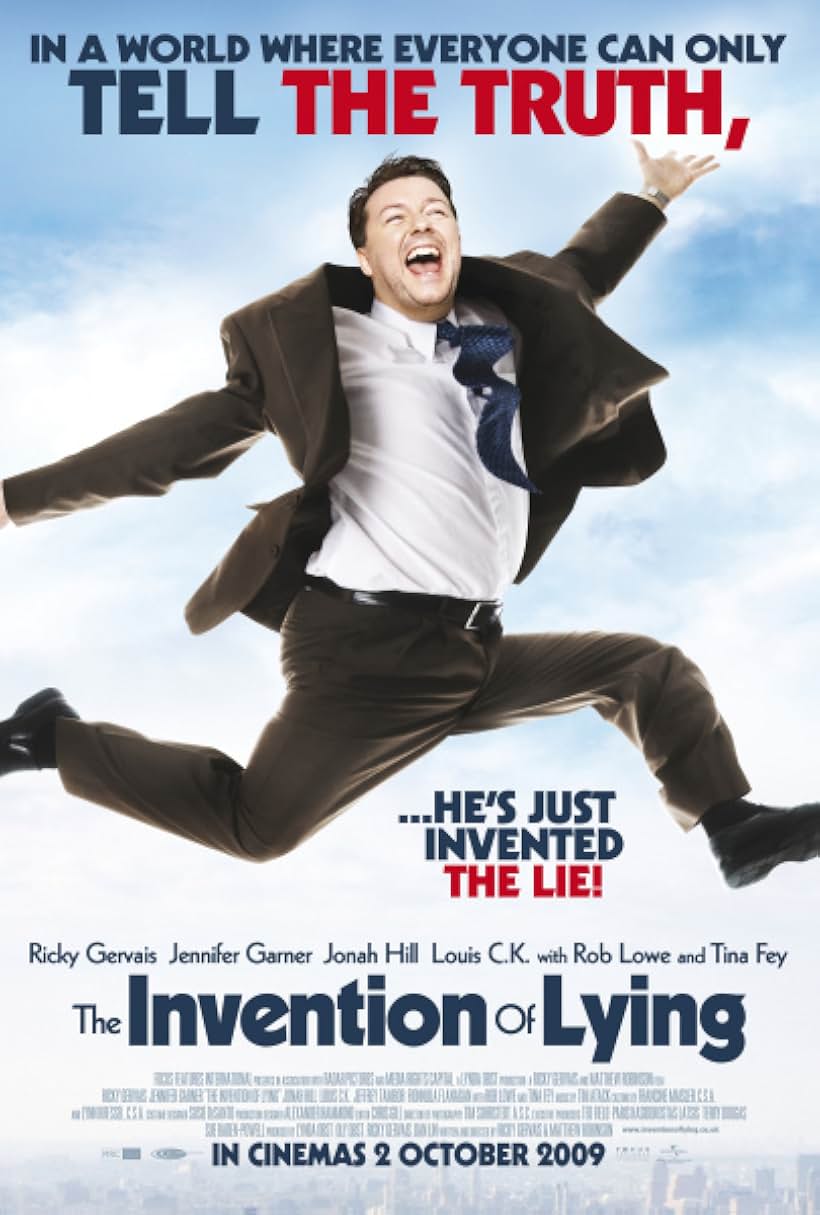
Years ago, Ricky Gervais made a movie (with his writing/directing partner Matthew Robinson) called The Invention of Lying.

Gervais starred (along with my high school classmate Jennifer Garner) as a screenwriter in a world where lying doesn’t exist. As a result, he’s limited to only writing movies about historical events since fiction does not exist. He winds up discovering how to lie, part of which is being able to write a fictional screenplay.

The movie itself is fine, but the part about fiction not being able to exist in a world without lying always stuck in my craw. Then, a few weeks ago, I saw this on Facebook:

And that sticking came back with a vengeance (although she was sharing it in a humorous way). Because, you see, the notion that fiction – storytelling – is “lying” is simple-minded bullshit.

George Constanza famously said that a lie isn’t really a lie if you believe it, but that kind of goes both ways – a lie is really only a lie if the people hearing it expect it to be true. This is most evident when you’re talking about lying in court – perjury. Any witness, before they say a word to a jury or answer a single question, either takes an oath to or affirm that they are going to tell the truth. Jurors are primed to believe them.

But the same is true for most everyday interactions. When I ask my wife how her day was I don’t expect her to lie to me, after all. We may not be completely accurate with others all the time (that’s probably beyond the capability of human brains), but, for the most part, we’re not trying to lie to others on a regular basis. There’s an expectation of truth, at the very least.

Fiction, by contrast, announces itself from the start. “This is not real,” it says, “this is made up.” Even if there are close cases on the margins (including, ironically, stories about historical events and figures), nobody would ever say that The Lord of the Rings or 2001 or what have you were anything other than made up stories designed to entertain and enlighten. They are not presented as fact.

Of course, sometimes storytellers lie as part of the fiction. Fargo famously starts with a disclaimer:

This is a true story. The events depicted in this film took place in Minnesota in 1987. At the request of the survivors, the names have been changed. Out of respect for the dead, the rest has been told exactly as it occurred.

Amusingly, the Coen Brothers have changed their own story over the years as to whether the story of Fargo had some basis in real events or was completely made up. Does that make the movie any more of a “lie” either way? No! It’s a work of fiction, a story being told by storytellers. We’re not supposed to take it as truth.

For a certain definition of “truth,” of course. The argument goes that fiction can often get at truths about the human experience that non-fiction can have a hard time grappling with. That’s probably correct in some instances, although I can’t speak from experience. The stories I write are, I hope, entertaining and engaging, but any brush with deeper cosmic truths is probably coincidental.

As a wise man once said:

So, yeah, writers and other storytellers do make stuff up. It’s kind of the business model (the hard part is making up stuff nobody else has come up with yet!). But that’s what people think we do, right? Nobody could ever possibly believe we’re telling the truth.

Or maybe I’m full of shit? You’ll never know!