One of my favorite podcasts is Mary Versus the Movies, in which the titular Mary watches a popular movie from the 1980s she’s never seen and then discusses it with her co-host/husband (I think that’s who he is). It’s a fun setup, as each episode starts with what she thinks the movie is about before watching it, which is sometimes hilariously wrong.
On a recent episode the subject was 2010: The Year We Make Contact, the sequel to 2001: A Space Odyssey, directed by Peter Hyams. Of course, it’s impossible to talk about a sequel without talking about what came before, but that’s doubly true of 2010 and 2001, which are completely different types of movies. It’s like comparing OK Computer to Kid A – it’s as much about what the sequel is not compared to the first one as anything. For what it’s worth, I think 2010 is a pretty solid flick, but it pales in comparison to Kubrick’s masterpiece.
Part of the discussion these movies, inevitably, involved their relation to the books of the same name. That brought to front of mind that I’d never actually read Arthur C. Clarke’s novel 2001: A Space Odyssey. Seemed like as good a reason as any to get it from Audible and give it a listen.
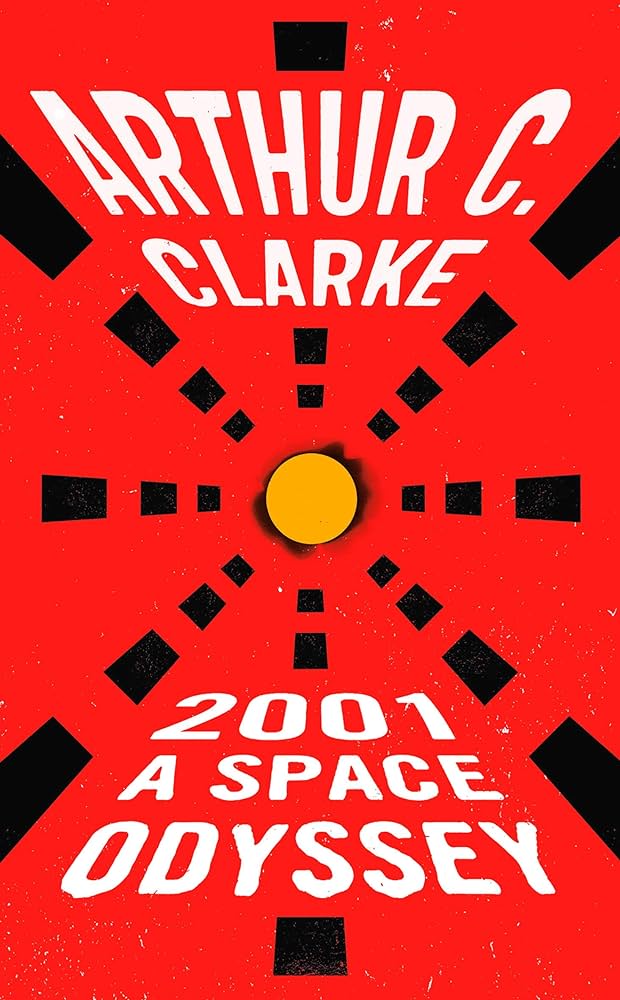
Kubrick is one of my favorite directors and 2001 one of my favorite movies of his, so it was impossible for me to read Clarke’s version of 2001 with completely fresh eyes. It also defies the usual analysis of looking to how the movie “adapted” the book since, in this case, the movie and book developed on parallel tracks – neither was an adaptation of the other. Which is particularly odd since, in terms of what happens, they track each other pretty closely.
The biggest difference from book to movie is the destination of Discovery’s journey. In the book they’re headed to Saturn, but in the movie it’s Jupiter. Apparently the change was due to the effects folks not being able to make Saturn’s rings convincing, so Kubrick moved the destination to Jupiter (ironically, the novel of 2010 – upon which that movie really was based – retconned the story to have them go to Jupiter). There are other minor differences – the monoliths aren’t all black and have particular measurements, we learn why HAL went apeshit, etc. – but for the most part the book is as faithful to the movie as it could be, given the circumstances.
Which is both a blessing and a curse. A blessing because they kind of play into each other and can help folks grasp what’s going on. It’s a curse because that means the main difference between book and movie is the execution and, on that score, Clarke simply can’t compare.
I’ve read some Clarke before, including Rendezvous With Rama, which is another one of his classics. It’s got a great idea at the core – an alien object enters the solar system and a research crew goes out to meet it. The book is basically their exploration of this vast ship. I found it pretty dull, without any real character development or emotional pull into the story. The exploration itself was, I’m sure, rigorously scientific and accurate, but for me there was no “there” there.
A lot of 2001 feels the same way. There are long stretches where Clarke describes the nature of space travel and how everything works that were probably fascinating back in the 1960s when this was all new but didn’t do anything for me. For instance, there’s a chapter where the Discovery crew tries to closely observe a passing asteroid – there’s no threat or danger, no chance that something will go wrong, just a chance to exercise some scientific curiosity. That’s a great thing! It just doesn’t make for compelling fiction, necessarily.
Of course, a lot of the movie is fairly slow and not exactly action packed, but the visual and audio work Kubrick does makes that work, creating a sense of deepening isolation as Discovery plows further on. Clarke tells us the numerical details of that isolation, but doesn’t show it in a way that creeps into your bones. That said, some of what works best for me about Clarke’s writing comes in the parts that are hardest to conceive of being written on the page, namely the stuff with the apes in the beginning and the whole “journey into the infinite” in the end.
Another area where the novel falls down are characters. None of them are particular interesting and exist mostly to talk about Clarke’s tech stuff and move the plot along. The movie isn’t much better, but it has one redeeming aspect in this area – HAL.
In both the book and movie HAL slowly goes crazy and starts killing people. As I said, the book tells us why (2010, the movie, does that, too), which takes some of the mystery and terror out of it. HAL comes across as a problem to be solved (and fairly quickly, at that) rather than a sentient, malevolent being.
The movie’s HAL, on the other hand, is one of the most chilling characters every to grace a movie screen. Not for nothing did HAL rank 13th on the American Film Institute’s list of greatest movie villains. The cold precision with which HAL goes through everything makes what he does so terrifying. Yet, the scene where Bowman shuts HAL down and he starts to sing is heartbreaking. Those scenes on the written page just don’t pop in the same way (I’m not sure any writer could have made them compete).
As for the endings, well, I think it depends on what you want out of your fiction. Clarke’s ending makes much more “sense,” in that he largely lays out precisely what’s happening, and it’s done fairly well. Again, though, it’s hard to top the movie’s visual/aural mindfuck that spits you out on the other side more bamboozled than before. Probably because I came to the movie first I prefer the ambiguity. It has that “what the fuck?” quality I talked about a few weeks ago that I dig in art sometimes.
It’s generally a fool’s errand to look at a book and a movie based on it (or vice versa) and determine which one is “better.” The written word and film are different mediums that reach the soul in different ways. What works well on the page might not on the screen (and vice versa). That’s doubly true with 2001. I can’t say the movie is “better” than the book, but I can say I prefer it. It transports me in a way Clarke’s prose doesn’t and leaves more of a lasting impression. Still, I’m glad to have read the book, if only to again realize how fruitless such comparisons are.
And neither of them are as groovy as Mike Keneally’s “2001,” anyway.
 JD Byrne