It’s that time of year again! No, not when the lungs are clogged with clods of pumpkin spice, but when it’s just about National Novel Writing Month!
As I wrote a little while back I’ve got a new project ready to go for NaNoWriMo this year. I’ve got a few more days to put to finishing touches on my planning and then it’s off to the races on Monday. Needless to say, there won’t be any new posts for November, and maybe even into December if I’m on a roll.
People create for lots of different reasons. Some folks do it purely for the fun or catharsis of creation. Some do it as a vocation, if they’re good at it, enjoy it, and can hit the market just the right way. Others are trying to tap into something fundamental about humanity or probe deep into the eternal mysteries of the universe. And some just want to share their creation with the world and hope it brings a few people joy.
I fall into that last category. I write largely because I enjoy it, because it’s fun to tell stories, and I hope some other folks out there will enjoy reading them. I’m not trying to write the “great American novel” or plumb the depths of the human condition to help better understand my fellow people. All I’m really interested in is entertaining, maybe more thoughtfully sometimes, but that’s it.
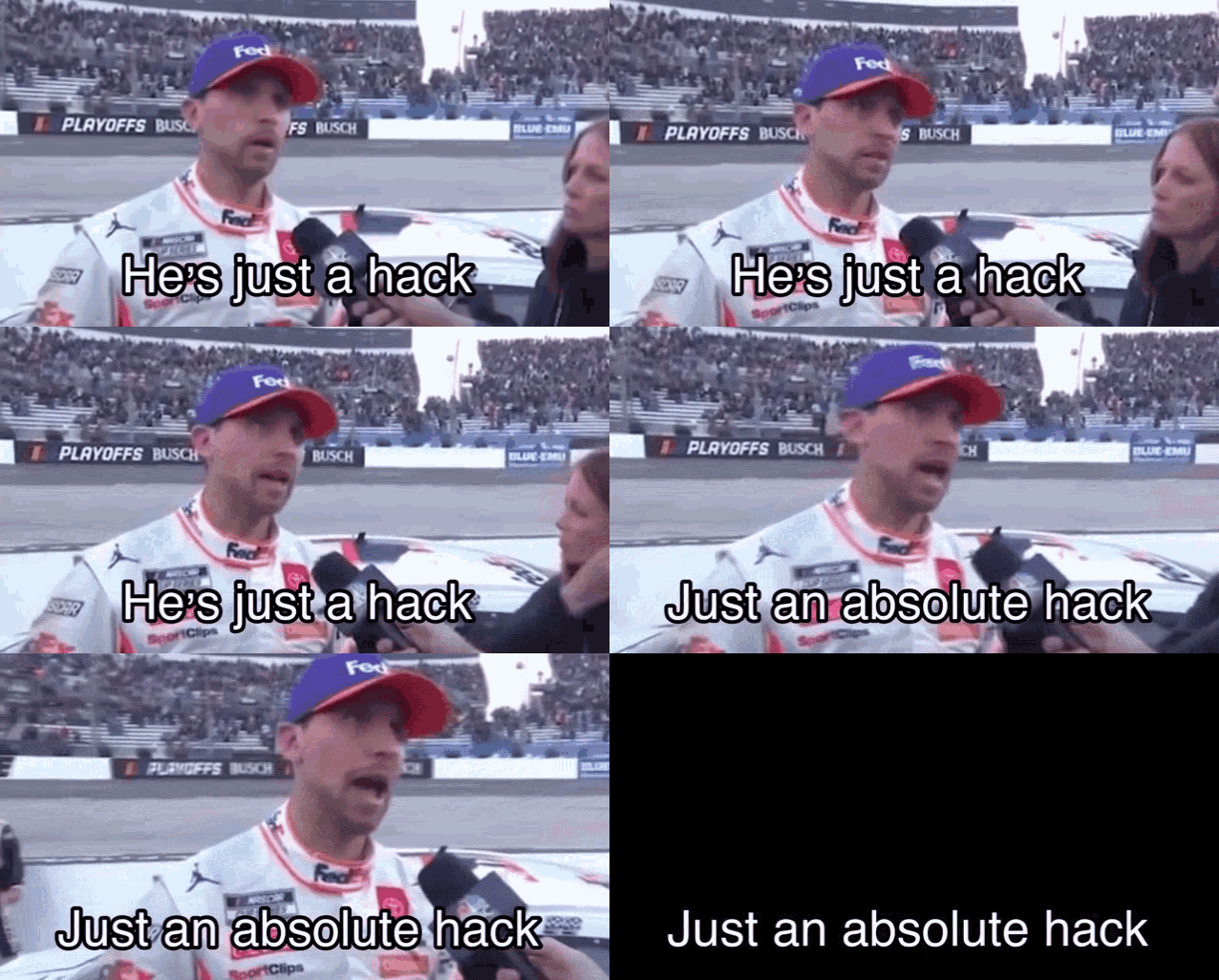
Does that make me a hack?
I never thought so until recently. To my mind, “hack” was a pejorative term. Wikipedia, at least, agrees with me, defining a “hack writer” as a:
Term for a writer who is paid to write low-quality, rushed articles or books “to order”, often with a short deadline. In fiction writing, a hack writer is paid to quickly write sensational, pulp fiction such as “true crime” novels or “bodice ripping” paperbacks. In journalism, a hack writer is deemed to operate as a “mercenary” or “pen for hire”, expressing their client’s political opinions in pamphlets or newspaper articles. Hack writers are usually paid by the number of words in their book or article; as a result, hack writing has a reputation for quantity taking precedence over quality.
Putting to one side the unwarranted bias against “pulp” writing or romances inherent in that definition, it’s clear that being called a hack is insulting. It’s a charge that your insincere, only in it for the money, not making art but some kind of crass commercial product. If I was called a hack I’d be deeply offended, same as if someone in my professional life called me a shill or a mouthpiece.
But maybe I’m looking at things all wrong, if this Slate piece by Sam Adams is right. Titled “Bring Back the Hack,” it argues that movie studios should look to “hack” directors to helm their big-budget franchises rather than getting up-and-coming auteurs whose singularity tends to get squished in the franchise machine, anyway:
The problem here is two-pronged. The first is Hollywood’s penchant for sucking promising young directors into its maw, tempting them into selling their artistic souls to the franchise devil with medium-fat paychecks and the possibility of speaking to a larger audience. The second is that the movies frequently end up being lousy, extinguishing whatever hint of personality made the filmmaker attractive in the first place and revealing them to be hopelessly out of their depth when tasked with bending a massive studio movie to their will. You don’t get the unique stamp of an artist, but you also don’t get the frictionless craftsmanship that would be brought to the job by a seasoned old hand—in other words, a hack.
Adams seems to deem the primary feature of a “hack” as being that “you don’t know who they are.” He then launches into a discussion distinguishing workmanlike directors such as Jon Turtletaub and even John Huston from true auteurs. Later on, however, he sort of admits that “hack” isn’t really the word he’s looking for:
That’s where hacks come in. A hack—or, if you insist on a less prejudicial term, a craftsperson—isn’t out to make a movie their own. Their aim is to fulfill the task set before them. Like former cinematographer Jan de Bont and former costumer designer Joel Schumacher, they often entered the business from the lower ranks of the crew rather than as writer-directors, rising to the top with an understanding based in the practicalities of production. A hack is a perfect match for a formula film, whether it’s the latest IP extension or simply squarely in an established genre, because they don’t consider themselves better than the material.
This “craftsperson hack” category includes, for Adams, people like Ron Howard (who won Best Picture and Best Director Oscars for A Beautiful Mind) and Jon Favreau (who launched the most successful film series in history, not to mention The Mandalorian). If those guys are hacks then I suppose I’d be happy to be called one, though that term doesn’t feel right. Neither is somebody that’s on my list of favorite directors, the kind of people whose stuff I want to see just because they made it. But Adams cites Favreau’s going to battle with the studio to cast Robert Downey, Jr. for Iron Man, which hardly seems like a pliant, go-along-to-get-along kind of thing. Hell, if hacks can make stuff like Rush then sign me up.
At any rate, I don’t think the same kind of distinction can be made with writers. Name brands are a thing, after all, since people like to read more books from an author if they liked one of their books. That applies equally to deeply sublime stuff and more pulpy just-for-fun stuff. I suppose the closest thing you have in books is situations where some established author’s name continues to hold sway even though others are actually writing the books. Zombie comic strips come to mind, too, I suppose.
I tend to agree with Adams that bringing in somebody known for their personal vision in movies to direct the next comic book flick is kind of a waste. Regardless, I don’t think defining hack so broadly as to lose its meaning does anybody any favors. Leave to it the stain of uncaring make work, produced without any personal motivation.
I may be a lot of things, but I think I’m safe in saying I’m not a hack.
One of my favorite podcasts is Mary Versus the Movies, in which the titular Mary watches a popular movie from the 1980s she’s never seen and then discusses it with her co-host/husband (I think that’s who he is). It’s a fun setup, as each episode starts with what she thinks the movie is about before watching it, which is sometimes hilariously wrong.
On a recent episode the subject was 2010: The Year We Make Contact, the sequel to 2001: A Space Odyssey, directed by Peter Hyams. Of course, it’s impossible to talk about a sequel without talking about what came before, but that’s doubly true of 2010 and 2001, which are completely different types of movies. It’s like comparing OK Computer to Kid A – it’s as much about what the sequel is not compared to the first one as anything. For what it’s worth, I think 2010 is a pretty solid flick, but it pales in comparison to Kubrick’s masterpiece.
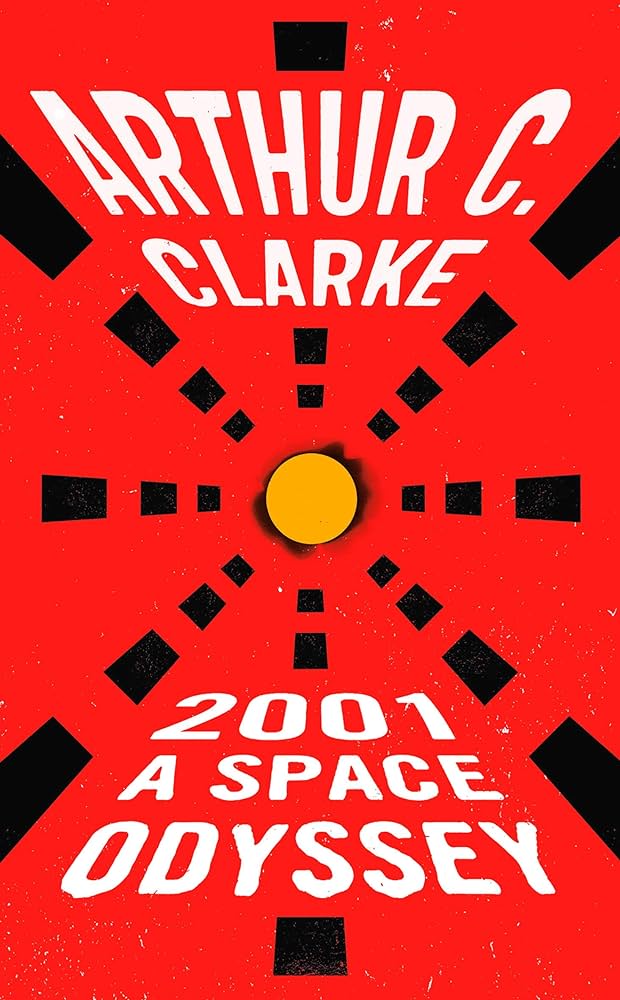
Part of the discussion these movies, inevitably, involved their relation to the books of the same name. That brought to front of mind that I’d never actually read Arthur C. Clarke’s novel 2001: A Space Odyssey. Seemed like as good a reason as any to get it from Audible and give it a listen.
Kubrick is one of my favorite directors and 2001 one of my favorite movies of his, so it was impossible for me to read Clarke’s version of 2001 with completely fresh eyes. It also defies the usual analysis of looking to how the movie “adapted” the book since, in this case, the movie and book developed on parallel tracks – neither was an adaptation of the other. Which is particularly odd since, in terms of what happens, they track each other pretty closely.
The biggest difference from book to movie is the destination of Discovery’s journey. In the book they’re headed to Saturn, but in the movie it’s Jupiter. Apparently the change was due to the effects folks not being able to make Saturn’s rings convincing, so Kubrick moved the destination to Jupiter (ironically, the novel of 2010 – upon which that movie really was based – retconned the story to have them go to Jupiter). There are other minor differences – the monoliths aren’t all black and have particular measurements, we learn why HAL went apeshit, etc. – but for the most part the book is as faithful to the movie as it could be, given the circumstances.
Which is both a blessing and a curse. A blessing because they kind of play into each other and can help folks grasp what’s going on. It’s a curse because that means the main difference between book and movie is the execution and, on that score, Clarke simply can’t compare.
I’ve read some Clarke before, including Rendezvous With Rama, which is another one of his classics. It’s got a great idea at the core – an alien object enters the solar system and a research crew goes out to meet it. The book is basically their exploration of this vast ship. I found it pretty dull, without any real character development or emotional pull into the story. The exploration itself was, I’m sure, rigorously scientific and accurate, but for me there was no “there” there.
A lot of 2001 feels the same way. There are long stretches where Clarke describes the nature of space travel and how everything works that were probably fascinating back in the 1960s when this was all new but didn’t do anything for me. For instance, there’s a chapter where the Discovery crew tries to closely observe a passing asteroid – there’s no threat or danger, no chance that something will go wrong, just a chance to exercise some scientific curiosity. That’s a great thing! It just doesn’t make for compelling fiction, necessarily.
Of course, a lot of the movie is fairly slow and not exactly action packed, but the visual and audio work Kubrick does makes that work, creating a sense of deepening isolation as Discovery plows further on. Clarke tells us the numerical details of that isolation, but doesn’t show it in a way that creeps into your bones. That said, some of what works best for me about Clarke’s writing comes in the parts that are hardest to conceive of being written on the page, namely the stuff with the apes in the beginning and the whole “journey into the infinite” in the end.
Another area where the novel falls down are characters. None of them are particular interesting and exist mostly to talk about Clarke’s tech stuff and move the plot along. The movie isn’t much better, but it has one redeeming aspect in this area – HAL.
In both the book and movie HAL slowly goes crazy and starts killing people. As I said, the book tells us why (2010, the movie, does that, too), which takes some of the mystery and terror out of it. HAL comes across as a problem to be solved (and fairly quickly, at that) rather than a sentient, malevolent being.
The movie’s HAL, on the other hand, is one of the most chilling characters every to grace a movie screen. Not for nothing did HAL rank 13th on the American Film Institute’s list of greatest movie villains. The cold precision with which HAL goes through everything makes what he does so terrifying. Yet, the scene where Bowman shuts HAL down and he starts to sing is heartbreaking. Those scenes on the written page just don’t pop in the same way (I’m not sure any writer could have made them compete).
As for the endings, well, I think it depends on what you want out of your fiction. Clarke’s ending makes much more “sense,” in that he largely lays out precisely what’s happening, and it’s done fairly well. Again, though, it’s hard to top the movie’s visual/aural mindfuck that spits you out on the other side more bamboozled than before. Probably because I came to the movie first I prefer the ambiguity. It has that “what the fuck?” quality I talked about a few weeks ago that I dig in art sometimes.
It’s generally a fool’s errand to look at a book and a movie based on it (or vice versa) and determine which one is “better.” The written word and film are different mediums that reach the soul in different ways. What works well on the page might not on the screen (and vice versa). That’s doubly true with 2001. I can’t say the movie is “better” than the book, but I can say I prefer it. It transports me in a way Clarke’s prose doesn’t and leaves more of a lasting impression. Still, I’m glad to have read the book, if only to again realize how fruitless such comparisons are.
And neither of them are as groovy as Mike Keneally’s “2001,” anyway.
It’s one of the most iconic moments in all of Star Trek lore – hell, in all of science fiction. The “death” of Spock:
Spock’s mantra is a callback to his earlier pontification of the maxim that “the needs of the many outweigh the needs of the few.” It’s a stirring call to sacrifice for the betterment of your fellow being, a dictum that sounds throughout different ethical systems and religions. A personal best practice it’s hard to argue with (if also hard to follow).
But it’s also kind of fucked up, if you think about it.
I think the writers of Silo thought about it. Adapted from the Wool series by Hugh Howey, Silo’s first season on Apple TV wrapped up not too long ago. It’s a slice of post-apocalyptic sci-fi with a twist – it takes place almost entirely in a silo that stretches for dozens of levels underground, where survivors of some catastrophe eke out an existence via strict rules and superb logistic coordination.
Naturally there are secrets and lies and all that good stuff, which the main character doggedly sets out to uncover. Hovering over her is the interim mayor of the silo, played by Tim Robbins, who eventually turns heel and when he does he says a quite interesting thing:
Holy shit – “the needs of the many” – significant pause – “require the sacrifices of a few.” I can’t be the only one who thinks that’s not a coincidence.
Star Trek is generally thought of as utopian, aspirational sci-fi. Sure, there are baddies like Romulans and The Borg and The Dominion running around making the universe a mess, but, for the most part, life in Trek land is pretty good. Most people in the Federation get to lead a life they feel is fulfilling and, it appears, nobody has to do shit work for money. It’s not quite as decadent as The Culture universe, but it’s getting there.
Trek isn’t unique in presenting a positive human future (indeed, there’s some argument that sci-fi by definition has to be of that persuasion), but it’s probably the best well known. And its achieved that in a world that, at least in the last few decades, seems much more interested in exploring various dystopias than it is speculating how science might solve humanity’s problems. Silo fits snuggly into that dystopian field and stands as almost a challenge to the Trek view of the future.
Which is why I can’t believe its swerve on “the needs of the many” is an accident. There’s no reason it should be. As I said, Spock’s maxim is a generous rule of thumb to guide personal interactions. As a societal principle, however, it doesn’t take took long until it looks pretty dangerous. You don’t have to go very long down the slippery slope before you’re severely restricting personal freedom in name of the greater good (see also, Omelas, of course).
What makes dystopias so rich is that their fundamental dilemma is one we deal with everyday in the real world. I have to strain my imagination to imagine a world of little scarcity where anything I can dream of needing can be pumped out of a replicator. On the other hand, it’s not too far to buy into a society run by a guy who thinks the only way for life to survive is to brutally crush dissent, given human history since, well, ever.
It doesn’t make one better than the other, but we rarely see them in conversation with each other. I think that’s what Silo was doing. As a slogan, “the needs of the many outweigh the needs of the few” looks good on a coffee mug, but that doesn’t mean it can lead society to some very dark places. The road to hell being paved with good intentions and all that.

 JD Byrne