Decision Made (Finally!)

The more I write the more I realize that coming up with ideas isn’t the hard part. What’s hard is figuring out which ideas have legs and can become stories or books. Sometimes it takes some hard work to separate the wheat from the chaff, so to speak.

When Heroes of the Empire came out in June  it brought to a close a long period of focusing on one world and one project. Since 2018, at least, when I started the first draft of Gods of the Empire, I’d basically lived in the world of the Unari Empire, building it out and telling the stories of my characters in it. The only reason I felt able to work on the sequel to Moore Hollow in the spaces between those books was that it meant returning to a world I already knew.

At the same time, I was gathering ideas like some thieving magpie, putting them away in various Word documents for a later date. I knew from the time I collected them that some had more substance than others, but I wasn’t quite prepared for how long it would take me to figure out which ones were which.

See, the thing with trilogies, at least for me, is that they are an implicit promise to the reader – I know how this ends and I’m going to finish it in good time. If I say “here’s my new book, it’s the first part of a trilogy,” rest assured that, barring some unforeseen circumstance, I’m working on those books for the next few years.

Which means, back in June, I got really excited about the idea of diving into a new world. Part of what makes writing fantasy so fun is you get to let your imagination wander and come up with strange new places, things, and people. Writing a trilogy means that you have to put that wandering on hold and I was happy to get my walking shoes back on (so to speak).

And I had a target – I wanted to start my next book during National Novel Writing Month. I’ve done that for several of my books. NaNoWriMo provides a great way to focus on writing for a month, even if what you’re left with on December 1 is only two-thirds or even one-half of a finished manuscript. That would give me a couple of months to build the world, flesh out the characters, and then figure out what was going to happen to them.

Easy, right? If only.

I actually had to go through my idea files pretty brutally, with virtual red pen and everything, and just get rid of stuff that didn’t really strike my fancy. Some of those were mere ideas (“surely there’s a fantasy story in the Scapa Flow incident, right? What about High Noon but with wizards!”) that were never going to become a real story. Others were things that I’d hung on to so long without developing that I figured their time had passed. Ultimately, they were ideas that I just didn’t see sprouting stories and I hadn’t faced up to that fact yet.

In the end I had about three dozen ideas that could become my next project, so I decided to so what my anal retentive self always does – start dividing and conquering them. I put each idea into one of four groups – Sci-Fi, Older Fantasy, Newer Fantasy, and Non-SF/Fantasy (yes, I’ve got a couple of those). The goal was to produce a “winner” in each group and then compare those four to each other. I almost worked – I wound up with five finalists because I couldn’t decide between the top to Newer Fantasy ideas.

I worked through each idea. I took a week and spent one day thinking through all the angles I could for every one. I did a PowerPoint presentation for my wife to get her feedback on the ideas. Good ideas that I at first thought were front runners fell by the wayside either because they weren’t as deep as I’d hoped or they just weren’t singing to me.

Finally, last week, I was in Richmond for court and had some time the night before to work through the final three (don’t worry, my colleague was doing the argument the next morning). I walked around my hotel room, talking to myself, arguing the pros of a particular idea then playing devil’s advocate and tearing it apart. After a couple of hours, and a really enormous calzone, I finally made a decision.

My next project has the working title The Fall. It’s inspired by the sad tale of Franz Reichelt, a Parisian tailor who met an infamous fate:

To use an awful pun, that’s the jumping off point for this project. It’ll be set in a similar kind of world, timeline wise, but include what I think is a really nifty magical element. This is my first time building a magic system for one of my novels, so I’m both anxious and excited about the prospect. Structurally I’m leaning toward doing something like Citizen Kane, where the main character is investigating someone’s life and we see it play out in flashbacks.

All in all, I’m really looking forward to diving into this.

And, yes, it is the one my wife liked best.

Some Thoughts On My Alma Mater(s)

It’s always nice when you see Margaret Atwood share a picture of your alma mater(s)’s most distinctive building! Oh, wait:

Yes, West Virginia University, from which I obtained my two degrees, has been in the national news recently and not for anything good (although the men’s soccer team is nationally ranked!). Faced with a tens-of-million dollar shortfall, the WVU administration has decided to cut numerous class offerings and majors. As the faculty open letter Atwood highlights puts it:

WVU’s current crisis has received significant national news coverage over the past few weeks. Faculty and staff heard vague rumors about financial problems in late 2022, but the deficit was publicly announced only in March 2023. The crisis is largely caused by financial mismanagement; the university is running a $45 million deficit after a decade of real estate boondoggles, administrative bloat, and declining state funding. Instruction costs have declined but the administration is responding to the budget deficit by proposing a mass layoff of around 170 faculty and an undeclared number of staff this fall on top of 135 layoffs over the summer. Many departments may be closed or gutted to the point of not being able to function. Academic support units are also suffering: the library was forced to reduce its operational budget by thirty percent and currently cannot purchase books. Not a single senior administrator—many making at least five to ten times what most faculty earn—is taking a pay cut.

Beyond the fact that the administrators who got WVU into this mess aren’t likely to face any repercussions (Gordon Gee, WVU president who presided over all this mess, will retire to a spot on the College of Law faculty – the academic version of a corrupt prosecutor becoming a judge, I suppose), what really bothers me about all this is WVU’s insistence that everything is actually fine.

I got an email the other day (at my work email address, for some reason), titled:

It says, a little further one:

Due respect, but no, it won’t be the same University I know and love. For one thing it will be diminished as a teaching institution. How couldn’t it? The email (and other news releases) cite the relatively low number of students majoring in, say, foreign languages, but that minimizes the issue. How many future WVU students will be denied the experience of a former colleague of mine who, via the foreign language requirement for her major, wound up studying abroad and widening her horizons in ways that still impact her today?

For another, the reputation of WVU will take a hit due to all the negative coverage of this mess. Sad to say, most people already don’t have a mental picture of that “West Virginia University” is a citadel of higher learning. That the main move here in dealing with a budget shortfall isn’t “find the money somewhere,” but rather gut a bunch of academic programs sends the signal that they’re impression isn’t that far off. That only degrades the degrees already handed out and will stigmatize students going forward.

And really, did someone type this with a straight face?

It’s not a “budget crisis,” merely a “structural budget shortfall”! Orwell would be proud. Here’s the thing, in my line of work the “structural” modifier only makes it worse. Really, there’s no way to sugarcoat the bottom line that the school spent too much money in anticipation of students that have not arrived. Maybe that was an honest “oopsie” instead of a growth-driven fever dream that somebody should have tried to cool off, but either way – WVU is short a shitload of money.

And now, we learn, the hits keep on coming:

University leadership have also been reviewing WVU’s academic support programs for potential cost-saving changes.

Programs under review include the libraries, Honors College, Office of Global Affairs, LGBTQ+ Center and the Women’s Resource Center.

Also on the chopping block is WVU Press, the book publishing arm of the school, which recently had one of its titles be a finalist for the National Book Award (among a host of other awards). These are not the kinds of things you cut if you’re trying to attract students and maintain the school’s reputation as a big-time research institution. The way things are going I’m afraid this isn’t too far from the truth:

Except we’ve been nowhere near a “massive” football program for years.

Fuck.

Weekly Watch – Quick Hits

Sometimes the weekend passes in a string of movies – not even very good ones. That was the case this past weekend as the wife and I fell down a Netflix rabbit hole (so to speak – around these we also consumed the final season of Disenchanted, of which I’ll have more to say later). I suppose a 1 out of 3 average isn’t bad from a baseball stat point of view, even if the one is more of a bloop single than anything more impressive.

Spoilers ahoy! Don’t say I didn’t warn you.

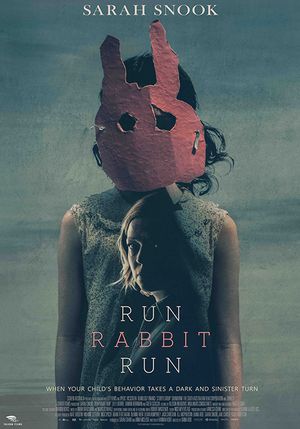
Run Rabbit Run (2023)

Sarah Snook (Shiv Roy of Succession fame – who knew she was Australian?) stars as a mother, Sarah, struggling with a troubled daughter, Mia, in the overlong, but often creepy, horror flick. In the wake of Sarah’s father’s death, Mia starts to behave strangely, insisting on meeting her grandmother she’s never seen before, and referring to herself by a different name – Alice, the name of Sarah’s long “lost” sister. Things proceed from there, usually because Sarah makes the worst possible decision at any given opportunity until she and Mia are holed up in a rural farmhouse where bad things continue to happen.

The deep mystery here is what happened to Alice, who appears to be possessing Mia. We’re never given any even implausible mechanism for this to happen, by the way. We know Sarah had some part in what happened to Alice because she’s haunted by guilt. Eventually we find out why – she pushed her sister off a cliff. Not by accident, not in a fit of passing rage. Nope, she just flat out murdered her sister. This is an odd narrative choice as is zaps any sympathy we have for Sarah, to the point that when we see Alice walking Mia toward the cliff you almost think justice might be done.

As I said, the movie is about a half hour too long. To its credit, it does maintain creepy vibes the whole time and the actress playing Mia does a good job of making her stand out in a film world flooded with odd, creepy children (although she’s not the best of the weekend – which is saying something). Snook is good, too, but the whole thing really doesn’t amount to much in the end.

As an aside, Sarah’s ex-husband (and Mia’s father) is played by Damon Herriman who will forever in my head by Dewey Crowe from Justified and manages to turn up in just about everything Australian I see these days.

In the Shadow of the Moon (2019)

I thought this flick had a pretty decent idea behind it – a cop tracks a serial killer over decades because they only strike every nine years. Cool! What I didn’t realize until we actually started watching this is that less than a detective story this was a half-baked fantasy story (the “science” nodded at is too silly to really call it sci-fi) with some appalling ethics at the core of it.

All that would go down better if the actual stuff on screen was actually better. Nothing particularly works, from the setup (why start the main character off as a beat cop who wouldn’t have anything to do with detective work and the, just as quickly, kick him off the force?) to the writing to the acting (Boyd Holbrook was much better in Justified: City Primeval, even if he was overshadowed by the return of Boyd Crowder in the last ten minutes) to the laughable explanation for all this (it involves time travel and the moon – seriously).

With all that said, it could have been kind of a fun lark if it hadn’t trampled all over one of the classic historical “what if?”s – if you could go back and strangle the infant Hitler in his crib, would you? It’s a thorny ethical dilemma, since at that point infant Hitler is completely innocent and hasn’t done anything to anybody – doesn’t that make it straight up murder (maybe Sarah could push him off a cliff?)? And even if you did it, would it make a difference, or were the forces at work in Weimar Germany of a sort that the Nazis would have seized power anyway?

This movie jettisons all those thorny ethical issues in favor of brute force – in order to prevent a right-wing militia group from bombing Philadelphia in 2024 and starting a new civil war, the killer is travelling back in time (to 1988, at least) to kill the bombers as children. Wait, no, that might make some sense. Rather, the killer is going back and murdering everybody on the mailing list of the predecessor organization of the group who committed the bombing. Not only have they not actually done anything when killed, they had decades in which to recognize the error of their ways!

It’s as if you took Minority Report and stripped out of it any issues of free will, determinism and whether we can punish people for something they might do. It’s just dumb, on multiple levels.

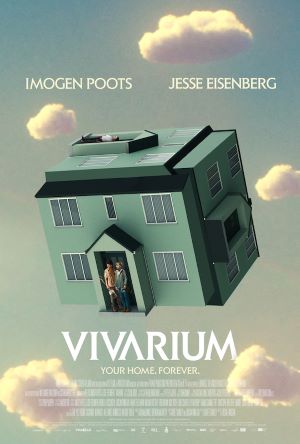
Vivarium (2019)

Well, at least Vivarium was interesting, if not particularly successful in the end.

A couple (Imogen Poots & Jesse Eisenberg) looking to buy a home is shown to a weirdo mono-chrome suburb that looks like something out of a Wes Anderson movie that’s seen better day by completely off-putting real estate agent. While they’re looking at the house, purely out of formal obligation, the agent slips away, leaving them stuck in the place. Why can’t they leave? Probably the same reason the dinner guests can’t leave in The Exterminating Angel – it’s surrealism, baby!

After their failed escape attempt (the couple always returns to the same house, number 9 – subtle Beatles reference, perhaps?), the couple settles into a weird routine that’s punctuated by boxes full of “food” and other supplies showing up in the street. One day the box contains what looks like an infant human child, but it’s quickly clear that it isn’t. It grows rapidly, screeches horrifically when it’s hungry, and can mimic the voices of its “parents” in completely unsettling ways (if this kid ever hooks up with Mia we are all fucked).

Ennui and horror ensue from there, but without any particular payoff. Poots takes on the unwilling role as mother to the child-beast, while Eisenberg starts digging a hole in the yard, returning to it day after day for fruitless labor. In the end they die, the child-beast grows up, and winds up replacing the original real estate agent in luring in a new pair of victims. Apparently this is all a sci-fi (they’re aliens?) riff on brood parasitism, in which species rely on others to raise their young. OK, I guess, but that gloss kind of ruins the ability of the film to actually be about anything larger regarding the human condition (I don’t think the standard “suburbia sucks and destroys your soul” angle really works, given that the couple didn’t choose to remain and weren’t seduced into it – they were just trapped).

Last week I talked about art that made me just go “what the fuck?” as having value. At least Vivarium gave me that. It’ll stick in my head for a while in a way that the other two won’t. Doesn’t mean I’d recommend it, but at least it’s weirdly interesting in its own way.

Keep in mind – taste is personal, your mileage may vary, etc.

Now That’s Art

I’ve got a fondness for micronations, those tiny bits of land that someone has declared a small, independent nation that nobody else in the world really recognizes (aside from other micronations). My favorite, up to this point, has been the Principality of Sealand, which is actually an old offshore platform in the North Sea off the British coast.

Sealand even has its own soccer team (there’s an entire World Cup for unrecognized nations) and, I’m pretty sure, inspired an excellent song by Orchestral Manoeuvres in the Dark Song:

That’s interesting and quirky and all, but is a micronation art? It certainly can be.

Welcome to the Republic of Zaquistan:

You might think it’s just a few acres of scrub in the Utah wilderness (and you wouldn’t be wrong), but it’s also a project of artist Zaq Landsberg. I found out about him via this article in the Washington Post about his statue “Reclining Liberty,” currently installed in Arlington, Virginia, in which he translates the Statue of Liberty into the form of the reclining Buddha you can find all over Southeast Asia.

I like the whole vibe of it:

one of the piece’s goals is to be accessible — Lady Liberty is relaxed in the grass, not towering above viewers from a pedestal. It is easy to interact with her, and he hopes that people will.

‘There’s plaster layers, the copper, the patina, but really, the last layer is the kids climbing on it,’ he said. ‘This thing, it’s on the ground, there’s no pedestal, there’s no admission ticket, there’s no velvet rope.’

So something like Zaquistan is right up his alley. He’s filled the scrub with various sculptures and installations, including a “port of entry” and Victory Arch. My favorite, though, are The Guardians of Zaquistan, a couple of large 1950s-style robots. According to the place’s website they were installed in 2006 and “[t]o this day they steadfastly protect Zaquistan’s borders from intruders.”

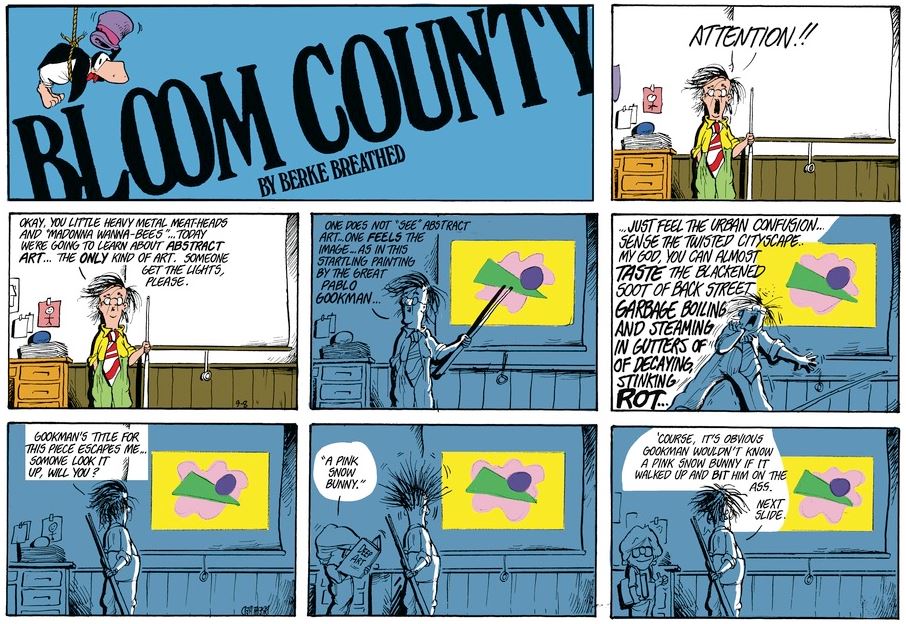
My wife and I don’t see eye-to-eye when it comes to visual art. She prefers the look of more traditional painting and sculpture, things you can look at and see recognizable people and things. I prefer more modern and abstract stuff, things that aren’t even particularly “arty” at first glance. Our trip to the Tate Britain earlier this year spawned a good round of “is this art?” discussions. They often go like this:

I think part of what I like about the more modern stuff is that it inspires in me a sense of playful wonder and awe that more traditional works don’t. I can certainly appreciate the artistry of Renaissance statuary or paintings by the great masters, but I find myself more interested in the details of what’s being depicted by them than the art itself. More modern stuff hits me right in the gut, however, and almost demands that I deal with it on its own terms, without concern for what it’s “about.”

When I was in law school I got to go to Chicago for a mock trial competition. One afternoon, a teammate and I wandered through the Art Institute, which was probably the first big art museum I’d ever been to. Around one corner we walked into the wildest thing I’d ever seen, an installation called “Clown Torture,” which:

consists of two rectangular pedestals, each supporting two pairs of stacked color monitors; two large color-video projections on two facing walls; and sound from all six video displays. The monitors play four narrative sequences in perpetual loops, each chronicling an absurd misadventure of a clown (played to brilliant effect by the actor Walter Stevens). In ‘No, No, No, No (Walter),’ the clown incessantly screams the word no while jumping, kicking, or lying down; in ‘Clown with Goldfish,’ the clown struggles to balance a fish bowl on the ceiling with the handle of a broom; in ‘Clown with Water Bucket,’ the clown repeatedly opens a door booby-trapped with a bucket of water that falls on his head; and finally, in ‘Pete and Repeat,’ the clown succumbs to the terror of a seemingly inescapable nursery rhyme. The simultaneous presentation and the relentless repetition creates an almost painful sensory overload.

This is not an inaccurate description, particularly the “almost painful sensor overload” part (and particularly if you don’t know what you’re walking into!). Now, I’m not going to say I loved “Clown Torture,” but I love the idea of it and I love that it completely unsettled me and made me think “what the fuck?” for a good long time afterward (still does, sometimes). In some instances that’s all art has to be about.

The Republic of Zaquistan is nowhere near as disturbing as “Clown Torture,” but it gives off similar “what the fuck?” vibes and so I kind of love it. It’s weird and its funny and it kind of makes you reconsider the world around you. If that’s not art I don’t know what is.