The Prequel Problem

Ending stories is hard – trust me. But figuring out the right place to start them can be just as hard. That’s true for all kinds of stories, but particularly fantasy or sci-fi stories where you have to build the whole world around the story you’re telling and the characters involved. By definition their world existed before their story did and will continue to do so once it’s over (barring apocalypse, of course).

Which explains the popularity of prequels. There’s so much backstory to dig through, most of it only hinted at, that there appears to be a rich environment to exploit. It must also seem like a fairly safe investment, since you’re dealing with, if not familiar and fan-favorite characters, at least events and histories in which the fans are already invested.

But there’s an inherent problem with prequels – they’re playing in a universe in which the future is already known to us. That can box writers in and sometimes make it difficult for the prequel to stand on its own as a piece of compelling drama, something we should care about for its own merits.

I thought a lot about this problem over the weekend as the wife and I (at her suggestion!) finally caught up with the Obi-Wan Kenobi series.

The six-episode series is set in the time between Rise of the Sith, with its culling of the Jedi, and the original Star Wars (aka A New Hope), a time during which, for all we knew, Obi-Wan was living off the grid on Tatooine keeping tabs on Luke Skywalker. Years pass, of course, so the idea that he didn’t get into anything worthy of telling a story about is pretty sad, but do the writers use that freedom to do something really interesting?

No, not really.

The inciting incident of the series is when Princess Leia is kidnapped on Alderaan (nice planet – too bad it goes boom) by, of all people, Flea. This is part of a plan to draw out Obi-Wan so some Jedi hunters can get him. Those Inquisitors are kind of interesting and could have been explored in some depth, but they have a boss and his name is Darth Vader. And so, the series largely revolves around maneuvering Vader and Obi-Wan into the same space.

As a result, we get two solid confrontations between them, the second of which would have felt like a pretty epic duel if it had any kind of stakes. It couldn’t, however, because of the prequel problem: both Vader and Obi-Wan survive to fight again in Star Wars, so neither can be killed or even seriously injured in ways that conflict with the “future.” Likewise, young Leia (who, as you might expect, is quite the scamp) is never in any real danger, as we know she survives unscathed. Indeed, the series punts her offscreen for the final episode mostly, as it rushes back to Tatooine for a confrontation between one of the Inquisitors and Luke’s family – which, again, we know will ultimately come to nothing.

It didn’t have to be that way. Using Leia’s kidnapping to lure Obi-Wan out of hiding was a solid idea. Imagine if she’d mostly stayed off screen (a MacGuffin, if you will) while he scrapped with and evaded Inquisitors and grew into his status as a hero. There’s actually a good character arc in the series, as Obi-Wan goes from trying to lay low and hide to being more engaged with the Rebellion. Isn’t that a cool enough story to tell? Do we need the Vader stuff? Do we need any suggestion that Leia or Luke will be harmed?

Star Wars knows how to do this. Rogue One is regarded by a lot of people as the best Star Wars movie since the original trilogy, even though we knew precisely how it was going to end. What made it work was that existing characters were largely absent and we got to know and care about a whole new cast so that when they made the necessary sacrifices to complete their mission it landed with some heft.

Ultimately, I think the prequel problem is a matter of characters rather than universes. After all, we read historical fiction all the time that involves real events. It’s not what happens to characters, it how it effects them, changes them, that matters. But when your prequel ties itself to characters who can’t change, that becomes a problem. I’ve dinged Star Trek – Strange New Worlds for tying itself too closely to characters steeped in Trek lore, rather than freely exploring people we know nothing about.

I’ve never really been interested in the idea of writing prequels. I had a prequel story, of a sort, for one of the characters in the Unari Empire trilogy that I almost wrote, but ultimately decided that all that was important about him was in one of the books already. Generally speaking, I’d rather go on and dive into a new world with new characters than revisit old ground.

But if you asked nicely . . .
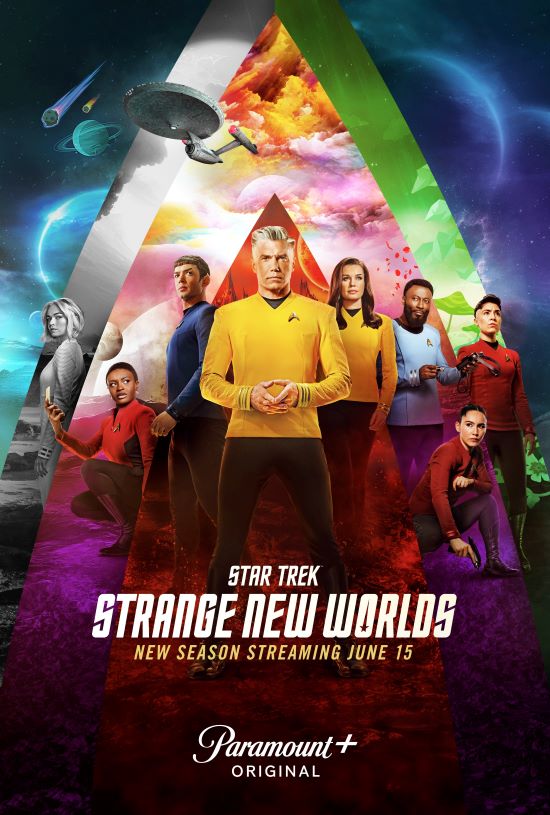
Weekly Watch: Star Trek – Strange New Worlds (Season Two)

Seeing as how the second season of Star Trek – Strange New Worlds just wrapped up, I thought I’d follow up on my review of the first season. If you’ll recall, I was pleasantly surprised and looking forward to a second season:

I’m cautiously optimistic about the second season. Given results thus far, I’m willing to give everyone the benefit of the doubt that we won’t be overwhelmed by Kirks (Jim’s brother is on this ship, too, for some reason) and we’ll be introduced to more strange new worlds.

What gave me pause about the first season was the need of the writers to try and keep looping SNW back into the wider series mythology rather than do some really new stuff. Did we really need Kirks? Did we really need the security chief to be related (however distantly) to one of Trek’s greatest villains? Why weren’t the Gorn anything other than, you know, the Gorn we all knew?

I wish I could say all my concerns were alleviated, but the truth is that in season two SNW leaned into some of the things that I most disliked about the first season. That said, it was still damned entertaining and, maybe through sheer repetition, I’m starting to be worn down on those concerns.

Let’s start with the Kirks. James Kirk showed up in one episode of the first season, a nifty retelling of a classic episode from the original Trek. It made sense, but I worried where it would lead. Where it led was that Kirk appearing in three episodes this season, getting major screen time without any great effect. Simply put, there’s no reason that his role in those episodes couldn’t have be filled by a wholly new character. Kirk has now had multiple encounters, including a fairly personal one, with a person named “Noonien-Singh” and yet said nothing about that when Khan first showed up in the show. It’s a minor nit, but one that bugs me over and over – what’s gained by tying this into the established Trek mythos?

Likewise, the series appears to be doubling down on making the Gorn the Borg of this series. I’m not against creepy space monsters, but wasn’t part of what made the initial appearance of the Gorn in original Trek work so well is nobody knew anything about them? Why not create an entirely new beastie to menace this version of the Enterprise? Maybe my feelings here are partially colored by the fact that war Trek is my least favorite Trek variant and that seems to be the role of the Gorn moving forward.

That being said, I still really enjoyed this season for the most part. A big part of that is that, while at the same time grasping for connections to prior Trek lore, the SNW creative crew is also willing to really push the limits of what a Trek show can be. That came through loud and clear in two episodes from this season.

The first was a crossover episode with the animated Lower Decks series, in which two of the characters from that show travel back in time (and into live action) and interact with the Enterprise crew. I’ll admit that I don’t get Lower Decks – it’s too fast and hyper to be funny to me – but I thought this episode was really great, from the animated opening credit sequence to the animated outro with the Enterprise crew getting ripped on some sort of booze. And I appreciated the two Lower Decks characters, in a rare moment alone, making a joke about how slowly everybody talked. Good humored timey-wimey fun.

The second was the big musical episode. I’m not a huge fan of musicals and I found the actual music here pretty samey and dull (exception being the acapella version of the theme music in the opening credits, which was great) and the idea, that some outside entity is forcing the crew to sing their true feelings, is straight out of the better-executed Buffy musical episode, but, still, it’s hard not to like the curveball this episode was. And without it we’d never have gotten Klingons as the galaxy’s scariest boy band, a sight I wouldn’t want to miss.

My favorite episodes were a couple that dealt with characters grappling with their pasts. “Among the Lotus Eaters” took a quick line from the original Trek pilot about one of Pike’s regrets and fleshed that story out (a pretty good example of raiding the lore for story ideas) and spun it into an interesting meditation on memory and forgetting. “Under the Cloak of War” dove into Dr. M’Benga’s history and that of a Klingon war criminal and how they were struggling to come to grips with their pasts. I’m not a big fan of M’Benga’s ability to eat space spinach and go berserker on numerous Klingons, but I like the general idea of a healer growing out of a warrior. The Uhura-focused episode, “Lost In Translation,” was also pretty good.

All in all I found the second season of SNW a lot like the first – really good most of the time, with some choices that I wish had gone differently. It is by far my favorite of the nu Trek stuff. And, if anything, I’d like for a few more episodes per season to let things breathe a bit (the Spock/Chapel situation flamed out way too quickly). But mostly, I hope going forward they’ll heed the call to explore “strange new worlds” and give us more of that and less backward-looking connections to Trek lore.

I’ll be watching, regardless.

Is the ATAC a MacGuffin?

For Your Eyes Only is my favorite James Bond flick.

Part of that is due to when I saw it, it being one of the first Bond movies I’d seen. But a big part of it due to the fact that the spine of the movie’s plot is a more plausible Cold War scenario than the Dr. Evil inspiring big bads Bond often faced.

In a nutshell, a British ship (disguised as a fishing trawler but really a spy ship) sinks off the Greek coast. On board was the Automatic Targeting Attack Communicator or ATAC, a computer that helps coordinate the UK’s ballistic missile fleet. Naturally the Soviets want to get their hands on it. Bond, aided by supreme Bond Girl Melina Havelock, tries to get it back for the Brits. In the end . . . well, the end is one of my favorites of all time:

So I was delighted to come across an episode of the All 80s Movies Podcast about For Your Eyes Only. I was surprised, though, when the guys on the podcast called the ATAC (which they hilarious mispronounce “AhhTAC” – it’s not like they don’t say it over and over again in the movie!) a “MacGuffin.” That didn’t jive with my idea of what a MacGuffin was and got me to thinking about it.

The term apparently dates to about 1930s or 1940s and was coined by a British screenwriter named Angus MacPhail, who worked a lot with Hitchcock. As defined by the OED, a MacGuffin is:

a particular event, object, factor, etc., presented as being of great significance to a character or characters, but in the end proving illusory.

Hitchcock would further explain that a “MacGuffin is the thing that the spies are after, but the audience doesn’t care” and, ultimately, “is actually nothing at all.”

It’s that last part that I always associated with the concept of a MacGuffin. A famous more recent example is the briefcase in Pulp Fiction, which multiple characters go to great lengths to possess, but we never learn what is inside, except for:

But I’m seeing lots of examples cited of things that are, to my mind, so substantial to be considered MacGuffins. Some cite all the things in the Indiana Jones movies (as in “Indiana Jones and the BLANK of BLANK”) as MacGuffins. This includes the Ark of the Covenant in the first movie – but they find the Ark, it melts some Nazis, and basically deus ex machina’s Indy’s escape. Is that a MacGuffin? Another list includes Colonel Kurtz from Apocalypse Now, a real human being with whom the main character significantly interacts, as a MacGuffin. That makes no sense to me. Likewise the Death Star plans in Star Wars – not only do they jump start the plot, but we see them after delivery and the info in them allows Luke to blow the place to shit!

Other examples hew closer to my conception of a MacGuffin. “Rosebud” in Citizen Kain, for example, since the important part of the story isn’t the damned sled but that rise and fall of Kain’s life. The Holy Grail in Monty Python and the Holy Grail is an even better example, since it motivates the action but is never seen or obtained by the characters.

While pondering all this I checked out one of the all-time great MacGuffin movies, which I’d never seen, The Maltese Falcon.

It definitely fits the mold of MacGuffin I have in my mind. The bird itself doesn’t show up until about 15 minutes from the end of the film and then, once it’s revealed to be fake, ceases to have any real meaning. Rather, the movie is about what the pursuit of this object (which Bogart’s Sam Spade calls “the stuff that dreams are made of”) changes and corrupts all who decide to pursue it. It could be anything – a Javanese lion, an Andalusian wombat – and the same story gets told. That the damned thing matters to the characters but doesn’t to the audience seems to be the whole point.

I suppose for me the question is how important the actual item is to the resolution of the story. If all it does it motivate people and the ultimate identity/characteristics of the thing doesn’t matter, I’d call that a MacGuffin. If it’s more important than that, probably not.

Where does that leave the ATAC? Since we see it in action, then see it recovered, then stolen, and then ultimately destroyed by the main character so the bad guys can’t have it, I’m definitely not getting MacGuffin vibes from it. It’s just too important to the movie, including the wider world of it. The world of The Maltese Falcon continues to spin regardless of how that petty crime is resolved, while the world of For Your Eyes Only gets considerably more dangerous if the ATAC falls into Soviet hands.

Ultimately, what qualifies as a MacGuffin is probably in the eye of the beholder. As a writer, it’s a useful tool to have in order to motivate characters. On the other hand, don’t lose sight of the fact that sometimes the little doohickey everybody is trying to get their hands on is pretty damned important in its own right.

Just like obscenity, you know it when you see it.

Weekly Read: Legends & Lattes

My wife is a voracious reader and introduced me to the concept of “cozy” genres. Her big one is cozy mysteries, in which the murder takes place bloodlessly off screen and the cookie recipes in the back are more important than the whodunnit. I stumbled into one of those that crossed into fantasy a while back, The Accidental Alchemist, which was fun enough, but not quite my thing. Would a second go on cozy fantasy change my mind? Not yet, at any rate.

The setup for Legends & Lattes is pretty slick – Viv, an orc who’s spent her life adventuring and killing in a typical fantasy world, decides to get out of the business and settle down. Her new line of work? Running a coffee shop in a town that’s never heard of the stuff (in-world it’s an invention of dwarves, IIRC). “High fantasy and low stakes,” claims the cover, which certainly suggests a light, frothy outing.

Which it is! I’ve seen a lot of people rave about this book for being like a big hug or warm blanket, super comfy and cozy and I won’t disagree. I wish it had something more to it, however, to make it more than just a bit of literary comfort food (adept as it is when it comes to that).

It could, for example, have been really funny. There are a couple of chuckles here and there, but it’s not what I’d call a comedy. The basic idea sounds like it could have come out of a Discworld novel, but Pratchett always had a more cutting edge and could write amazing jokes. There’s nothing like that here.

I’ve seen some people complain that the book has “no plot,” but that’s not true. Things happen! What is really lacking is conflict, in any meaningful sense. For instance, Viv and the crew she assembles around her have to get the business off the ground and running. Every innovation they think of – offering iced coffee in addition to hot, adding baked goods (sumptuously described, it has to be said) to the menu, etc. – works like a charm. There’s even a local protection racket that Viv has to deal with, but it’s wrapped up easily with a conversation (and Viv paying protection, oddly).

That isn’t to say there isn’t a bad guy. A member of Viv’s old crew shows up about two-thirds of the way through and commits what appears to be a heinous crime – so much so that it’s completely out of place with the warm fuzziness of the rest of the book – but it’s barely a hiccup in the end.

Without any real conflict I need something more. Could have been humor, but, like I said, that’s not really what the book was going for. It could have been a more thorough exploration of Viv’s new home town. I particularly thought the protection racket stuff would give her a chance to interact with other people in her neighborhood, either to rally them or find out that resistance was futile. It could have been a cool way to see other species at work, add some additional color. Alas, the book sometimes feels like a TV show allegedly set in a big city that’s clearly shot on a soundstage that never moves from the single corner it regularly depicts.

I don’t want to come down too harshly on Legends & Lattes. It’s a quick, fun read, even if it leaves you feeling a little “so what?” when it’s over. But I’m clearly in the minority in not finding it completely charming and wonderful (it’s nominated for an Nebula and Hugo awards, after all). Which means, ultimately, that I just don’t think the “cozy fantasy” thing is really my cuppa, so to speak. And that’s OK.

I’d really like one of them cinnamon rolls, though. Hold the icing.